Tag Archives: China

image_pdfimage_print

LCQ2: Promoting recreational and cultural activities in districts

     â€‹Following is a question by the Hon Ma Fung-kwok and a reply by the Secretary for Home and Youth Affairs, Miss Alice Mak, in the Legislative Council today (June 21):
 
Question:
 
     There are views that the District Councils (DCs) should perform the function of promoting recreational and cultural activities more proactively, and therefore, after the improvement of the district governance structure, the Government should further mobilise the initiative of community and district organisations to encourage them to organise more activities with local characteristics, so as to enrich the cultural and recreational life of members of the public, thereby enhancing their sense of belonging to the community and creating local cultural characteristics. In this connection, will the Government inform this Council:
 
(1) of the authorities’ plan, after the improvement of the district governance structure, to encourage various district organisations to organise more cultural and recreational activities with local characteristics, so that DCs can perform the function of promoting recreational and cultural activities more proactively;
 
(2) whether the authorities will consider appointing some people with cultural and sports backgrounds to DCs, so that DCs can better perform the function of promoting recreational and cultural activities; and
 
(3) whether the authorities will consider creating one post of cultural and sports activities coordinator in each district dedicated to the promotion and coordination of cultural and sports activities and performances in the district, and encouraging district organisations to organise more cultural and sports activities with local characteristics?
 
Reply:
 
President,
 
     The Government is committed to promoting leisure and cultural developments. At the district level, the 18 District Offices (DOs) and the Leisure and Cultural Services Department (LCSD) have been encouraging members of the public and organisations to participate in and organise leisure and cultural activities, with a view to enriching the life of the members of the public and enhancing their sense of belonging to the community. In consultation with the Culture, Sports and Tourism Bureau, the consolidated reply to the three parts of the question is as follows:
 
(1) and (3) The DOs organise and collaborate with community organisations to organise different community involvement projects, including district recreational, sports, arts and cultural activities, so as to promote community building, social harmony and public participation in community affairs.
 
     The Government has set up the Community Involvement (CI) Programme to provide funding to the relevant government departments and eligible organisations for organising events featuring local characteristics, including festive events, activities to promote community building and social harmony, as well as cultural, recreational, sports and arts activities. The annual total provision for the implementation of CI Programme is about $460 million. In order to promote recreational and cultural developments in districts, $160 million out of the total provision is reserved for the LCSD, which is responsible for the relevant work, to organise cultural, recreational, sports, and arts activities (such as Community Arts Scheme, concerts, Cantonese opera workshops, recreational and sports training courses, recreational activities and competitions). The remaining $300 million is used by DOs and local organisations to organise various kinds of district activities.
 
     In addition, district sports associations (DSAs) and district arts associations (DAAs) play an important role in promoting recreational, sports, arts and culture development in the community. Through their district networks, these associations have unique advantages in promoting district-based cultural, recreational and sports activities and encouraging active participation of members of the public in the community. In order to support the day-to-day operation of these associations and encourage them to organise more district activities, Home Affairs Department (HAD) has implemented the Community Sports Subvention Scheme and the Community Arts Subvention Scheme, under which an annual provision of up to $150,000 is provided to each DSA and DAA to support their operating expenses and finance their activities. These associations can also apply for funding under the CI Programme from their respective DOs to organise more district recreational, sports, cultural and arts activities.
 
     The LCSD provides quality cultural and recreational services to enrich people’s lives; and works closely with sports, cultural and community organisations to create synergies to strengthen the momentum of arts and sports developments in Hong Kong.
 
     The LCSD supports district arts and cultural groups to organise arts and cultural activities. Among them, the District Arts and Cultural Activities Venue Sponsorship Programme welcomes applications from qualified district arts and cultural groups, with a view to encouraging them to organise more cultural activities with special features of the district. The LCSD also provides free use of venues under its management and ticketing services for qualified district arts and cultural groups.
 
     As for other district activities, the LCSD will continue to arrange or organise different types of arts and cultural activities in various districts of Hong Kong, such as the 18dART Community Arts Scheme and the Community Cultural Ambassador Scheme. For some of the activities, the LCSD actively seeks collaboration with appropriate district groups/organisations as “supporting organisations” to assist with the promotion of relevant activities in the district.
 
     Furthermore, in order to encourage DSAs to organise more sports programmes, the Government launched the five-year District Sports Programmes Funding Scheme in 2022 to provide DSAs with additional resources so that they may organise more sports programmes in each district, thereby building a stronger sporting culture in the community.
 
     A key objective of the proposals on improving governance at the district level is to get the District Councils (DCs) back on track as district organisations which are not organs of political power in accordance with the Article 97 of the Basic Law. DCs are to be consulted by the Government of the Hong Kong Special Administrative Region on district administration and other affairs, or to be responsible for providing services in such fields as culture, recreation and environmental sanitation.
 
     The reformed DCs will play the role of complementing the Government, assisting the Government in keeping its finger on the pulse of the community so that the Government can have more effective planning of district services. They will also help foster social cohesion, garner public support for the Government, as well as provide different services to the people in the districts. Under the District Councils (Amendment) Bill 2023, the revised District Council Ordinance will stipulate that DCs can assist in the smooth delivery of cultural and recreational services relating to the interests of the people in the District under the coordination of the Government; as well as apply for funding for projects and activities for the purpose of promotion of sports, arts and culture. DCs and its committees or working groups can continue to collaborate with local organisations, including applying for funding under the CI Programme to organise more sports, arts and cultural activities with local characteristics.
 
     With regard to the co-ordination aspect, the LCSD has already set up dedicated offices to arrange arts and cultural, as well as recreational and sports activities of the department in 18 districts. In addition, the LCSD also arranges staff to regularly attend district council meetings to assist the work of district councils.
 
(2) The Government makes appointments to advisory and statutory bodies on the basis of the merit of individuals concerned, taking into account a candidate’s ability, expertise, experience, integrity and commitment to serve the public and with due regard to the functions and nature of business of the bodies concerned and the requirements in the relevant ordinances of statutory bodies.
 
     Under the principle of appointment by merit, the Government will, with due regard to, the situation of each district appoint capable persons (such as professionals or important stakeholders in the district) who are patriotic and have an affection for Hong Kong to serve as appointed DC members. The appointed DC members should not only be patriotic and have an affection for Hong Kong, but also have good conduct and integrity; have experience in serving the district or have made achievements in their respective professional fields; and be representative and well-recognised in the district or field concerned, etc. The Government will identify candidates of different backgrounds, ages and sectors, including those with cultural and sports backgrounds, for appointments having regard to the circumstances of each district, so as to enhance the diversity of DCs and their overall capabilities in performing their functions. read more
LCQ18: Management measures upon dissolution of Estate Management Advisory Committees

     Following is a question by the Hon Edward Leung and a written reply by the Acting Secretary for Housing, Mr Victor Tai, in the Legislative Council today (June 21):
 
Question:
 
     Estate Management Advisory Committees (EMACs) established by the Hong Kong Housing Authority (the HA) for its public housing estates (PHEs) were responsible for using the funds allocated by the HA to carry out minor improvement works in the estates and improve the estate environment before they ceased operation last year. There are views pointing out that after the cessation of the operation of EMACs across the territory, the decision on the use of the funds concerned is left to the Housing Managers (HMs) of the estates, which may not reflect the wishes of the residents and meet their needs. In this connection, will the Government inform this Council:
 
(1) whether there are changes in the amount of funds allocated by the HA to various PHEs and in such funding mechanism upon the dissolution and cessation of operation of EMACs across the territory;
 
(2) of the balance of available funds of EMACs of various PHEs across the territory at the time of their dissolution, and the amount of such balance together with the amount of the new funds allocated to them since their dissolution, with a breakdown by District Council district and PHE;
 
(3) as the HA has indicated that HMs of PHEs will collect tenants’ views through different communication channels, including expanding both the traditional and electronic means of communication, and take their opinions into consideration in drawing up proposals on the use of the funds at the beginning of the financial year, of the total number of estates which have set up electronic means for expression of views so far;
 
(4) of the respective numbers of residents’ views on funding, minor improvement works in the estates and improvement of the estate environment received by HMs of various PHEs through different communication channels since January this year, with a breakdown by District Council district and PHE;
 
(5) given that in the past, EMACs could, based on residents’ views, rate the performance of outsourced security or cleansing service contractors of the estates for deciding whether to renew the contracts with the contractors or replace them, how the Government ensures that residents can participate in the relevant decisions and express their views after the dissolution of EMACs; and
 
(6) as there are views that in the past, EMACs could encourage residents to participate in estate management and reflect their views to the Housing Department so as to help improve the management of the estates, whether the Government will consider re-establishing EMACs through other channels, so that residents of PHEs can be more involved in the exchange of views on estate management matters?
 
Reply:
 
President,
 
     The consolidated reply to the questions raised by the Hon Edward Leung is as follows:
 
     The Mutual Aid Committee (MAC) representatives formed the majority of the Estate Management Advisory Committee (EMAC) membership of the Hong Kong Housing Authority (the HA). As the MAC Scheme of the Home and Youth Affairs Bureau was terminated on January 1, 2023, the operation of EMACs in public rental housing (PRH) estates ceased correspondingly.
 
     Upon the dissolution of EMACs, the HA has implemented a series of measures to maintain and optimise the original functions of EMAC. 
 
     As regards the Estate Funds, the HA will continue to allot funds to all PRH estates in accordance with the number of flats, i.e. estates with not more than 600 units will be allotted a total of $80,000 per annum, estates with 601 to 1 000 units $100,000 per annum, and the rest $100 per unit per annum, for carrying out minor improvement works and organising estate activities, including community building functions, carnivals, partnering functions with non-governmental organisations, publication of Estate Newsletter, procuring calendars, red packets, and fai-chun for tenants, carrying out festive decoration and celebration, etc. Estate Housing Manager/ Property Service Manager will continue to be the controlling officer of the funds. They will collect and consider tenants’ opinions on specific projects or programmes through various channels in drawing up proposals on the use of the Estate Funds, so as to formulate the estate plan for the coming year.
 
     To enhance the channels of communications, the HA has widened both traditional and electronic means for direct collection of opinions from PRH tenants. The Housing Department (HD) has placed suggestion boxes at the ground floor lobbies of domestic blocks in all estates. Apart from providing paper survey forms, QR code and hyperlink of the electronic survey form are printed on the notice for opinion collection to facilitate PRH tenants to complete electronic questionnaires. Since January 2023, HD has conducted Tenants’ Opinion Survey by both electronic and paper forms for collecting tenants’ opinions on estate management and environmental hygiene. The figures of the opinions on environmental hygiene and use of Estate Funds collected from stakeholders through different channels are set out at Annex.
 
     To monitor and to evaluate the performance of service contractors, the HA has already established a structured appraisal system, including assessments made by HD staff and the regular conduct of Survey on Performance of Services Contractor and Routine Maintenance Contractors (the Survey) to collect tenants’ opinions. The HA has enhanced the Survey in terms of the sampling size with a view to gathering opinions from more tenants on the performance of service contractors (including property service agents, works contractors, cleaning and security contractors in the estates) so as to improve the management service of the estates. For award or renewal of service contracts, the HA will assess the relevant working experience and the performance level of service delivery of all bidders in accordance with the current assessment mechanism so as to select suitable service contractors.
 
     Estate staff will continue to maintain close liaison with local stakeholders and attend meetings of District Councils and Area Committees regularly to discuss and collect opinions from them on local estate matters and the HA’s policies. We will also invite those who have served EMAC before and are interested in promoting estate activities to serve as project ambassadors, for example, environmental protection ambassadors and fire safety ambassadors, to assist in encouraging and driving tenants’ participation. Tenants can continue to exchange views with HD’s staff on estate management matters and performance of service contractors by visiting our Estate Management Offices in person and through telephone hotline or emails as usual.
 
     The HA will strive to optimise the communication mechanism and measures with PRH tenants and provide multiple and convenient communication channels, in order to raise the management standard and build a harmonious community. read more

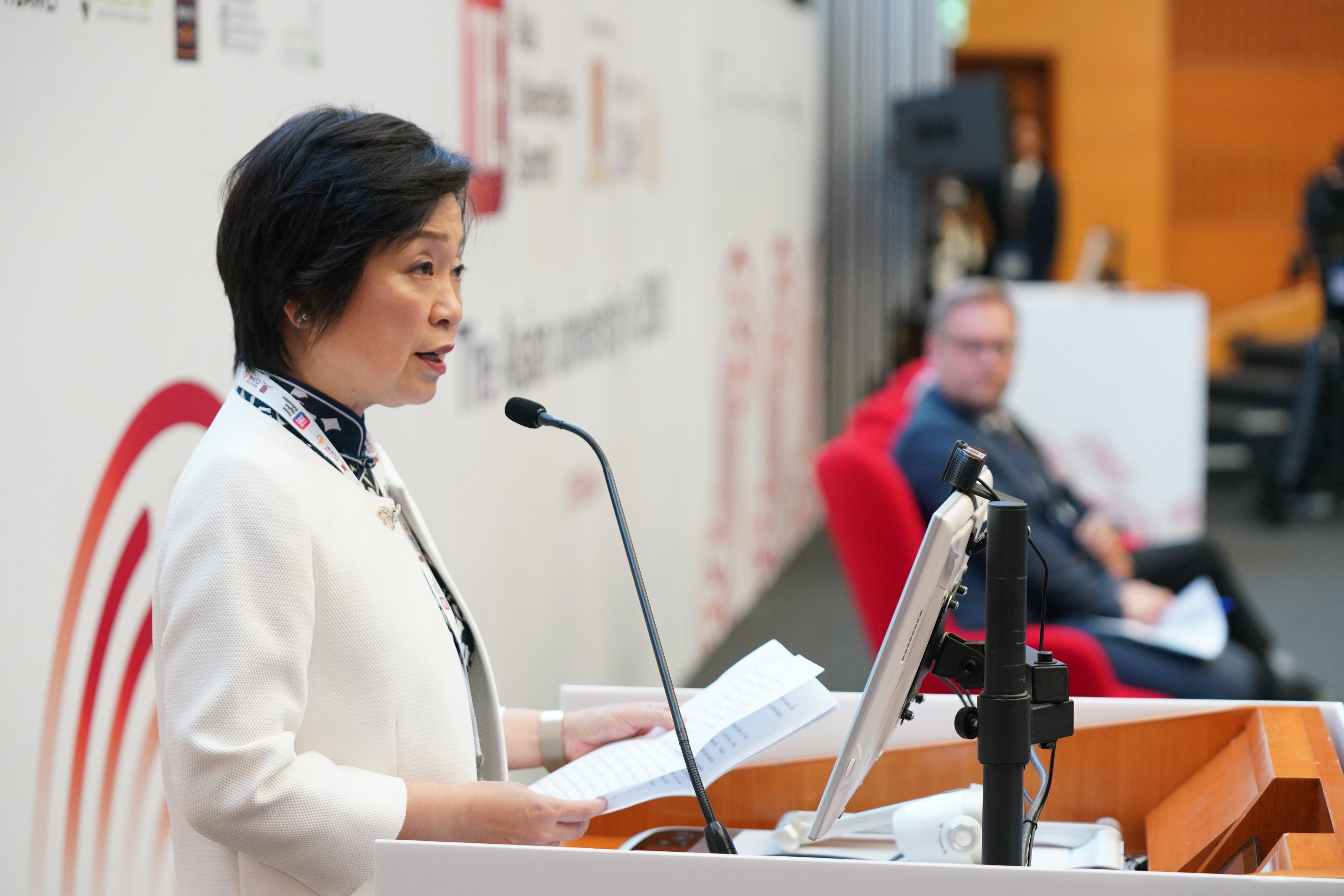
Speech by SED at Times Higher Education Asia Universities Summit Opening Ceremony (English only) (with photo)

    Following is the speech by the Secretary for Education, Dr Choi Yuk-lin, at the Times Higher Education Asia Universities Summit Opening Ceremony today (June 21):
 
Mr Paul Howarth (Chief Executive Officer, Times Higher Education), Mr Phil Baty (Chief Global Affairs Officer, Times Higher Education), Professor Rocky Tuan (Vice-Chancellor and President, the Chinese University of Hong Kong), distinguished speakers, guests, ladies and gentlemen,
 
     Good morning. It gives me great pleasure to join you today at the opening ceremony of the Times Higher Education (THE) Asia Universities Summit 2023. On behalf of the Hong Kong Special Administrative Region Government, I wish to first extend my warmest welcome to the distinguished guests joining us from all four corners of the world. It is exciting for all of us as this Summit is a significant step for our higher education sector to resume connectivity to the world after the pandemic. I would also like to express my sincere appreciation to the Chinese University of Hong Kong (CUHK) and THE for hosting this Summit, which is one of the most prestigious international events organised by the higher education sector in Hong Kong this year. 
 
     THE is not unfamiliar to the Hong Kong society as most of our publicly funded universities have been on the top list of the THE rankings. In 2023, five of them, covering more than 80 per cent of all students pursuing publicly funded programmes, are among the top 100 universities in the world according to the THE rankings. I must also congratulate the host of this Summit, CUHK, for breaking into the top 100 in the 2023 THE Impact Rankings announced early this month. With only 7.4 million residents in an area of 1 104 square kilometres, we are one of the cities in the world with the largest number of universities in the top 100. The outstanding achievement undoubtedly speaks to the significant influence of our higher education in the region and beyond, and helps consolidate our status as an education hub in Asia.
 
     Apart from world rankings, research excellence and the robust research environment of our sector are also well-recognised and confirmed by international peer experts through the University Grants Committee’s regular research assessment exercises (RAE). In the last RAE concluded in 2020, about 360 international experts, with 70 per cent of them being distinguished scholars all over the world, were invited to assess about 16 000 research submissions by the eight publicly funded universities, including research outputs, research impact and research environment. The RAE panels considered 81 per cent of the research environment scored the highest two ratings, meaning that their research strategy, infrastructure, people, income, esteem, etc, were all conducive to producing world-leading or internationally excellent research. Furthermore, impact agenda is receiving more attention in the global research community, and the performance of our universities was equally encouraging, with 80 per cent contributing “outstanding” and “considerable” impact to society. Our solid achievement in research has, again, further consolidated our status as a regional hub for research collaboration.
 
     In addition, Hong Kong’s universities are highly globalised with a rich diversity of cultures. At present, one in every five students of our publicly funded programmes is from outside Hong Kong, and the proportion is even slightly higher for the universities which have established themselves internationally and are hence more popular among non-local students. The extent of internationalisation is even higher among faculty members. Among around 6 300 academic staff, 64 per cent are from outside Hong Kong. All of them are top-notch experts, bringing in innovative ideas, cutting-edge expertise and diverse perspectives that contribute to the vibrancy and diversity of our academic community. Our sector has also signed over 2 600 exchange agreements with universities worldwide, offering students with opportunities to increase their exposure, thereby cultivating a global sense and international outlook. 
 
     Building upon such a robust foundation, and coupled with Hong Kong’s uniqueness as an international city that is in harmony with the system of Mainland China, our universities are well-equipped to leverage the opportunities arising from the globalisation and the rapidly growing economies of Asia. With an exciting theme of “Future Asian University 2050”, I have great confidence that you will find this Summit rewarding because Hong Kong, as a regional education hub, is best positioned to inspire you, from a multidimensional perspective, the long-term prospect of higher education and the emerging opportunities in the region, particularly those in Mainland China. 
 
     The world economy and the landscape of the higher education are constantly evolving and becoming increasingly interconnected, which accelerate the flow of capital, investment and talent between East and West. Looking ahead, to remain competitive and maximise the growth prospects, universities should break down traditional silos and foster cross-boundary collaborations to expand their presence in the fastest-growing economies in Asia, particularly in the major cities on the Mainland. 
 
     Over the past decades, our country has been according top priority to the development of teaching, research and technology transfer. In 2021, the 14th Five-Year Plan was approved at the National People’s Congress of China, mapping out the development blueprint and action agenda for the country in the five years of 2021 to 2025, covering several key priorities and initiatives for building a more innovative, sustainable and competitive economy. Under the Plan, Hong Kong has been assigned with a key role to reinforce and enhance its competitive advantages for integrating into the national strategy, with a focus on enhancing academic co-operation and exchanges among higher education institutions in cities of the Guangdong-Hong Kong-Macao Greater Bay Area (GBA), a burgeoning region that comprises the two Special Administrative Regions of Hong Kong and Macao, and the nine municipalities in Guangdong Province. With a total area of around 56 000 sq km, over 86 million in population, and a GDP close to US$1,700 billion in 2020, the region’s potential growth in the coming decades is certainly promising and full of possibilities.
 
     Thanks to the strong policy and resources support by the Central People’s Government, our universities are ambitiously taking the GBA development as the best entry point to integrate into the overall development of our country, bringing continuous impetus to Hong Kong’s higher education sector. Relevant initiatives include establishing new campuses and cross-boundary multidisciplinary research centres in the GBA cities, as well as developing joint academic programmes and research projects with Mainland institutions, leveraging different academic strengths in the region. Our strong ties with the Mainland also enable our universities’ closer collaboration with business and industry partners, providing not only funding for research and development, but also expertise, technologies and business networks which are key to achieving impactful research. On this, I am glad that CUHK has included a tour to its campus in Shenzhen, one of the major cities in the GBA, as part of the programme of this Summit. I am sure the tour will provide participants with more insights about all these ideas that I just mentioned, and will help them explore possible ways to scale new heights through regional co-operation. 
 
     Ladies and gentlemen, the COVID-19 pandemic has taught us a lesson that no single economy or place can solve the global challenges alone. Only through closer cross-boundary partnerships and collaborations can we tap into collective wisdom, skills and resources, thereby leveraging our strengths while overcoming weaknesses. I can assure you that Hong Kong always stands ready to be your strategic partner and serve as a gateway to access the potential collaboration opportunities with the Mainland. By working together and committing to a shared vision of excellence and innovation, we are ready to build a brighter future for our next generations.
 
     My gratitude, once again, to CUHK and THE for organising this event and for offering such a valuable platform for us to reconnect with friends from the world. I wish you all many fruitful exchanges and the Summit a great success. Thank you very much.

Photo  
read more

LCQ22: Hearing of cases involving lands and buildings

     Following is a question by the Hon Doreen Kong and a written reply by the Chief Secretary for Administration, Mr Chan Kwok-ki, in the Legislative Council today (June 21):

Question:

     Quite a number of members of the public have relayed that the waiting time from setting down of their cases to hearing at the Lands Tribunal is too long. With the waiting time of some cases being as long as nine months, there is a relatively significant deviation from the targets set in the performance pledge by the Lands Tribunal. In this connection, will the Government inform this Council:

(1) of the following information on cases heard by the Lands Tribunal in each of the past five years: (i) categories, (ii) numbers, and (iii) the average waiting time from setting down to hearing (set out in a table);

(2) given that the Building Management Mediation Co-ordinator’s Office will refer some cases to mediators for handling, whether the authorities have compiled statistics on the satisfaction level of mediation service users in respect of their cases;

(3) whether it has compiled statistics on the current number of lawyers who specialise in handling land leases and disputes related to real estate in Hong Kong; whether the authorities have plans to formulate corresponding training programmes in this specific area for the sector; and

(4) whether it has assessed if the existing manpower of the Lands Tribunal is adequate to cope with its increasing workload; whether the authorities have plans to expedite the hearing of cases by recruitment of additional staff or redeployment of resources, thereby shortening the waiting time for members of the public in respect of their cases from setting down to hearing?

Reply:

President,

     Having consulted the Judiciary and the Department of Justice, my reply to the Hon Doreen Kong’s question is as follows: 
 
(1) The numbers of cases filed in the Lands Tribunal in the past five years shown by types are as follows:
 

Types                                   Number of cases
2018 2019 2020 2021 2022
Appeal Cases 313 1 472 789 910 591
Compensation Cases 11 1 2 6 5
Building Management Cases 269 298 203 232 214
Tenancy Cases 3 663 3 910 3 391 3 193 3 161
Land Compulsory Sale Applications 40 37 36 16 22
Miscellaneous Proceedings Applications 3 3 11 1 5
Total: 4 299 5 721 4 432 4 358 3 998
 
     The average court waiting times* for cases in the Lands Tribunal in the past five years are as follows:
 
Types                                    Average Waiting Time (days)
Target 2018 2019 2020 2021 2022
Appeal Cases 90 20 35 39 # #
Compensation Cases 90 38 38 29 64 45
Building Management Cases 90 29 21 31 25 20
Tenancy Cases 50 19 17 24 16 16
*From setting down of a case to hearing.
#Not applicable as no appeal case was filed.

(2) The Building Management Mediation Co-ordinator’s Office (BMMCO) at the Lands Tribunal holds information sessions on mediation and helps the litigants seek mediation to resolve their disputes in a more cost effective, timely and satisfactory manner, including providing information on mediation and service, such as the list of mediators available, and making referrals to the mediators selected by the parties. According to the feedback collected from the service users in 2022, over 90 per cent of the service users found the information session on mediation helpful and their understanding of mediation has been enhanced. 

(3) The Government does not maintain the statistical numbers referred to in part (3) of the question. According to the Directory of Hong Kong Law Firms published by The Law Society of Hong Kong (Law Society), as of June 2023, approximately 230 law firms provide legal services in “conveyancing” and “civil claims”. 

     The Standing Committee on Legal Education and Training (SCLET), established under section 74A of the Legal Practitioners Ordinance (Cap. 159) (Ordinance), is responsible for reviewing, evaluating and assessing the academic requirements and standards for Postgraduate Certificate in Laws (PCLL) admission. It is understood that all students seeking admission to PCLL must meet the required standards in 11 core subjects (including land law). Moreover, property law practice is one of the compulsory areas of practice for PCLL. 

     On the other hand, section 73 of the Ordinance also empowers the Council of the Law Society to make rules regulating the employment of trainee solicitors and the continuing legal education or training that must be undertaken by solicitors. “Property” is one of the basic legal topics in which a trainee solicitor may gain proper training and experience during their two years of training. As regards on-the-job training, the Law Society has established committees to review matters relating to legal professional development and continuing education.

     We will continue to support SCLET and the Law Society in continuously reviewing and improving local legal education and professional training, with a view to cultivating more outstanding legal talents for Hong Kong.

(4) The Lands Tribunal is headed by a President who is also a Judge of the Court of First Instance of the High Court (Note 1). It currently comprises three Presiding Officers who are Judges of the District Court, and two Members with land valuation and surveying background (Note 2). They are supported by a total of 26 non-directorate supporting staff who are responsible for providing court support and registry services to Judges and Judicial Officers and court users. 

     The Judiciary has been deploying the required manpower and resources in view of the current workload at the Lands Tribunal. Apart from flexible deployment within the Judiciary, the Judiciary would continue to keep the situation under review and seek additional manpower resources in accordance with the established mechanism where necessary and justified. 

Note 1: The President of the Lands Tribunal is generally sitting as a Judge of the Court of First Instance and does not handle Lands Tribunal cases on a daily basis. That said, where necessary, he/she may hear Lands Tribunal cases either alone or together with a Member.

Note 2: Under the Lands Tribunal Ordinance (Cap. 17), a wide range of professionals are eligible to be appointed as Members.   read more

LCQ19: Cash Allowance Trial Scheme

     Following is a question by the Hon Luk Chung-hung and a written reply by the Acting Secretary for Housing, Mr Victor Tai, in the Legislative Council today (June 21):
 
Question:
 
     The Government launched a three-year Cash Allowance Trial Scheme (CATS) in late June 2021 to provide cash allowance (allowance) to eligible persons, so as to alleviate the difficulties in livelihood faced by grass-roots families who have been waiting for public rental housing (PRH) for a long period of time. On the other hand, a survey has found that it is estimated that nearly 75 percent of CATS applicants may still not be able to move into PRH after two years, and that about 100 000 non-elderly single persons who have waited for PRH for less than three years currently cannot benefit from CATS. In this connection, will the Government inform this Council:
 
 (1) of the number of beneficiaries in each year since the launch of CATS, and the PRH waiting time of CATS applicants; among the beneficiaries, the number of those whose allowance has been terminated but still have not yet been allocated PRH flats;
 
(2) whether it will consider increasing the amount of allowance in line with inflation, and extending the period of time for which the allowance is provided under CATS (e.g. granting the allowance to the applicants until they move into PRH); if so, of the details; if not, the reasons for that;
 
(3) whether it will consider expanding the target beneficiaries of CATS to cover non-elderly single persons who are currently waiting for PRH; if so, of the details; if not, the reasons for that; and
 
(4) as there are views pointing out that CATS is the only financial assistance measure aimed at relieving the housing pressure of tenants of subdivided units, but some tenants are excluded from the scheme due to their not meeting the eligibility criteria and thus become low-‍income households not living in public housing and not receiving Comprehensive Social Security Assistance (commonly known as “N have-nots households”), whether the Government will, without affecting the implementation of CATS, reintroduce the one-‍off living subsidy provided to N have-nots households; if so, of the details; if not, the reasons for that?
 
Reply:
 
President,
 
     The Government launched the three-year Cash Allowance Trial Scheme (the Scheme) in late June 2021 to provide cash allowance to eligible public rental housing (PRH) General Applicant (GA) households (i.e. applicant households with two or more persons, and applicants under the Single Elderly Priority Scheme) who are not living in PRH, not receiving Comprehensive Social Security Assistance (CSSA), and have waited for PRH for more than three years but have not been offered the first PRH allocation, with a view to relieving the pressure on livelihood of grassroots families who are waiting for PRH allocation. In consultation with the Home and Youth Affairs Bureau (HYAB) and the Labour and Welfare Bureau (LWB), our consolidated reply to the various parts of the question raised by the Hon Luk Chung-hung is as follows:
 
(1) As at end April 2023, the Housing Department (HD) had disbursed a total of around $3.04 billion in cash allowance to about 87 700 eligible PRH GA households. The breakdown of the number of beneficiary households by financial year and by PRH waiting time is at Annex. Meanwhile, around 36 100 PRH GA households have ceased to receive cash allowance because they are no longer eligible (e.g. having received the first PRH flat offer, beginning to receive CSSA). Among these households, about 70 percent have been housed in PRH, about 20 percent have had their PRH applications cancelled or are no longer eligible for PRH allocation (e.g. having purchased a subsidised sale flat), and the remaining households are waiting for the second or third PRH flat offer.
 
(2) and (3) The cash allowance provided under the Scheme is not a “rental subsidy”. However, given rent is a substantial part of the household expenditure of grassroots families, we have drawn reference from the Maximum Rent Allowance (MRA) under CSSA in determining the levels of cash allowance under the Scheme. The Government will also take into account the private housing rent index under the Consumer Price Index (A) when considering the adjustment of MRA. Following the review by the Social Welfare Department, the MRA which took effect from 1 February 2023 was kept at the same level as that in 2021. 
 
     Taking into account the Hong Kong Housing Authority’s target to provide the first PRH flat offer to GA households at around three years on average, the Scheme is applicable to eligible PRH GA households who have been waiting for PRH for more than three years. Since non-elderly one-person applicants are subject to the Quota and Points System, the average waiting time target of around three years for the first PRH flat offer is not applicable to them. Hence, non-elderly one person applicants are not eligible for the cash allowance.
 
     The Scheme runs on a trial basis for three years until mid-2024 and the Government will conduct a review at an appropriate time.
 
(4) According to the HYAB and the LWB, the Community Care Fund (CCF) launched a “One-off Living Subsidy for Low-income Households Not Living in Public Housing and Not Receiving CSSA” (hereunder referred to as “one-off living subsidy”) Programme in 2020 to support low-income households who were not living in public rental housing and receiving CSSA and had not benefitted from the relief measures announced by the Government in August 2019. The then Chief Executive in 2019 Policy Address invited the CCF to disburse an extra round of “one-off living subsidy” so as to allow time for the Government to complete the study on devising a scheme to provide a cash allowance on a regular basis by end-2020. In view that the two rounds of “one-off living subsidy” has achieved the target, i.e., to provide assistance to eligible low income households, the CCF will not launch the relevant programme again. read more