New figures reveal thousands of beds lost in Scotland’s NHS

image_pdfimage_print

11 May 2017

Miles Briggs

Hospitals across Scotland have lost more than 8000 beds since 2003, official statistics have revealed.

According to the Scottish Government, there are now 21,028 non-intensive care beds across the country.

That compares to 29,445 beds 13 years ago, a reduction of almost 30 per cent.

The Scottish Conservatives said while there was a shift in the way people are treated, with many being cared for in non-hospital settings, the drop was still “hugely significant”.

The figures were released following a parliamentary question by Scottish Conservative MSP Miles Briggs.

They also revealed the number of intensive care beds have increased, from 700 in 2003 to more than 900 now.

The decrease in non-intensive care beds has hit health boards across the country.

In NHS Lothian there were reductions at St John’s Hospital in Livingston (503 to 432), while Ninewells Hospital in Dundee (854 to 800) and Aberdeen Royal Infirmary (870 to 682) also experienced bed cuts.

Since the SNP came to power and assumed full control of the health brief in 2007, the number of overall non-intensive beds have gone from 26,367 to 21,028, a drop of a fifth.

Scottish Conservative public health spokesman Miles Briggs said:

“We know the way people are being treated is changing, with more receiving the care they need outwith hospital settings.

“However, the SNP cannot just hide behind that argument when bed numbers have dropped by nearly a third since 2003. That’s hugely significant.

“The population is increasing and ageing, and the pressure on the NHS is like never before.

“That’s why the Scottish Government has to get the balance right, and simply slashing the number of beds without thinking of the consequences is not the way to do it.

“This is more evidence of an SNP distracted by its obsession with breaking up Britain, neglecting our precious NHS in the process.”


Below is the number of non-intensive care beds by year in Scotland:

2003 – 29,445
2004 – 28,481
2005 – 27,741
2006 – 27,018
2007 – 26,367
2008 – 25,804
2009 – 25,083
2010 – 24,116
2011 – 23,290
2012 – 22,786
2013 – 22,521
2014 – 22,220
2015 – 21,560
2016 – 21,028

To see a full breakdown of the number of beds lost since 2003, visit:
http://www.scottishconservatives.com/wordpress/wp-content/uploads/2017/05/Hospital-Beds.xlsx

Labour says the Tories have held back Britain long enough

image_pdfimage_print

Labour’s
Campaign Coordinators Andrew Gwynne and Ian Lavery will today unveil a
campaign poster highlighting how Britain has been held back by the
Conservatives.  

Ian Lavery will say:

“Millions of people feel they are living in a country where they
are held back from fulfilling their potential.

“They don’t feel secure in their jobs and they can’t remember the
last time they had a pay rise. Their children are struggling to learn in
crowded classrooms, and their hearts sink when they see what it
costs to rent or buy a home.

“Many who have saved and planned for their retirement find they
have to work longer because the state pension age is running away from them.

“The Tories have given tax breaks to the richest and big business,
while failing to invest in services, skills, infrastructure and the new industries
of the future.

“If the Tories are re-elected, things will only get worse. You
can’t trust the Tories with your future or with the NHS, your child’s future or
your pension.

“The Conservatives have held back Britain for too
long. Labour will build a fairer Britain for the many not the few. We can
do it together. Don’t let them hold you back.”

Garden Tigers, Gold Spangles and Burnished Brass

image_pdfimage_print
From the Curator of Museum Services at the University of Dundee :

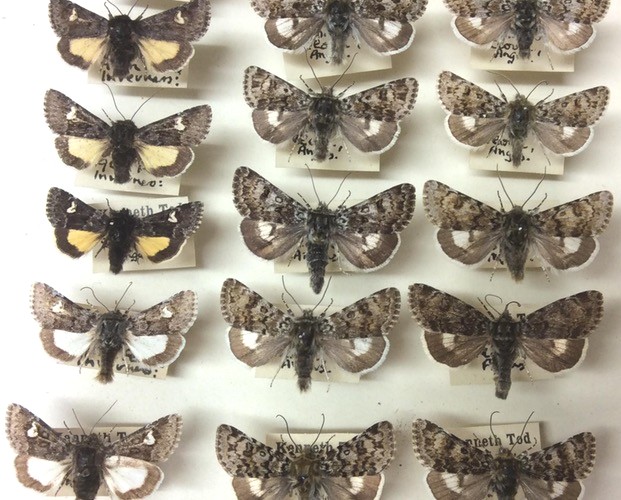
Our next free talk in the D’Arcy Thompson Zoology Museum will be on Tuesday 16th May at 6pm, when Georgia Carr and David Lampard will be speaking on Garden Tigers, Gold Spangles and Burnished Brass: Digitising the Kenneth Tod Moth Collection. 

Did you know there are over 2 500 species of moths in the UK compared to 59 species of butterfly? Or that not all moths fly at night? Some moths have ears, some don’t have mouths!

Little is known about moths in Angus and Dundee yet there is a wealth of information hiding in our museum stores. The Kenneth Tod Collection at the University of Dundee holds rare, localised Alpine species which are of particular concern in times of changing climate. Learn how digitising museum collections across the county gives the global scientific community access to historical, geographic and taxonomic specimen data that can help answer our greatest ecological and conservation questions. Find out how Tod discovered new and unusual locations for the Small Dark Yellow Underwing and the Northern Dart, and how Tod’s fear of other collectors means these locations are a secret to this day.

The Angus Moth Project is an 18-month digitisation project funded by Museums Galleries Scotland. Over the course of the project three historical moth collections at the McManus, Montrose Museum and the University of Dundee have been digitised, photographed, conserved and rehoused. All data pertaining to specimens collected in Watsonian Vice County 90, the historic county of Forfarshire, has been sent to Butterfly Conservation for use in the 2018 National Moth Atlas. Data and specimens are now easily accessible to the scientific community and the wider public.

David Lampard is the Natural History Curator of Invertebrates and Geology at The McManus: Dundee’s Art Gallery & Museum. He is the Butterfly Conservation moth recorder for the County of Angus.

Georgia Carr has a background in ecological and conservation management and is the Angus Moth Project officer based at the McManus.

Admission is free but it would be very helpful if you could book a place here.

Refreshments will be served after the talk. Please enter by the main front door of the Carnelley Building. Latecomers may not be admitted.

Chinese nurse’s first aid to Japanese student goes viral

image_pdfimage_print
Chinese nurse's response to sick Japanese student goes viral

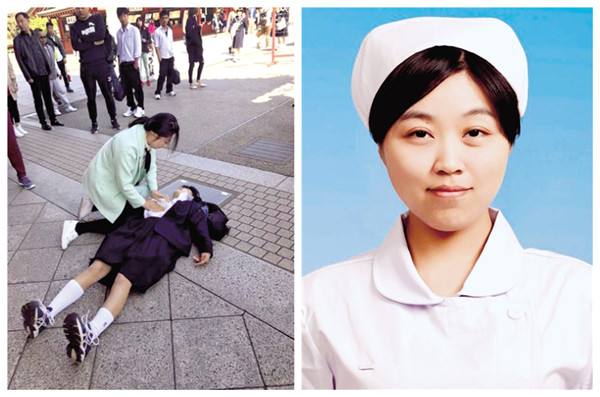
Chinese nurse Ren Shuangshuang. [Photo/Zhengzhou Evening News]

A post about a Chinese nurse who helped a Japanese student has gone viral on Weibo, a Twitter-like social media platform.

During a vacation in Japan, the 28-year-old nurse rushed to aid a Japanese middle-school student who was having an epileptic seizure on April 18, according to media reports.

Ren Shuangshuang works at Henan Cancer Hospital as a surgical nurse. She encountered the Japanese girl when visiting the famous tourist attraction Senso-ji.

“It was very crowded and a girl fainted,” Ren recalled. She immediately approached the girl after the translator for her tour group cried out for help. The girl was twitching and foam was coming out of her mouth. Ren immediately guessed that the girl was having an epileptic seizure.

Ren lay the girl down, unbuttoned her coat and cleaned the foam from around her mouth. She stuffed a wet tissue into the girl’s mouth to prevent her from accidentally biting her tongue. The girl eventually regained awareness and tried to sit up to thank Ren, but the nurse told her to lie back down and rest. An ambulance later arrived to transport the girl to a hospital.

Ren’s actions were recorded by other tourists and uploaded to social media. Her good deed has been widely lauded.

So far, the post has got more than 12,000 comments and nearly 200,000 thumbs-up. “Good girl! That’s what a doctor with good virtues would do. Love has no nationalities,” said one of the comments, which received more than 16,000 thumbs-up.