Tag Archives: Governmental

image_pdfimage_print

Yemen: As food crisis worsens, UN agencies call for urgent assistance to avert catastrophe

10 February 2017 – The number of food insecure people in Yemen has risen by three million in seven months, with an estimated 17.1 million people &#8211 more than two-thirds of the entire population of 27.4 million &#8211 now struggling to feed themselves, according to a joint assessment by three United Nations agencies.

&#8220The speed at which the situation is deteriorating and the huge jump in food insecure people is extremely worrying,&#8221 said the Food and Agriculture Organization’s (FAO) Representative in Yemen, Salah Hajj Hassan, in a news release.

&#8220Bearing in mind that agriculture is the main source of livelihood for the majority of the population, FAO is urgently calling for funds to scale up its agricultural livelihoods support to farmers, herders and fishing communities to improve their access to food in 2017 and prevent the dire food and livelihood security situation from deteriorating further,&#8221 he added.

Of the 17.1 million food-insecure people, about 7.3 million are considered to be in need of emergency food assistance, according to the preliminary results of the Emergency Food Security and Nutrition Assessment, which attributed the rapid deterioration of the conditions to the ongoing conflict.

The UN and humanitarian partners has recently launched an international appeal for $2.1 billion to provide life-saving assistance to 12 million people in Yemen in 2017 &#8211 the largest-ever humanitarian response plan for the war-torn country.

The joint assessment was conducted by FAO, the UN Children’s Fund (UNICEF) and the World Food Programme (WFP) in cooperation with the authorities in Yemen. It is the first national, household-level survey conducted in the country since the escalation of the conflict in mid-March 2015.

Rates of acute malnutrition were found to have passed the &#8220critical&#8221 threshold in four governorates, while agricultural production is falling across the country.

Even if they survive, these children risk not fulfilling their developmental potentials

&#8220We are witnessing some of the highest numbers of malnutrition amongst children in Yemen in recent times,&#8221 said UNICEF’s Country Representative, Meritxell Relano.

She warned that children who are severely and acutely malnourished are 11 times more at risk of death as compared to their healthy peers, if not treated on time.

&#8220Even if they survive, these children risk not fulfilling their developmental potentials, posing a serious threat to an entire generation in Yemen and keeping the country mired in the vicious cycle of poverty and under development,&#8221 she said.

Stephen Anderson, WFP Country Director, also sounded the alarm. &#8220The current level of hunger in Yemen is unprecedented, which is translating into severe hardship and negative humanitarian consequences for millions of Yemenis, particularly affecting vulnerable groups.&#8221

&#8220Tragically, we see more and more families skipping meals or going to bed hungry, while children and mothers are slipping away with little to sustain themselves,&#8221 he said.

WFP is urgently calling for support to provide food for the seven million people who are severely food insecure and may not survive this situation for much longer, he added.

Source: OCHA 2017 Humanitarian Response Plan for Yemen

Meanwhile, the Office of the UN High Commissioner for Refugees (UNHCR) reported that fighting in the coastal districts of Al Mokha and Dhubab in the western governorate of Taizz is spreading to the inland districts of Al Wazi’iyah and Mawza.

&#8220A result is that more than 34,000 people have fled their homes,&#8221 UNHCR spokesperson William Spindler told reporters in Geneva.

The UN refugee agency has mobilized assessment teams across displacement sites in Hudaydah, Ibb and the district of Maqbanah in Taizz, where recently displaced people are being hosted and began deliveries of emergency assistance, including basic relief items and emergency shelter.

As of 1 February 2017, UNHCR had received only $738,303 of the $99.6 million needed for the refugee agency’s operational response in Yemen this year.

The Office of the UN High Commissioner for Human Rights (OHCHR) said that extremely worrying reports have emerged about the impact on civilians of the fighting over the past two weeks, in the southwestern port of Al Mokha in Taizz Governorate. Credible reports indicate that Houthi-affiliated snipers shot at families attempting to flee their homes in Houthi-controlled areas &#8211 suggesting the use of civilians as human shields.

&#8220Civilians were trapped and targeted during the Al Mokha fighting. There are real fears that the situation will repeat itself in the port of Al Hudaidah, to the north of Al Mokha, where air strikes are already intensifying,&#8221 UN High Commissioner for Human Rights Zeid Ra’ad Al Hussein said in a news release.

read more

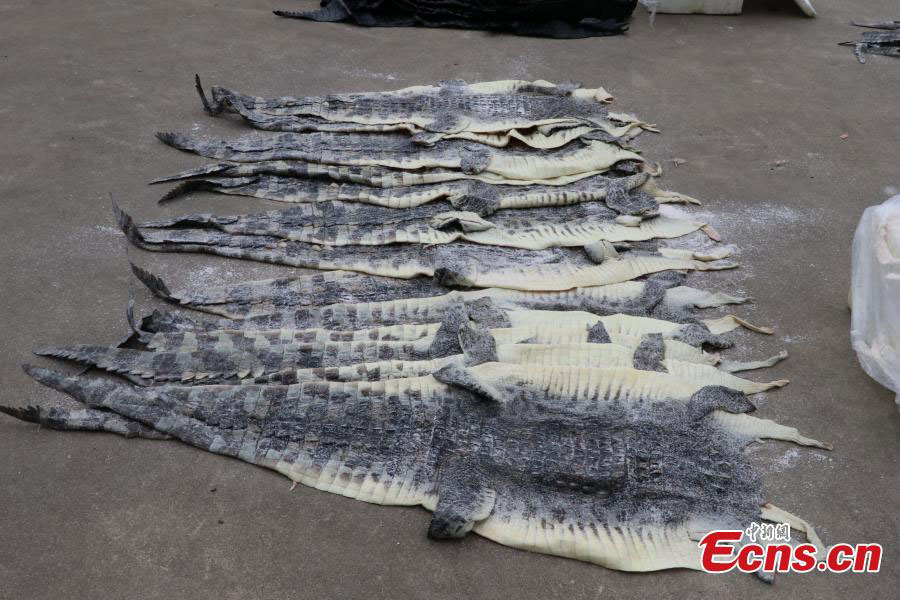
Over 1,600 crocodile skins seized in S. China

Crocodile skins seized by coast guards are on show in Fangchenggang City, South China’s Guangxi Zhuang Autonomous Region, Feb. 7, 2017. [Photo: China News Service/ Wang Lidan]

More than 1,600 pieces of crocodile skins and 500 kilograms of what appears to be crocodile meat were seized in south China’s Guangxi Zhuang Autonomous Region, coast guards said Thursday.

During a patrol Tuesday, a group of coast guards boarded a boat around 3 a.m., which was carrying a number of large polystyrene boxes. Upon inspection, the boxes contained what appeared to be 1,609 crocodile skins, each around 1.4 meters long, and 506 kilograms of crocodile meat.

The boat and its owner have been detained. A suspect caught said he was hired by a buyer in the city to receive the goods from a port in Vietnam.

Crocodiles are under state protection in China and are also classed as endangered by the Convention on International Trade in Endangered Species of Wild Fauna and Flora. Crocodile skin is the upmarket of consumer goods because of its small quantities and luxurious quality. The smuggling of alligator skins is emerging as the high-end leather market flourishes.

Crocodile skins are often used for luxury handbags.

The investigation continues.

read more

Jail sentences for selling data on 200,000 newborns

Eight people involved in stealing, selling and buying information of more than 200,000 newborns have been sentenced for infringing citizens’ personal information.

The Pudong New Area People’s Court said yesterday that the defendants included two former employees of the city’s Center for Disease Control and Prevention. The eight were sentenced from seven to 27 months, and were ordered to pay penalties ranging from 2,000 to 5,000 yuan (US$290 to US$730).

One of the accused, surnamed Han, 41, was working in the city-level Center for Disease Control and Prevention, and another surnamed Zhang, 50, was working for the district-level authority. In 2014, Zhang persuaded Han to steal information of newborns from the center’s database to help his friend promote infant health products, promising a commission fee.

From the beginning of 2014 to July last year, Han illegally downloaded the information from the system and sent the details to Zhang via e-mail twice a month. Each time information on about 5,000 newborns was given. Zhang then sold the information to another of the accused, surnamed Fan, who was in the infant health products business. According to the court, Han, Zhang and Fan stole personal information on more than 200,000 newborns.

Moreover, Fan sold more than 250,000 pieces of information to another of the defendants, surnamed Li, who sold on the information to two of the accused, surnamed Huang and Wang. All three were also involved in infant health products. Wang’s ex-driver, surnamed Wu, also stole information of more than 70,000 newborns.

All eight confessed their guilt to the court, returned their illegal income and paid the penalties imposed.

read more

Shanghai ranks No. 4 of world’s top-30 cities

Shanghai is the highest of five Chinese mainland cities at No. 4 in the list of the world’s 30 most dynamic cities, according to the Global City Momentum Index released Thursday by real estate services provider JLL.

Beijing, Shenzhen, Hangzhou and Nanjing are the other four Chinese cities that appeared in the fourth annual list, ranking 15th, 22nd, 26th and 29th, respectively, according to the index, which monitors 134 major business hubs across the world and tracks the rate of change of a city’s economy and commercial real estate market.

The most dynamic cities are able to embrace technological change, absorb rapid population growth and strengthen global connectivity, JLL said.

“Shanghai has strong ambitions to continue its growth and explicitly aims to become a global center for both financial services and technological innovation,” said Joe Zhou, head of research for JLL China.

“For now, Shanghai’s real estate market remains one of the world’s most dynamic markets, with strong demand being driven by the growth of domestic firms.”

Asian cities made up half of the top 10, with Bangalore in India replacing London to take the top spot for the first time.

“Our research showed that the Asia-Pacific region is home to more than half of the globe’s 30 most dynamic cities and real estate markets, highlighting the rise of commercial cities such as Bangalore and Ho Chi Minh City as major hubs of commerce,” said Megan Walters, head of research for Asia Pacific at JLL.

read more