‘The world needs science and science needs women,’ UN says on International Day

11 February 2017 – United Nations Secretary-General António Guterres today urged greater investments in teaching science, technology, engineering and math to all women and girls as well as equal access to these opportunities.

&#8220For too long, discriminatory stereotypes have prevented women and girls from having equal access to education in science, technology, engineering and math (STEM),&#8221 said Mr. Guterres in his message for International Day of Women and Girls in Science, marked annually on 11 February.

&#8220As a trained engineer and former teacher, I know that these stereotypes are flat wrong,&#8221 he said, explaining that they deny women and girls the chance to realize their potential &#8211 and deprive the world of the ingenuity and innovation of half the population.

&#8220On this International Day, I urge commitment to end bias, greater investments in STEM education for all women and girls as well as opportunities for their careers and longer-term professional advancement so that all can benefit from their ground-breaking future contributions,&#8221 he said.

Earlier this week, the UN Educational, Scientific and Cultural Organization released its UNESCO Science Report: Towards 2030.

‘Female engineers and computer programmers wanted,’ is the main message of the report, which shows that women are increasingly graduating with life science degrees, but still rare in engineering and computer science, especially in developed economies.

&#8220An analysis of computer science shows a steady decrease in female graduates since 2000 that is particularly marked in high-income countries,&#8221 it states.

The share of women graduates in computer science between 2000 and 2012 slipped in Australia, New Zealand, the Republic of Korea and the United States, as well as in Latin America and the Caribbean.

&#8220This should be a wake-up call,&#8221 UNESCO said. &#8220Female participation is falling in a field that is expanding globally as its importance for national economies grows, penetrating every aspect of daily life.&#8221

The share of women working as engineers is also higher in some developing countries, with increases observed in sub-Saharan and Arab countries. Women in the United Arab Emirates, for example, have benefited from national polities that promote training and employment of Emirati citizens, and in particular women.

In her message on the Day, UNESCO Director-General Irina Bokova called for empowering women and girls to learn and research.

&#8220We must raise awareness about the work of women scientists by providing equal opportunities for their participation and leadership in a broad spectrum of high-level scientific bodies and events,&#8221 Ms. Bokova said, calling also for mentoring opportunities for women.

In 2016, UNESCO and the L’Oréal Foundation launched the manifesto For Women in Science, to engage governments and stakeholders in promoting the full participation of girls and women in science.

For its part, UN Women noted that science and technology offer unique opportunities for women and girls to overcome a number of the barriers they typically face. For example: mobile money has empowered and transformed the lives of millions of women previously thought to be &#8220unbankable&#8221 by enabling them to directly access financial products and services.

Women with skills in science and technological fields can help improve vital infrastructure such as water and power supply, and in doing so ease the responsibilities that women and girls carry of providing unpaid care work for the household.

Similarly, Internet and mobile technology can help bridge barriers to education for the 32 million girls who are out of school at the primary level and the 29 million at the lower secondary level, explained the main UN entity on women’s empowerment and gender equality.

Source: UNESCO Institute for Statistics estimates based on data from its database, July 2015

Encouraging women to do research

Women now account for 53 per cent of world’s bachelor’s and master’s graduates in science and 43 per cent of PhDs, according to the UNESCO report. Since 2000, there has been a steady increase in female graduates in agricultural sciences, likely driven by an emphasis on national food security and the food industry.

In sub-Saharan Africa, for instance, female graduates in agricultural science have been increasing steadily, with women comprising 40 per cent or more of graduates in Lesotho, Madagascar, Mozambique, Namibia, Sierra Leone, South Africa, Swaziland and Zimbabwe.

Medicine is also a field increasingly popular with women, with six out of 10 researchers being women in both medical and agricultural sciences in Belarus and New Zealand, for instance.

In research, however, women still lag men at 28 per cent. The figure fluctuates geographically with women in Southeast Europe are on par with men, and at 44 per cent in Central Asia, Latin America and the Caribbean. According to the report, the numbers are particularly low in the European Union, sub-Saharan Africa and South Asia.

To encourage women and girls to study and work in science, technology, engineering and mathematics (STEM), the UN has organized a number of events around the world.

In New York, a high-level event is underway today tying gender, science and the 17 Sustainable Development Goals (SDGs). The event was organized with support from the Government of Malta, as the president of the Council of the European Union.
AUDIO: American astronaut Peggy Whitson is making history as the first woman ever to command two missions aboard the International Space Station.


Over 1,600 crocodile skins seized in S. China

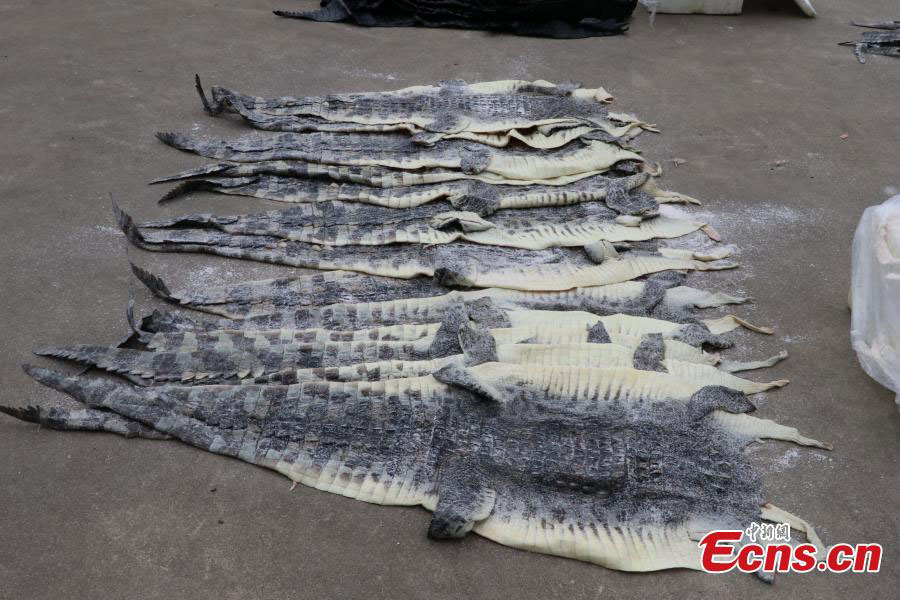
Crocodile skins seized by coast guards are on show in Fangchenggang City, South China’s Guangxi Zhuang Autonomous Region, Feb. 7, 2017. [Photo: China News Service/ Wang Lidan]

More than 1,600 pieces of crocodile skins and 500 kilograms of what appears to be crocodile meat were seized in south China’s Guangxi Zhuang Autonomous Region, coast guards said Thursday.

During a patrol Tuesday, a group of coast guards boarded a boat around 3 a.m., which was carrying a number of large polystyrene boxes. Upon inspection, the boxes contained what appeared to be 1,609 crocodile skins, each around 1.4 meters long, and 506 kilograms of crocodile meat.

The boat and its owner have been detained. A suspect caught said he was hired by a buyer in the city to receive the goods from a port in Vietnam.

Crocodiles are under state protection in China and are also classed as endangered by the Convention on International Trade in Endangered Species of Wild Fauna and Flora. Crocodile skin is the upmarket of consumer goods because of its small quantities and luxurious quality. The smuggling of alligator skins is emerging as the high-end leather market flourishes.

Crocodile skins are often used for luxury handbags.

The investigation continues.


Jail sentences for selling data on 200,000 newborns

Eight people involved in stealing, selling and buying information of more than 200,000 newborns have been sentenced for infringing citizens’ personal information.

The Pudong New Area People’s Court said yesterday that the defendants included two former employees of the city’s Center for Disease Control and Prevention. The eight were sentenced from seven to 27 months, and were ordered to pay penalties ranging from 2,000 to 5,000 yuan (US$290 to US$730).

One of the accused, surnamed Han, 41, was working in the city-level Center for Disease Control and Prevention, and another surnamed Zhang, 50, was working for the district-level authority. In 2014, Zhang persuaded Han to steal information of newborns from the center’s database to help his friend promote infant health products, promising a commission fee.

From the beginning of 2014 to July last year, Han illegally downloaded the information from the system and sent the details to Zhang via e-mail twice a month. Each time information on about 5,000 newborns was given. Zhang then sold the information to another of the accused, surnamed Fan, who was in the infant health products business. According to the court, Han, Zhang and Fan stole personal information on more than 200,000 newborns.

Moreover, Fan sold more than 250,000 pieces of information to another of the defendants, surnamed Li, who sold on the information to two of the accused, surnamed Huang and Wang. All three were also involved in infant health products. Wang’s ex-driver, surnamed Wu, also stole information of more than 70,000 newborns.

All eight confessed their guilt to the court, returned their illegal income and paid the penalties imposed.


Shanghai ranks No. 4 of world’s top-30 cities

Shanghai is the highest of five Chinese mainland cities at No. 4 in the list of the world’s 30 most dynamic cities, according to the Global City Momentum Index released Thursday by real estate services provider JLL.

Beijing, Shenzhen, Hangzhou and Nanjing are the other four Chinese cities that appeared in the fourth annual list, ranking 15th, 22nd, 26th and 29th, respectively, according to the index, which monitors 134 major business hubs across the world and tracks the rate of change of a city’s economy and commercial real estate market.

The most dynamic cities are able to embrace technological change, absorb rapid population growth and strengthen global connectivity, JLL said.

“Shanghai has strong ambitions to continue its growth and explicitly aims to become a global center for both financial services and technological innovation,” said Joe Zhou, head of research for JLL China.

“For now, Shanghai’s real estate market remains one of the world’s most dynamic markets, with strong demand being driven by the growth of domestic firms.”

Asian cities made up half of the top 10, with Bangalore in India replacing London to take the top spot for the first time.

“Our research showed that the Asia-Pacific region is home to more than half of the globe’s 30 most dynamic cities and real estate markets, highlighting the rise of commercial cities such as Bangalore and Ho Chi Minh City as major hubs of commerce,” said Megan Walters, head of research for Asia Pacific at JLL.


41.2 pct of Chinese hold urban hukou in 2016

China’s registered permanent urban residents rose to 41.2 percent of the total population in 2016, after easing of “hukou” (household registration) policy, the Ministry of Public Security announced Thursday.

In 2015, only 39.9 percent of the population held urban status and the current urbanization drive is aiming for 45 percent by 2020.

At a video conference held on Thursday, the ministry of public security called for a more reasonable points system and for registration in most cities for students and migrant workers to become easier still.

The government is gradually bringing the unregistered population into the hukou system, including orphans, second children born illegally during the one-child policy and the homeless.

Last year, more than 1.43 million people formerly without hukou were registered, the ministry said.

Various benefits such as health care and education are based on hukou, and are supposed to be in line with long-term places of work and residence.