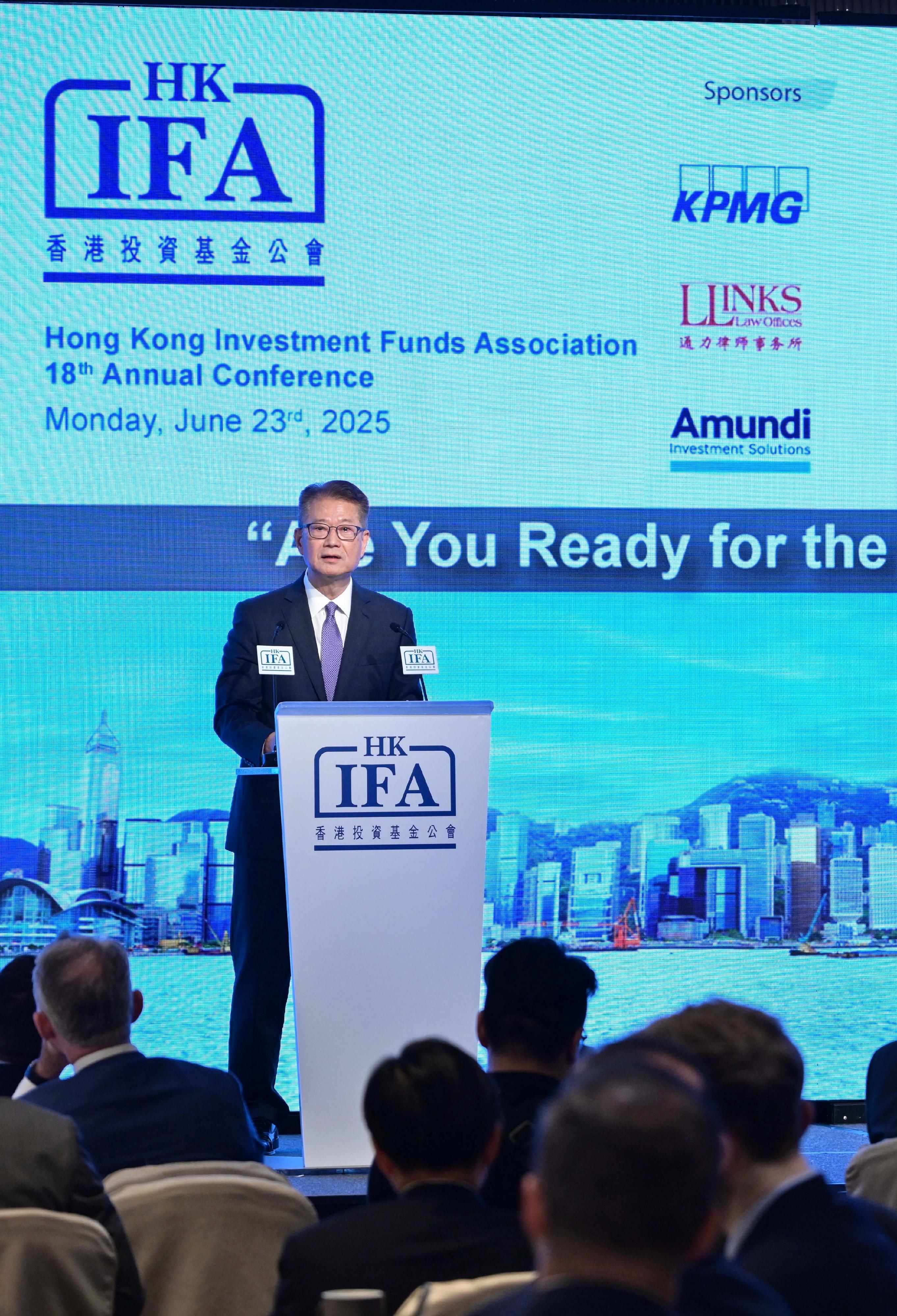
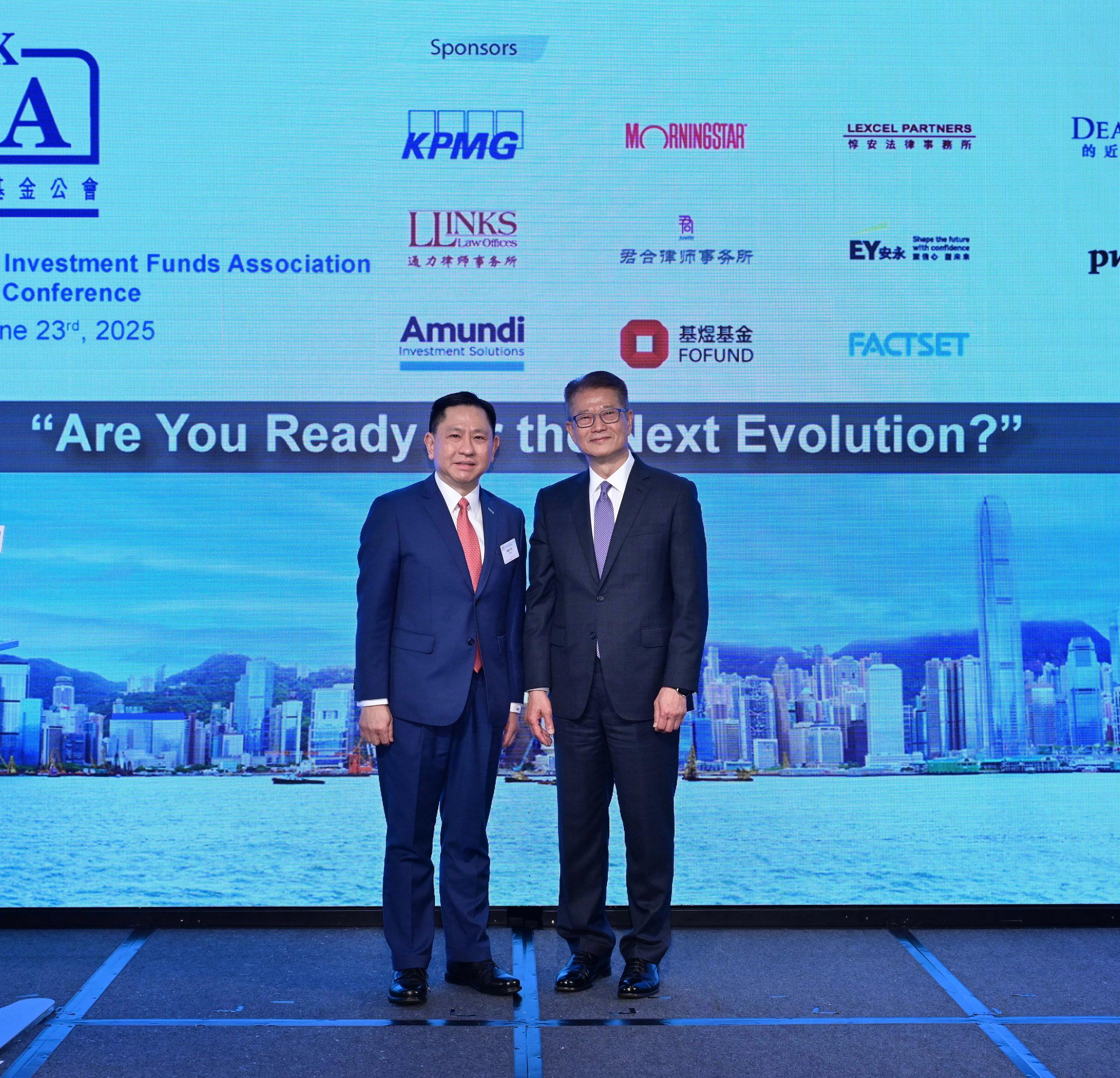
Following is the speech by the Financial Secretary, Mr Paul Chan, at the Hong Kong Investment Funds Association 18th Annual Conference today (June 23):
Sam (Chairman of the Hong Kong Investment Funds Association (HKIFA), Mr Sam Yu), Your excellency Mr El-Kuwaiz (Chairman of the Capital Market Authority of Saudi Arabia, Mr Mohammad El-Kuwaiz), Consul General Mr Alhimali (Consul General of Saudi Arabia in Hong Kong, Mr Mazin Hamad Mohamad Alhimali), Kelvin (Chairman of the Securities and Futures Commission (SFC), Dr Kelvin Wong), Eddie (Chief Executive of the Hong Kong Monetary Authority, Mr Eddie Yue), Julia (Chief Executive Officer of the SFC, Ms Julia Leung), distinguished guests, ladies and gentlemen,
Good morning. It is my pleasure to join you all at the 18th Annual Conference of the Hong Kong Investment Funds Association. Let me first thank the HKIFA for your continued efforts in fostering dialogues and collaboration within the fund management community.
The theme of this year’s conference – “Are You Ready for the Next Evolution?” – is both timely and thought-provoking. We are living through a period of profound transformation, marked by shifts that are global in scale and historical in speed.
This morning, allow me to highlight just two megatrends that I believe will significantly shape the future of investment.
The megatrends and investment
Yes, the first is geopolitical change. Much has been said about rising geopolitical tensions and policy uncertainties in the US. But just as important is the rebalancing of global economic influence, especially the accelerating rise of the Global South. Today, the Global South accounts for 40 per cent of the global GDP (Gross Domestic Product), and 60 per cent if on a purchasing power parity basis, and contributes 80 per cent of global growth. This is more than a trend; it is a structural shift that everyone needs to embrace.
China continues to be a powerful engine in this evolving landscape. Its economy grew by 5.4 per cent in the first quarter, with strong momentum expected to carry forward in the second quarter. Amid global headwinds, China’s commitment to high-level opening up and high-quality development reinforces its role as a stabilising force and a promising source of long-term growth.
In the Middle East, despite ongoing tensions, the Gulf economies remain resilient and forward-looking. Many GCC (Gulf Cooperation Council) nations are advancing ambitious diversification agenda, including financial market reforms. When I visited the region in the past two years, I was impressed by their deep commitment to economic diversification and strengthening financial connectivity with Asia.
Similarly, ASEAN (Association of Southeast Asian Nations) economies are rising rapidly, driven by rapid industrialisation, massive infrastructure investments, a growing middle class, and expanding consumer markets.
The second trend is technological innovation, with artificial intelligence at its heart. AI is now accelerating transformation across industries. Whether in finance, healthcare, logistics or manufacturing, AI is reshaping value chains. Coupled with breakthroughs in quantum computing, semiconductors and robotics, this wave of innovation is ushering in a new era of enhanced productivity, keen competition and, above all, investment opportunities.
These trends send a clear message. In a world of rapid change, success means foresight and pursuit of new markets, new sectors and new partnerships.
And Hong Kong is uniquely positioned to facilitate this evolution.
The growth of funds
Today, Hong Kong continues to stand out as a trusted gateway and market for global capital. Under the “one country, two systems” arrangement, we retain the core competitive strengths that define our city.
The institutional strengths, combined with policy certainty, regulatory transparency and an enabling government, have reinforced Hong Kong’s position as a safe harbour for global investors during these turbulent times. This is most obviously reflected in the recent upturn in our stock market and influx of capital as reflected in bank deposits.
The asset and wealth management sector is also seeing strong growth momentum. As of March, net inflows into Hong Kong-domiciled funds for the past 12 months surpassed US$44 billion, a nearly threefold increase year on year. Our exchange-traded products market has also continued to grow, now boasting 210 listed products, with a transaction volume accounting for over 15 per cent of the stock market’s total.
We are optimistic about the upcoming SFC Asset and Wealth Management Activities Survey. At last count, Hong Kong managed nearly US$4 trillion in assets, more than 10 times our GDP. Notably, two-thirds of this capital originates from outside Hong Kong.
Several factors are driving this growth. First, the Greater Bay Area (GBA). With its affluent population and growing demand for offshore asset allocation, Hong Kong is the natural choice. Since the GBA Wealth Management Connect was enhanced in February last year, the cumulative cross-boundary fund flows have surged sevenfold, now exceeding RMB100 billion.
Second, we are actively attracting ultra-high-net-worth individuals. The New Capital Investment Entrant Scheme, for example, has already received nearly 1 400 applications in about 15 months, bringing in potential investments of over US$5.2 billion. Besides, the family office sector continues to grow. Hong Kong is now home to around 2 700 wealthy family offices. Projections say that the number will exceed 3 000 in the near future.
To further support the growth of the asset and wealth management industry, the Government is taking forward a number of initiatives. For example, we are working to enhance the preferential tax regimes for family offices, including expanding the scope of “fund”, increasing the types of qualifying transactions, and enhancing the concession arrangement in relation to carried interest distribution by private equity funds. We target to submit the legislative proposals in 2026, with implementation from the 2025-26 year of assessment onward.
Regulatory clarity is also being enhanced to facilitate the growth of private equity funds. In February, the SFC clarified the requirements for authorising and listing alternative asset funds, such as PE funds, on the HKEX (Hong Kong Stock Exchange). In May, the MPFA (Mandatory Provident Fund Schemes Authority) clarified that MPF funds may also invest in approved listed PE products.
Later this year, the regulators will consult the public on broadening retail access to private markets, including unlisted long-term investment funds. I encourage the industry to stay engaged and contribute your views.
The bigger picture
Ladies and gentlemen, now allow me to go back to the bigger picture: in light of the evolving trends, how can we capture the opportunities, and what role can funds in Hong Kong play?
We believe our role as a connector of markets is more important than ever.
In today’s geopolitical climate, international capital is actively seeking opportunities in Asia. Meanwhile, Mainland companies are going global in order to diversify their industry and supply chains, and they need capital for international expansion. Hong Kong is their natural platform to raise funds they need.
And our Connect Schemes with the Mainland are growing in depth and scale. They encompass not just stocks and bonds but also ETFs (exchange-traded funds) and derivatives, offering an unparalleled channel to access the liquidity on the Mainland. In January this year, the mutual recognition of funds arrangement between Hong Kong and the Mainland was enhanced. It has relaxed relevant sales restrictions and expanded product diversity and scale, thereby boosting the attractiveness and accessibility of funds in each other’s market. And funds in Hong Kong, understandably, are the winners.
Beyond the Mainland, we are also deepening connections with other regions via mutual market access and co-developing new cross-boundary investment products.
Our partnership with Saudi Arabia is a prime example. Following the launch of Asia’s first Saudi ETF at the Hong Kong Stock Exchange in 2023, two Hong Kong index-tracking ETFs were listed on the Saudi Exchange in 2024. As of March 2025, their combined market capitalisation exceeded US$1.8 billion, being the largest ETFs in Saudi Arabia.
Last month, we welcomed Asia’s first government sukuk ETF investing in Saudi Arabia.
Looking ahead, deeper engagement with other emerging markets is definitely a key strategy. For example, we are exploring more mutual market access collaboration with ASEAN, in order to promote two-way capital flows and broaden investors’ choices.
Another strategic frontier for investment is technology. China has demonstrated many technological breakthroughs with innovations like DeepSeek and others. Here in Hong Kong, we are also advancing in AI, green tech, biotech, and new materials. With priority access to the Mainland market and our international connectivity, Hong Kong is an ideal base for tech companies of various stages. They are investment opportunities for fund managers, not just for financial returns but also for making a difference in shaping the future.
It is noteworthy that the Hong Kong Investment Corporation Limited (HKIC), a strategic investment vehicle of the Government, has already invested in over 100 projects in the areas of hard tech, biotech and green tech. The HKIC welcomes collaboration with the fund management sector to build a more dynamic and vibrant innovation ecosystem in Hong Kong.
Fintech is another fast-moving area. Recently, interest in digital assets, particularly stablecoins, has grown significantly. Further to the regulatory regime on virtual asset trading platforms, we have recently completed the legislation on stablecoins, which will take effect on August 1. This provides clarity and confidence for the market, and opens up new product development opportunities for fund managers. Indeed, digital asset ETFs are among the best-performing products on our Stock Exchange in recent months. We welcome fund managers to explore more in this fast growing space.
Closing remarks
Ladies and gentlemen, in closing, I wish to return to the theme of evolution. The world is now filled with uncertainty, but also with unprecedented opportunities. To thrive, we must continue to reinvent ourselves.
I trust today’s gathering of industry leaders, academics, and innovators will spark the ideas and partnerships needed to chart the next chapter of growth for the industry. On this note, I wish this Conference every success. Thank you very much.