South Sudan: UN and regional partners call for immediate cessation of hostilities

image_pdfimage_print

29 January 2017 – The United Nations, the African Union (AU) and regional partners today reiterated their call for an immediate cessation of hostilities in South Sudan and urged the parties to ensure an inclusive political process, both in the proposed National Dialogue and in the implementation of the 2015 peace agreement.

Meeting in the Ethiopian capital, Addis Ababa, on the margins of the 28th African Union Summit, the AU, the Intergovernmental Authority on Development (IGAD), and the UN, held a joint consultative meeting on South Sudan.

According to a joint press statement issued after the meeting, the participants expressed their deep concerns over the continuing spread of fighting, and risk of inter-communal violence escalating into mass atrocities, and the dire humanitarian situation in South Sudan. As such, they reaffirmed their continued and collective commitment in the search for lasting peace, security and stability in the country.

Stating that there can only be a political solution to the conflict, within the framework of the 2015 Agreement on the Resolution of the Conflict in South Sudan (ARCSS), the AU, IGAD and UN reiterated their call for an immediate cessation of hostilities and urged the parties to ensure an inclusive political process, both in the proposed National Dialogue and in the implementation of the peace deal.

The AU, IGAD and the UN reaffirmed their commitment and determination to further enhance their cooperation in support of the South Sudan peace process

Further to the press statement, the participants commended the important work performed by the Chairperson of the Joint Ministering and Evaluation Commission (JMEC) &#8211 responsible for monitoring and overseeing the implementation of the Agreement &#8211 and encouraged the AU High Representative for South Sudan to undertake active shuttle diplomacy towards ensuring the inclusivity of the National Dialogue and the implementation of the peace accord, in close consultation with the JMEC Chairperson, the UN and IGAD.

The AU, IGAD and the UN reaffirmed their commitment and determination to further enhance their cooperation in support of the South Sudan peace process, the statement added.

The meeting, chaired by Hailemariam Desalegn, Prime Minister of Ethiopia and Chairperson of IGAD, was also attended by Nkosazana Dlamini-Zuma, Chairperson of the AU Commission; and UN Secretary-General António Guterres. The AU High Representative for South Sudan, former President Alpha Oumar Konare, and the Chairperson of the JMEC, former President Festus Mogae briefed the meeting.

Also in attendance, were the Minister for Foreign Affairs of Ethiopia, the Executive Secretary of IGAD, the AU Commissioner for Peace and Security, and other senior officials of the three organizations.

South Sudan has faced ongoing challenges since a political face-off between President Salva Kiir and his then former Vice-President Riek Machar erupted into full blown conflict in December 2013. The crisis has produced one of the world’s worst displacement situations with immense suffering for civilians.

Despite the August 2015 peace agreement that formally ended the war, conflict and instability have also spread to previously unaffected areas in the Greater Equatoria and Greater Bahr-El-Ghazal regions of South Sudan.
Foreign volunteers help make Chunyun easier

image_pdfimage_print

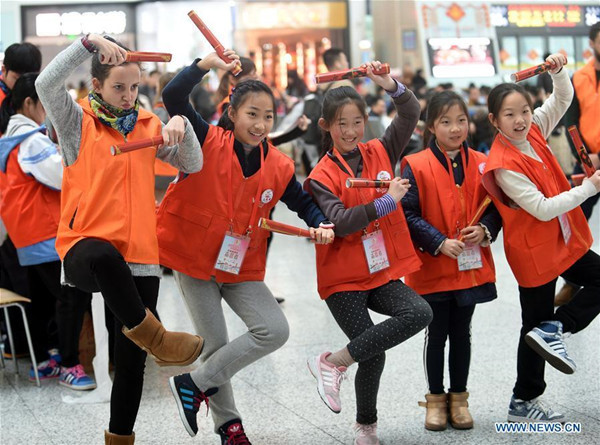
Rachel (1st L) from Britain performs the Monkey King with young volunteers during a break at the East Railway Station of Hangzhou, capital of east China’s Zhejiang Province, Jan. 23, 2017. Five foreign volunteers worked at the railway station to offer help to passengers who rush home for family reunion during the Spring Festival. (Xinhua/Wang Dingchang)

This Spring Festival, a group of foreigners volunteered to give something back to China as a gesture of thanks for what China has done for them.

Yu Zhongyan, was among about 80,000 passengers that will use Wuhan railway station each day during the Spring Festival travel rush, or Chunyun, this year.

She was deeply touched when the volunteers offered to help her with her bags.

“They made our holiday special this year,” said the granny with her grandson in arms.

Wuhan, the capital city of the central province of Hubei, is one of the country’s busiest railway hubs. This year 28 foreign students from 15 countries, wearing yellow hats and orange vests, were on hand to help passengers.

Thursday is Bassim Mohammed Dahash Aljizani’s last day in Wuhan. He earned his doctorate at Huazhong University of Science and Technology.

Together with his wife and three sons, the man had five suitcases and a buggy. Sadi Makangila Patrick from the Democratic Republic of the Congo and Agil Mubariz from Azerbaijan hurried to help.

Aljizani told Xinhua that he will take the train to Guangzhou, before flying back to Baghdad. “I have been in Wuhan for four years and I really don’t want to leave, but my country needs me,” he said.

“It is great experience to see people off at the station,” said Areen Muhammed, a student from Iraq. “The work is tiring. But when I see the smiles, I feel so happy.”

“China’s government provides us scholarship for our study here,” said another volunteer from Sri Lanka. “China helped me, and in return, I would like to do something for the people here.” [ Yuan Gaoping, an official with Wuhan railway bureau, said that by working in the station, the volunteers could experience Chunyun, and experience Chinese culture and the development of its railway firsthand.

Yu Zhongyan asked Patrick to pose for a photo together, before bidding farewell to the foreign “uncle.” “Thank you,” said the boy, while Yu waved, “Happy New Year.”

Shanghai Disney celebrates Chinese New Year

image_pdfimage_print

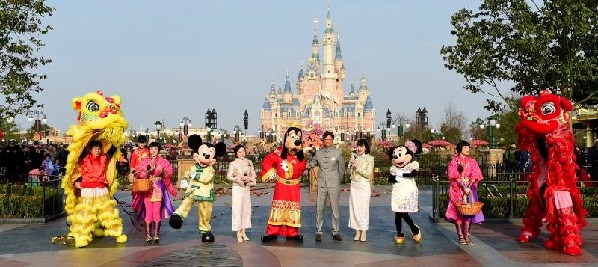
Shanghai Disney Resort celebrated the first day of the Year of the Rooster with two traditional Chinese lions bringing fortune and prosperity to guests in front of the Storyteller Statue on Jan. 28, 2017.

Shanghai Disney Resort  celebrated the first day of the Year of the Rooster with two traditional Chinese lions bringing fortune and prosperity to guests in front of the Storyteller Statue.

Philippe Gas, general manager of the resort, dotted the eyes of the lions, as a traditional celebration to awaken them to spread good cheer and luck to resort guests and cast members. He was joined by Mickey and Minnie, and Goofy dressed as the traditional God of Fortune.

“Shanghai Disney Resort has created a special line-up of festive activities for our first Chinese New Year celebration, ensuring guests from across China and around the world enjoy a unique experience at the resort. We wish everyone a prosperous and healthy Year of the Rooster,” Philippe said.

The special Chinese New Year celebration runs until February 12, amidst a series of entertainment programs, festive decorations, seasonal food and beverage offerings, lucky bags and holiday-themed shopping experiences.

The resort management also reminds guests that during the Chinese New Year high-visitation period, guests are recommended to check the resort’s official website or mobile app before traveling to the resort for the most up-to-date information on theme park ticket availability.

To preserve the guest experience, ticket sales may be limited or suspended on high attendance days. Other experiences inside the Shanghai International Tourism and Resorts Zone, including Disneytown, will be open for guests to enjoy throughout the holiday period.

Shanghai Disney Resort opened in June 2016 and includes a Magic Kingdom style theme park, two themed hotels, a Broadway style theater, an international shopping, dining and entertainment district and Wishing Star Park.

In its first seven months of operations, the resort’s “Authentically Disney and Distinctly Chinese” design, entertainment and attractions concepts have proved to be popular with Chinese consumers.

Shanghai Mayor Ying Yong has said Shanghai Disneyland has attracted over 5 million visitors, while the Shanghai International Tourism and Resorts Zone has received over 11 million people.

Spring Festival enchants foreigners

image_pdfimage_print

Since arriving in Beijing to study in 2014, every Chinese New Year Sabaa Ali El-Tayeb has bought a stuffed toy animal.

This year, the Year of the Rooster, she bought a rooster on Wangfujing, a busy commercial street in downtown Beijing. Last year, the year of the Monkey, she bought a lovely monkey toy.

“I will take these toys back home, and when I finish my degree they will remind me of my time in China,” said the Sudanese woman, who is studying literature at Beijing Language and Culture University.

The Chinese zodiac assigns one of 12 animals, either real or mythological, to each year. This lunar year began on Saturday.

“Celebrating Spring Festival in China makes me love China even more,” said Tayeb.

On Thursday, Tayeb’s university organized an event where foreign students could try their hands at making dumplings, a traditional food eaten during the festival.

Tayeb said she liked this aspect of the festival the most. “Back home we have similar important meals where we eat specific food and extend our best wishes to each other.”

Besides dumplings, Chinese New Year is a time for temple fairs, red lanterns, paper-cuts, blessings of good fortune and ancestor worship.

Basma Bayomy, an Egyptian student at the same university, said she planned to visit a temple fair in Chaoyang Park on Sunday.

The girl, who has been in Beijing since 2012, spent one Spring Festival at her Chinese classmate’s home in Shijiazhuang, a city 300 km south of Beijing.

Bayomy was deeply impressed with the Spring Festival in 2014. She remembers how her classmate’s father left out plates of food for their families’ ancestors.

Similarly, Egyptians leave offerings of fruit and bread on the graves of their ancestors. Both traditions, Bayomy said, are rooted in respect for the family.

Like Chinese, many foreigners put couplets, Chinese characters wishing for good fortune, on their front doors.

Marie, a British translator in Beijing, was sent a couplet by her Chinese friend on Thursday. She stuck them on the door of her apartment, took a photo of herself standing in front of it, and shared it with her parents in Britain.

“These couplets are an expression of hope for the future and contain the Chinese spirit of ‘harmony’,” she said.

China to recycle 350 mln tonnes of waste resources by 2020

image_pdfimage_print

China is expected to recycle 350 million tonnes of waste resources including steel, nonferrous metals, plastic and paper annually by 2020, according to an official guideline.

The guideline was jointly released by ministries of industry and information technology, commerce, and science and technology.

China will develop a sophisticated system for renewable resources, said the guideline.

By 2020, China will use 150 million tonnes of waste steel, and 18 million tonnes of waste nonferrous metals annually, according to a plan included in the guideline.

The country also aims to recycle 23 million tonnes of waste plastic and half of all its waste paper by 2020 annually said the guideline.