Chinese media unite against news copyright infringement

Ten of China’s major news agencies and websites formed a union in Beijing on Wednesday in order to provide better copyright protection for the media.

The union was set up at a conference on internet copyright protection, where a declaration of the union was read by Zhou Xisheng, CEO of ChinaSo, a search engine set up by the country’s major news organizations, and a founding member of the union.

According to the declaration, the union will play a significant part in issues including the unified management of news copyright, and will support its members to uphold their own copyrights.

The declaration also criticized misconduct in the news business, such as piracy, incorrect or fake quotes and unauthorized reprints, which severely hurt the enthusiasm of journalists and negatively affect the sustainable development of the business.

The union has called for the society to respect and protect news copyrights, and has asked for more news organizations to join the union to improve the situation.

A total of 115 media outlets released a joint statement at the conference, also calling for better copyright protection in the news business.

China has been emphasizing the importance of copyright protection recently, as a national copyright monitoring website was set up on April 20, which was seen as a step forward in the nation’s crackdown on piracy.

The website, www.12426.cn, is managed by the Copyright Monitoring Center under the Copyright Society of China, providing identification, security monitoring, early warning and rights infringement solution services for registered copyright owners.
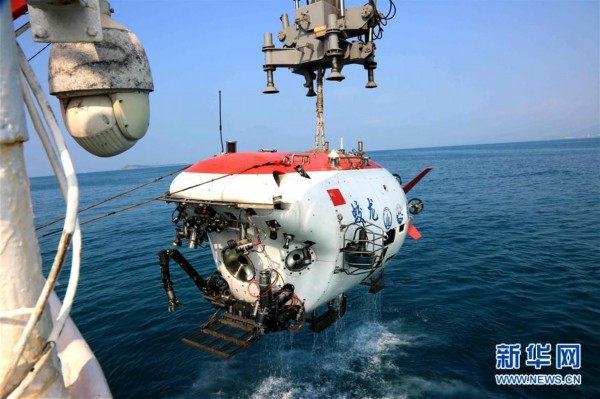
Chinese submersible Jiaolong completes S. China Sea dive

Jiaolong submersible goes through a dive simulation in Sanya, Hainan Province, on April 22. [Photo/Xinhua]

Jiaolong, China’s manned submersible, completed a dive Wednesday in the South China Sea.

Departing its mother ship Xiangyanghong 09 at around 7 a.m., Jiaolong stayed underwater for nine hours and twelve minutes for the dive before returning at around 4:19 p.m.

It managed to bring 16 liters of sea water samples collected near the seabed, eight sediment samples and two rock samples back to Xiangyanghong 09, in addition to high-definition photos and video footage shot during the mission.

Wednesday’s dive marks the first dive by Jiaolong in the second stage of China’s 38th ocean scientific expedition, which will last until May 13.

The maximum depth of the Jiaolong mission on Wednesday was 1,741 meters below sea level, and the submersible spent some seven hours on the seabed.

Three staff, including one seasoned crew member, Tang Jialing, and two interns, Liu Xiaohui and Yang Yifan, were on board the submersible.

“This is almost Jiaolong’s longest underwater mission,” said Tang.

In an interview with Xinhua prior to the drive, Yang Yaomin, chief scientist for the second stage expedition, said experts had planned to choose a site for experimenting with the collection of polymetallic nodules during the mission.

“We are working to avoid damaging the marine environment in mining,” said Yang. “The expedition will help develop technology for environmentally friendly deep-sea mining.”

Polymetallic nodules are mineral resources that are generally deposited more than 4,000 meters deep beneath the sea’s surface and contain manganese, iron, copper, nickel, cobalt as well as rare earth elements.

During the expedition, manned deep-sea submergence was also conducted in the seamount chain and continental slope areas in the South China Sea, according to scientist Shi Xuefa.

“We plan to carry out geological and biological surveys in the region,” said Shi. “The submersible will take photos of the distribution of polymetallic nodules, deep-sea life and seafloor terrain.”

The rock samples collected from the seamount will be used in research in chronology, mineralogy and geochemistry on the South China Sea, advancing the study of the region’s structural evolution, according to Shi.

The 38th oceanic scientific expedition started on Feb. 6. Jiaolong completed a dive in the northwestern Indian Ocean earlier this year in the mission’s first stage. It will also conduct surveys in the Yap Trench and the Mariana Trench in the third stage.

Named after a mythical dragon, Jiaolong reached its deepest depth of 7,062 meters in the Mariana Trench in June 2012.

5,000-yr-old ruins found at SW China construction site

Archaeologists announced Wednesday neolithic ruins dating back 4,500 to 5,000 years had been found in southwest China’s Sichuan Province.

The ruins was found on Ling Mountain in the ancient city of Langzhong last July, when villagers were building a reservoir, said Sun Zhibin, from the Sichuan Provincial Cultural Relics and Archaeology Research Institute.

A team led by Sun excavated the ruins from September 2016 to January 2017.

A total of 108 items were found at the ruins, including porcelain pots and plates, and stone tools, such as axes and spears.

“The discovery has provided new material for the research on cultural blending in the Sichuan Basin and its surrounding culture,” he said.

The discovery, the first ruins dating back to the late neolithic period near the middle reaches of Jialing River, has put back human activity at Langzhong from 3,000 years ago to 4,500 to 5,000 years ago, said Sun.

Official Statistics: Forestry Commission England Headline Performance Indicators 31 March 2017

The document will present Forestry Commission England’s six headline indicators: number of high priority forest pests in the UK Plant Health Risk Register, percentage of known tree felling that is carried out with Forestry Commmission approval, percentage of woodland in active management, area of woodland, cost of managing the Public Forest Estate and number of private sector businesses operating on the Public Forest Estate.

China seeks breakthroughs in combatting smog

China will increase research on smog in its battle against air pollution in Beijing and surrounding areas.

Government agencies, including environmental protection authority, academies and institutions will work together to integrate resources, according to reports of a State Council executive meeting presided over by Premier Li Keqiang on Wednesday.

Scientists working on anti-smog research may be given extra funding from the central budget.

The work will focus on causes of the heavy seasonal air pollution, emission control and health.

The government hopes to improve air quality and explore transferable pollution control systems for all parts if the country which suffer from smog.

China is addressing air pollution with stricter measures on emissions and an emphasis on clean energy. Minister of Environmental Protection Chen Jining said earlier this week that Chinese cities reported more “good air” days in 2016.