More second-child assistance sought

image_pdfimage_print

A senior health official has called on governments at all levels to help relieve the burden on families wanting to have a second child.

Cui Li, vice-minister of the National Health and Family Planning Commission, said on Tuesday that an array of departments need to introduce measures to help resolve issues that have arisen with the introduction of the second-child policy in January 2016.

Health authorities have been rolling out policies nationwide since family planning rules were relaxed, including improvements to maternal care facilities.

However, Cui warned that families will need help from other government departments to handle some problems, including increased expenses, maternity leave and a shortage of kindergartens.

“We hope through the efforts of governments at all levels … some tangible policies can be made in areas such as taxation and social security to promote the implementation of the policy so that those who want to have a second child can realize their dream,” she said.

“We will focus on problems that emerge as a result of the policy and work to solve them with other departments,” she said, adding that the second-child policy has already yielded positive results.

Cui said 18.7 million babies were born in China last year, up by 11 percent on 2015, with 45 percent born to women who already had a child.

Over the same period, the maternal mortality rate fell from 201 per 1 million births to 199, according to data released by the commission last month, despite the fact half of the 90 million women who became eligible to have a second child are over 40-putting them at a higher risk of complications during pregnancy.

A report released in December by the All China Women’s Federation and Beijing Normal University also called for more investment in public services to make having two children easier and more affordable.

The report included a survey of 10,155 couples in 21 cities who already have a child that found 53 percent did not want a larger family. The biggest concerns were education resources, healthcare services, the environment and the financial burden.

Cui added that the commission has received a lot of advice from the National People’s Congress, the top legislature, and the Chinese People’s Political Consultative Conference, the top advisory body, on implementation of the second-child policy, including measures to improve pediatric services.

The commission received 1,512 suggestions on various healthcare issues from the two bodies last year, she said.

Xi Yanchun, a spokeswoman for the State Council Information Office, added that ministries and departments under the nation’s Cabinet responded to 7,873 suggestions from the NPC and 3,862 from the CPPCC last year.

They included economic development, poverty alleviation and environmental protection proposals, Xi said.

Progress on transplants puts nation in spotlight

image_pdfimage_print

A 10-year reform that has shaken off China’s dependence on executed inmates as the primary source for transplant organs has brought the country to the Vatican to share on the world stage its experience in combating organ commercialism.

Huang Jiefu, a former vice-minister of health and now director of the National Human Organ Donation and Transplant Committee, was invited by the Vatican’s Pontifical Academy of Science to speak about the “China model” of organ donation and transplant management at the two-day Summit on Organ Trafficking and Transplant Tourism that opened on Tuesday.

“This is the first time that China has been invited to a summit on organ transplanting held by an authoritative international organization,” Huang was quoted by the Global Times as saying on Monday. He could not be reached for comment on Tuesday.

Chen Jingyu, deputy director of Wuxi People’s Hospital in Jiangsu province and a leading lung transplant specialist, said such an invitation is “a New Year gift for us Chinese transplant surgeons who have been gradually recognized by international peers”.

In response to speculation on whether the invitation marks an improvement in China-Vatican relations, Foreign Ministry spokesman Lu Kang said on Tuesday at a regular media briefing that Huang’s participation “has nothing to do with the development of the bilateral relationship”.

China first performed a transplant in the 1970s, and Huang acknowledged in 2005 that a majority of the organs transplanted were harvested from executed prisoners.

To conform with international practice, China launched a public organ donation system and announced in 2015 that the use of organs from executed inmates had ceased.

By the end of last year, about 28,000 major organs such as livers, kidneys and lungs were harvested from nearly 10,000 donors who had died, according to data from the National Health and Family Planning Commission.

More than 140,000 people have registered under the organ donation system, according to the China Organ Transplantation Development Foundation, an organization under the commission.

“That demonstrates the great benevolence of the Chinese and an ever-increasing voluntarism,” Huang said earlier.

That helps China gain international acclaim and, more important, “sustain the development of organ transplantation here”, said Guo Zhiyong, a leading liver transplant surgeon at the First Affiliated Hospital of Sun Yat-sen University in Guangzhou, Guangdong province.

“I consider the invitation by the Vatican a recognition and huge encouragement for China’s organ transplantation field,” he said.

“An increasing Chinese involvement in global academic exchanges in transplants also benefits the world, since China ranks second in the world in the number of transplants, second only to the United States,” Guo added.

Chen, from Wuxi People’s Hospital, urged more Chinese surgeons to participate in international academic communications and “inform the world of China’s changes”.

However, there is still a long way to go before China’s organ donations fully satisfy the demand, said Huang, the former vice-minister of health.

Although China performs about 10,000 transplants a year, 300,000 patients are waiting for organs, previous reports said.

Injuries prevalent in China marathons

image_pdfimage_print

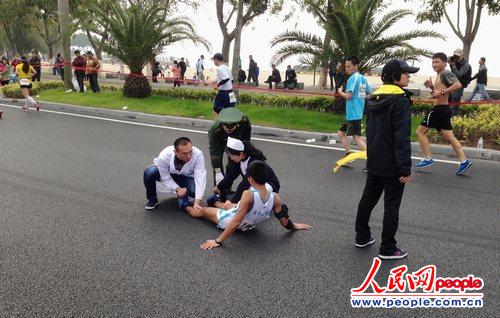
A runner has received medical treatment in Xiamen international marathon in 2014. [Photo: people.com.cn]

Marathon running is gaining rising popularity in China these days. Eight marathons were held in January in the country. However, runners’ awareness of injury prevention lags behind.

A recent survey conducted among around 10,000 runners by iranshao.com, a website focused on running, shows that over one third of runners have had knee injuries, about one fifth have had foot or waist injuries, about one seventh have had ankle injuries or suffered from plantar fasciitis, and only 15.7 percent haven’t had any injuries, which means six of seven runners have had injuries related to running.

In 2016, China held 328 marathons, attracting about 2.8 million participants, a massive 85 percent increase over 2015.

PHOTO FEATURE: Twenty years of protecting children affected by conflict

image_pdfimage_print

7 February 2017 – Following an era in which graphic images of child soldiers had become commonplace in the media, the United Nations General Assembly created a mandate dedicated to better protect children affected by armed conflict.

That was twenty years ago in December.

Leila Zerrougui recalls that in 2012, when she became the Special Representative of the Secretary-General for Children and Armed Conflict, she inherited a mandate with a strong legal framework and mechanisms to generate positive change for these children.

The following story is based on her insights.

In March 2014, Ms. Zerrougui and the UN Children’s Fund (UNICEF) launched the “Children, Not Soldiers” campaign to turn the page on the recruitment and use of children by national security forces in conflict situations.

The campaign has helped to reach a global consensus among Member States that children should not be recruited and used in conflict, and that they should be protected from all grave violations.

In the Democratic Republic of the Congo (DRC), a country that had become emblematic for its army of “kadogo,” or child soldiers, the Government has taken tough action towards making its armed forces child-free, highlights Ms. Zerrougui.

The Government has also become a dedicated partner to fight the massive recruitment of child soldiers by dozens of armed groups that are active in the restive east of the country.

Recently, a DRC army general said that they have changed how they look at children and that they are no longer being recruited.

Over the past twenty years, crucial work to end the use of child soldiers has helped to lay the foundation to address other grave violations, such as curbing sexual violence in conflict.

There is also a strong international mobilization to protect schools and hospitals, including through preventing their military use. Additionally, children’s special protection needs are increasingly being included in peace processes.

In Colombia for example, this has led to an agreement between the parties to release all children associated with the FARC-EP and to provide them with specialized services to facilitate their return to a normal life in their communities.

According to Ms. Zerrougui, this agreement also illustrates how the protection of children, the universal desire to build a better future for boys and girls, can truly serve as an entry point to negotiate peace.

In spite of the undeniable progress over the past twenty years, the UN Special Representative notes, daunting challenges remain. In countries like Syria, Yemen, South Sudan, Nigeria, Somalia and Iraq children face a variety of threats.

Dangers, such as violent extremism, mass detention, attacks on schools and indiscriminate use of explosive weapons in civilian neighborhoods are just a few of the perils faced each day.

Entering the third decade of this mandate, there are three areas of action that can directly impact the lives of thousands of children.

Denying humanitarian access to civilians trapped in or displaced by conflict has increasingly become a tactic of war. It is imperative to combat this by strengthening the respect for international law, underscores Ms. Zerrougui.

The international community must collectively resolve to act in defense of international humanitarian and human rights law.

The vast majority of parties responsible for grave violations against children are non-State actors. As the 2016 annual report of the Secretary-General on children and armed conflict lists 51 out of 59 parties to conflict as non-State armed groups, it is essential to exploit new opportunities to engage with these players.

According to the Special Representative, commanders of non-State armed groups are beginning to realize the legal and political risks associated with recruiting boys and girls, many of whom have reached out to her office and other UN entities for assistance to end the practice.

Once a child soldier is released, the biggest challenge is to provide him or her with a new life. The trauma and stigma they carry often make it difficult for them to return to their communities and to begin or resume their education.

Although psychosocial assistance and help for them to reclaim their lives through educational and vocational opportunities are vital, ensuring sufficient resources and expertise for these services remains a challenge in every country, according to Ms. Zerrougui.

These children should be treated as victims and not security threats.

In the past two decades, the action generated by the General Assembly’s mandate has represented a beacon of hope for millions of children.

Since 2000, more than 115,000 child soldiers have been released.

But more must be done, notes Ms. Zerrougui, including the improvement of how the international community works together. This will have a decisive impact for the future of boys and girls who cannot wait any longer for the protection they have been promised.

£4m investment in major expansion by Dyfed Steels will create and safeguard 200 jobs in Llanelli

image_pdfimage_print

Despite the current crisis affecting the steel industry, MD David Thomas who founded the Llanelli based business 41 years ago,  is currently turning away a significant volume of business annually due to lack of capacity.

By adding further value to their products Mr Thomas has identified expansion opportunities and with £750,000 support from the Welsh Government the investment will be undertaken at its Llanelli site, as opposed to another of its sites in England.

Dyfed Steels plans to redevelop an existing property adjacent to their site in Llanelli into a new processing centre to increase capacity, capability and efficiencies and will invest nearly £3m in new equipment to support the growth of the business increasing throughput by 10,000-15,000 tonnes per year.

Economy Secretary Ken Skates said: 

“Dyfed Steels is an indigenous Welsh company of considerable importance to both the economy of Llanelli and West Wales. It is the company’s 41st year of trading and in that time it has achieved considerable success without the assistance of the public sector. It is now operating in what is an extremely difficult climate for the steel industry and I am delighted the Welsh Government is supporting its investment to safeguard their Llanelli operation. 

“This major investment by an indigenous business in a critically important industry will safeguard and create new high value jobs and help the company increase capacity and grow its market share in more profitable processed work.


“As a major customer for both Tata and Celsa steel their expansion will also have a beneficial knock on effect for the wider steel industry in Wales.”

MD David Thomas said: 

“We are very grateful for the support shown by the Welsh Government, which during a time of great concern for the Steel Sector in the UK, their support became a necessity. Dyfed Steels Ltd needs to remain competitive in order to continue its leading presence within a challenging market. We will now continue to strive to ensure not only the future of the business but to encourage growth, safeguard jobs and create as many new staff opportunities as possible. We aim with this additional support to increase our production capacity, attract new business opportunities and to continue as a growing, established family business in West Wales.”

The business services more than 2000 customers across a range of sectors including agriculture, construction and engineering and offers a complete range of processing services from the simplest cut bar to high volume sophisticated processing of the highest specification.

It currently employs 270 people across 10 sites across the UK, of which 173 are employed at its head office and main processing and distribution centre in Llanelli. Its Welsh operations are in Port Talbot, Newport and Newtown.