UN urges Sri Lanka not to miss opportunity to advance justice and reconciliation

image_pdfimage_print

3 March 2017 – The slow pace of transitional justice in Sri Lanka and the lack of a comprehensive strategy to address accountability for past crimes risk derailing the momentum towards lasting peace, reconciliation and stability, a United Nations report said today.

&#8220Seventeen months ago, when we published a detailed report on the grave human rights violations committed during the conflict in Sri Lanka, I urged the Government and all the people of Sri Lanka to ensure that this historic opportunity for truly fundamental change should not be squandered,&#8221 UN High Commissioner for Human Rights Zeid Ra’ad Al Hussein said in a news release on the report.

He noted that in many ways, Sri Lanka appears to be turning a corner on the promotion and protection of human rights, but he stressed that hard-won gains could prove illusory if they are not tethered to a comprehensive, robust strategy.

&#8220This critical opportunity in Sri Lankan history cannot be missed,&#8221 he said, urging the Government and people of Sri Lanka once again to prioritize justice alongside reconciliation to ensure that the horrors of the past are firmly dealt with, never to recur.

The report, issued by the Office of the UN High Commissioner for Human Rights (OHCHR), assesses progress made in tackling the legacy of grave violations in Sri Lanka between 2002 and 2011 and acknowledges that there have been positive advances on human rights and constitutional reform.

However, the report notes that the structures set up and measures taken until now have been inadequate, lacked coordination and a sense of urgency.

&#8220Party politics, including the balancing of power between the different constituencies of the coalition in the run-up to constitutional reforms, have contributed to a reluctance to address difficult issues regarding accountability or to clearly articulate a unified position by all parts of Government,&#8221 the report states.

The report makes a number of concrete recommendations, including calling on the Government to embrace the report of the Consultation Task Force, to formulate a communications campaign to inform the public about details of the reconciliation agenda, to invite the UN human rights office to establish a presence in Sri Lanka, to give the highest priority to the restitution of all private land that has been occupied by the military, and to adopt legislation establishing a hybrid court.

The report also highlights a number of serious human rights violations that are reportedly continuing to occur in Sri Lanka, including the harassment or surveillance of human rights defenders and victims of violations, police abuse and excessive use of force, and the use of torture.

The High Commissioner will present the report to the Human Rights Council on 22 March in Geneva.

On Wildlife Day, UN says young people play special role as today’s change-makers, tomorrow’s custodians

image_pdfimage_print

3 March 2017 – With the fate of the world’s wildlife soon to be in the hands of the next generation, the United Nations is observing this year’s World Wildlife Day with a call to harness the power of young people’s voices in conservation efforts.

&#8220Poaching and illegal trafficking pose a significant threat to wildlife, especially some of the world’s most iconic and endangered species,&#8221 UN Secretary-General António Guterres said in his message for the Day, which this year is on the theme Listen to the Young Voices.

&#8220Strict enforcement of laws is important, but so too is awareness,&#8221 Mr. Guterres added, appealing to young people to protect their inheritance by becoming informed and acting to protect wild animals and plants from the threat of extinction.

In her message, Irina Bokova, the Director-General of the UN Educational, Scientific and Cultural Organization (UNESCO), stressed that young people have a special role to play as change-makers and future custodians.

&#8220We must listen to them and nurture their engagement, to craft new forms of action to conserve and protect wildlife on the basis of solidarity,&#8221 she said.

On 20 December 2013, the UN General Assembly decided to proclaim 3 March as World Wildlife Day &#8211 the day of the adoption of the Convention on International Trade in Endangered Species of Wild Fauna and Flora (CITES) in 1973, which plays an important role in ensuring that international trade does not threaten the species’ survival.

&#8220Given the current rate of poaching and smuggling, will future generations one day speak of elephants, rhinoceros and many other endangered species as we speak of mammoths…? We must not and will not allow this to happen,&#8221 said CITES Secretary-General, John E. Scanlon.

&#8220Our generation has not yet succeeded in securing the future of many wild animals and plants. Meeting this challenge will now be shared with the next generation,&#8221 he added.

Habitat loss, climate change and industrial-scale poaching are impacting species great and small, from elusive pangolins to migratory sea turtles, to apex predators like the tiger. World Wildlife Day is a very special occasion on the UN calendar as it helps to galvanize national and international action.

To succeed, it is vital to fully harness the innovation and energy of youth, and combine it with the wisdom that comes with experience, he said.

Last year, the UN launched the Wild for Life campaign, which asked people to make wildlife crime personal. Since its launch, it has engaged 35 celebrity champions, reached over 1 billion people, generated 4.5 million social media engagement and 12,000 pledges of action.

And some are taking monumental steps to combat the destruction of species. In December 2016, the future of elephants was given a huge boost by China’s declaration to ban all commercial ivory trade by the end of 2017.

&#8220China has set a great example to the world with its ivory ban. Young people should take heart from this and push for further progress globally to ensure that wildlife and their habitats are sustainably managed in the future,&#8221 said UN Environment Programme (UNEP) Executive Director Erik Solheim.

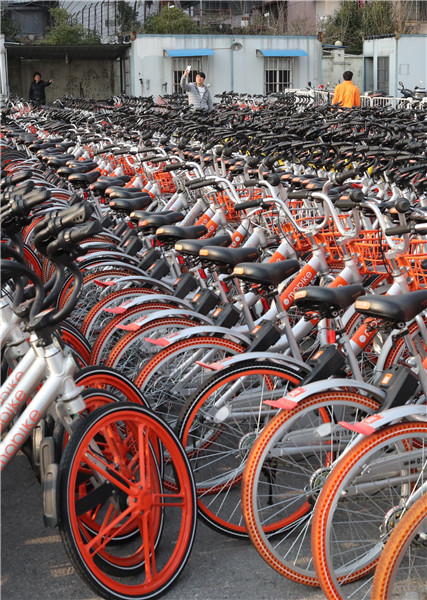
Illegally parked rental bikes seized

image_pdfimage_print

Bicycles, mostly from the bike-sharing company Mobike, were parked at a parking lot on Wednesday. [Photo/China Daily] 

Authorities in Shanghai’s Huangpu district have seized more than 4,000 rental bikes, most of them improperly parked, highlighting the poor management of bicycles rented over the internet and the shortage of parking areas, especially in downtown areas.

There are also concerns that the problems faced by Shanghai may quickly spread to other cities as competition intensifies.

At a parking lot on Zhizaoju Road, thousands of rental bikes were laid out in rows with their wheels connected by iron chains. Some web users described the venue as a graveyard of bikes.

Zhou Lan, deputy director of the urban management department of Huangpu, said the seizure serves as a countermeasure to fight illegally parked bicycles, instead of merely revenge on bike-sharing companies.

Zhou said that the regional government authorized two independent institutions to help with the proper parking of nonmotor vehicles, and to tow away those outside designated areas on sidewalks.

A small number of properly parked rental bicycles were seized to make way for other nonmotor vehicles.

It’s estimated that in Huangpu, there are about 150,000 nonmotor vehicles – more than half of them electric bikes. But there are less than 1,500 nonmotor vehicle parking lots in the district, while the number of rental bikes has surged to more than 20,000.

Citywide, it’s estimated that more than 280,000 rental bikes have been put on the streets. Guo Jianrong, secretary-general of the Shanghai Bicycle Association, said that by June, the city is expected to have 500,000 rental bicycles.

“The association is busy drafting three new sets of standards: the management standard for shared bicycles, for shared electric bikes and for their service providers,” Guo said.

But for the time being, the struggle between bike-sharing startups and the regional government is continuing as business leaders in the sector said they won’t reduce the number of bicycles in big cities.

“We will continue to put more bikes in operation in Shanghai, depending on user demand,” said a spokeswoman for Mobike, the pioneer and now dominant player in the bike-sharing sector.

She said that Mobike has a management team of about 100 in Shanghai, plus 400 front-line operators.

In a news release on Thursday, the company said that it is collaborating with Baidu by taking advantage of its cloud computing service to fix the accuracy of the position of its parked bikes, which will help with management of the bikes.

A reward plan is also in the pipeline to encourage users to park bikes properly, the company said. Regarding the seized bikes, Mobike said that it will communicate with the urban management department and is willing to cover some of the department’s management costs.

China outlines its positive sea role

image_pdfimage_print

Wang Guoqing, spokesman for the fifth session of the 12th National Committee of the Chinese People’s Political Consultative Conference, made the comment at a press conference. [Photo/Xinhua]

China values freedom and safety of navigation in the South China Sea more than any other country, a spokesman for the top political advisory body said yesterday.

Wang Guoqing, spokesman for the fifth session of the 12th National Committee of the Chinese People’s Political Consultative Conference, made the comment at a press conference, citing the fact that China was a major trading nation as well as the largest littoral country of the South China Sea.

Certain countries outside the region alleged China threatens freedom of navigation, an entirely “pseudo proposition,” he said.

Since China had recovered the South China Sea islands at the end of World War II, there had never been a problem with navigational freedom in the region.

The South China Sea islands are an integral part of China’s territory, Wang said, adding that it was “perfectly normal” for China to build facilities, including those for necessary defense purposes, on its own territory. International law entitled sovereign states to do so.

China, Wang reiterated, resolutely defended the freedom of navigation that every country enjoys in the South China Sea according to international law.

“We have set up cooperation mechanisms with many other countries to ensure safe navigation,” he said. The civilian facilities China has built on the South China Sea islands, such as lighthouses, had played a positive role in guaranteeing navigation safety and humanitarian rescue, Wang added.

He also said the Belt and Road Initiative was advancing steadily, bringing investment and jobs to participating countries.

More than 100 countries and international organizations had joined the initiative and over 40 of them had cooperation agreements with China, he said.

Chinese businesses had helped to build 56 economic and trade cooperation zones in 20 countries along the Belt and Road, with total investment exceeding US$18 billion, helping to generate over US$1 billion in tax revenue and more than 160,000 jobs.

Wang said the CPPCC National Committee would do more work in 2017 to promote cultural and people-to-people exchanges with countries along the Belt and Road. The initiative was proposed by China in 2013 and aims to become a trade and infrastructure network connecting Asia with Europe and Africa along ancient trade routes.

In the spirit of regional connectivity, China is working in aviation, power, rail, road and telecommunications projects with participating countries.

The CPPCC will open its annual session at 3pm today in Beijing, he said.

More than 2,000 members from different sectors across the country will discuss major political, economic and social issues concerning the country’s development during this year’s session, which is scheduled to conclude on March 13.

China to take first step for manned space outpost

image_pdfimage_print

China will launch a space station core module next year as the first step in completing the country’s first space outpost, a senior engineer with China Aerospace Science and Technology Corpsaid yesterday.

The core module of the space station, named “Tianhe-1,” will be launched on board a new-generation Long March-5 heavyweight carrier rocket, said Bao Weimin, director with CASC.

It will be followed by a series of launches for other components of the space station, including two space labs, which will dock with the core module in space, in the next four years or so, he said, adding that the space station will be completed around 2022.

Assembly of the core module has already been completed and tests are under way, said Bao.

Earlier reports said the new Chinese space station will initially be much smaller than the current International Space Station, which weighs 420 tons, but could be expanded for future scientific research and international cooperation.

With the ISS set to retire in 2024, the Chinese space station will offer a promising alternative, and China will be the only country with a permanent space station.

Bao said the Chinese outpost will function in orbit for “dozens of years,” and that it had been specially designed to be able to handle space debris.

“For the big pieces (of space debris), we could conduct evasive maneuvers, and for those measuring less than 10 cm in size, we just take the hit,” Bao said, adding that all key parts of the space station will be serviceable and replaceable.

He went on to say that the next five years will see some exciting advances in China’s space program.

In particular, the Long March-5 launch missions have been scheduled this year, including one that will take the Chang’e-5 lunar probe to the Moon in November and return with lunar samples.

Long March-5 is a large, two-stage rocket with a payload capacity of 25 tons to low-Earth orbit and 14 tons to geostationary transfer orbit, the largest of China’s carrier rockets. Its carrying capacity is about 2.5 times that of the current main model Long March carrier rockets.

The rocket will also be used in China’s planned Mars probes, and possibly future missions to Jupiter and other planets within the solar system, Bao said.