


Our February Blether will be on Tuesday 28th February – at 7pm in Madigan’s Food Emporium and Bookshop, Castle Street.
The theme this month is “Tales Frae Ower the Water.”
Hope to see some of you there – all welcome!
Feb242017
Feb242017
Innovate UK-supported life science company Phynova finds further evidence that its plant-based food ingredient promotes healthy blood sugar.
In a clinical trial run in conjunction with the University of Southampton and Oxford Brookes University, Phynova found clinical proof that its ingredient Reducose™ is effective at maintaining healthy blood glucose levels.
The study was funded through an Innovate UK grant. It demonstrated that Reducose™ could significantly suppress blood glucose and insulin rises after eating.
Reducose™ is a patented natural functional food ingredient. Derived from mulberry leaves, it can be incorporated directly into foods and drinks or used on its own in supplements to prevent sugar being absorbed by the body.
Dr. Mark Lown, lead author and clinical investigator, said:
It has been estimated that as much as a third of the UK population are prediabetic, where blood sugar levels are higher than normal but not high enough to be classed as diabetes. Excess calories from sugar and carbohydrate can increase the risk of developing diabetes.
The results of this study are positive and suggest that this herbal extract may have a role to play in regulating blood sugar levels. Further studies are required to evaluate the long-term effects.
The findings of the study are published on open access journal PLOS ONE and can be read for free.
Feb242017
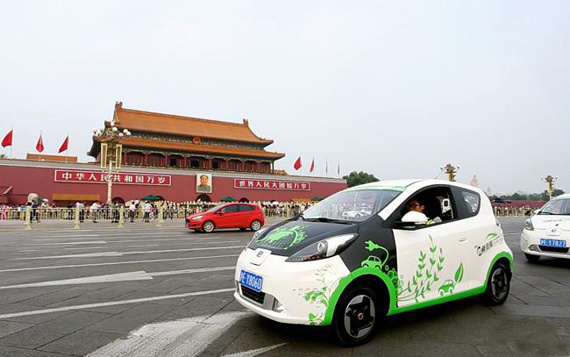
Beijing is aiming to gradually replace its petrol-powered taxis with greener new energy vehicles to help reduce air pollution starting from this year.
 |
|
A new engery car is on the road in Beijing. [File photo/ecns.cn] |
The plan is contained in a discussion document on preventing and solving air pollution problems in the Beijing-Tianjin-Hebei Region and neighboring provinces, which was issued on February 14, according to National Business Daily.
All petrol-and diesel-powered taxis being taken out of service would need to be replaced by electric or liquid petroleum gas (LPG) powered cars. Any vehicles that taxi companies plan to buy should be electric or other types of new energy cars.
Statistics show that Beijing currently has about 71,000 taxis in total, out of which 67,000 are conventionally powered, the National Business Daily reports.
It is estimated the market size would reach 9 billion yuan (about 1,309 million USD) if all the taxis in Beijing were replaced by electric or natural-gas-powered vehicles, according to National Business Daily.
Experts say once the plans in the discussion document implemented, it will not only contribute to the environment, but stimulate China’s new-energy vehicle industry.
However, it is not easy for green powered taxis to compete with traditionally powered ones at present, due to concerns over longer time needed on charging and the limited mileage of electric vehicles, says Liu Tao from the Beijing Taxi Cum Automotive Leasing Association
Purchasing a traditionally powered vehicle would generally cost between 60,000 yuan (about 8,725 USD) to 70,000 yuan (about 10,179 USD), but an electric vehicle would cost about 140,000 yuan (about 20,359 USD), Liu said.
But if the number of new energy vehicles is increased, that cost will go down, say Li Liangjin, CEO of CAOCAO, a Chinese travel service platform.
Feb242017
 |
|
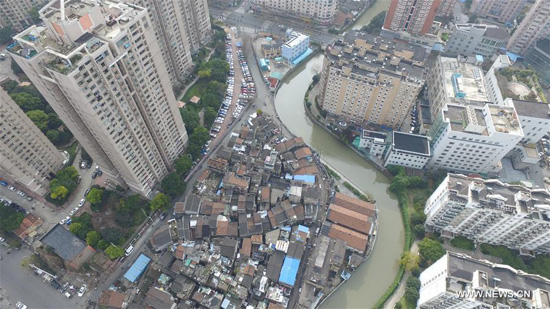
Aerial photo taken on Jan 9, 2017 shows view of Zhangqiao, one of the largest shantytowns, and surrounding estate in Hongkou district, East China’s Shanghai. [Photo/Xinhua] |
China will build 6 million new homes for residents of shantytowns before the end of 2017, said Chen Zhenggao, Minister of Housing and Urban-Rural Development, at a news briefing in Beijing on Feb 23.
The Chinese central government started a three-year project to rebuild urban shantytowns in 2015, aiming to construct a total of 18 million new homes in all. In 2015, construction began on 6.01 million new dwellings, and another 6.06 were started in 2016.
According to Chen, the Ministry of Housing and Urban-Rural Development (MHURD) kicked off this year’s shantytown transformation work on Jan. 16. The central government has provided 224.3 billion RMB in subsidies for the work in 2017, an increase of 15 billion RMB compared with last year.
China is determined to reconstruct all of its existing shantytowns by 2020. MHURD is working with relevant departments to conduct a thorough investigation and make the planned transformation a reality.
Feb242017
It has been fashionable to bash banks and bankers ever since the 2008 crash. Politicians have often been keen to criticise, as they enjoy finding a category of people more unpopular than themselves. The commercial banks were a useful whipping boy when there had been a monumental failure of monetary policy. The Regulators had allowed or encouraged the banks to expand credit and investment banking activity too far too fast, and had then sought to collapse the asset bubble and bank sheets too quickly when they changed their minds. They obviously wished to public to concentrate on the banks that failed to manage within this unreliable framework, rather than on those who had created a boom bust cycle.
Today the US banks are largely mended and capable of financing a reasonable recovery. The UK banks have much stronger balance sheets and have taken much of the pain for past bad loans and wrongful trading practices. RBS still struggles to make a profit and to put it itself in a strong enough position to return to the private sector. On the continent there are more weak banks.
A successful economy needs a group of competing commercial banks capable of offering low risk savings products to savers, and lending the money on to individuals and companies that can afford to borrow. The hatred of debt that is often manifest in many modern commentaries is unrealistic. A growing and flourishing economy needs some debt. Young people need to borrow to buy a home or to establish a business. They can repay the debts out of future earnings. Larger companies need to borrow to put in large scale modern plants to meet future demand. They can repay the debts out of future revenues and profits from the plants. Property companies need to borrow to put up good modern buildings, which they can let to other users in the society to pay off the borrowings.
Some worry about the overall level of debts. This should not be a reason to deny new borrowers who have plenty of unpledged income the opportunity to buy a home or capital asset on borrowed money. If 35-50 years olds have borrowed too much, there is no need to take it out on 20-35 year olds who may have good cause to borrow. If a government has borrowed too much – and the UK government has not – it need not prevent individuals and companies in that country borrowing more.
Mr Trump and his Treasury team are wanting to relax the credit creating banks a bit. That will be a healthy development. The US needs more investment in productive capacity, homes and infrastructure. There are companies and individuals who could afford to borrow to help do this. The UK too needs to ensure a sensible pace of additional private borrowing to continue a decent rate of economic growth.