8 dead, 35 injured in gas pipeline explosion in SW China

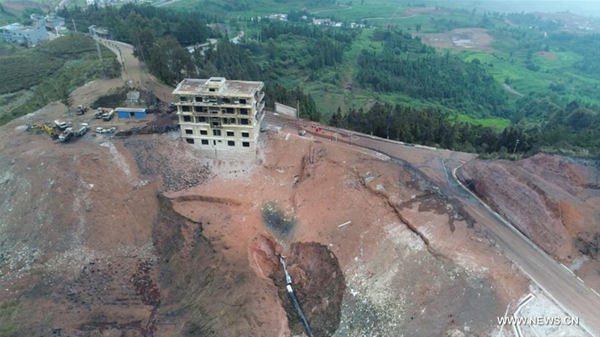
The site of a gas pipeline explosion is seen in Qinglong, southwest China’s Guizhou Province, July 2, 2017. [Photo/Xinhua]

At least eight people died and another 35 were injured in a natural gas pipeline explosion in southwest China’s Guizhou Province on Sunday, local authorities said.

The explosion occurred at around 10 a.m. in the town of Shazi, Qinglong County. The injured, including four in critical condition, have been sent to hospital for treatment, according to rescuers.

Days of heavy rain triggered a landslide, which crushed the pipeline operated by the China National Petroleum Corporation (CNPC) and caused gas leak and ensuing blast, according to the preliminary investigation.

The fire caused by the explosion was put out and residents nearby were evacuated, while further investigation continues, said the rescuers.

Bully victims learn to manage their emotions

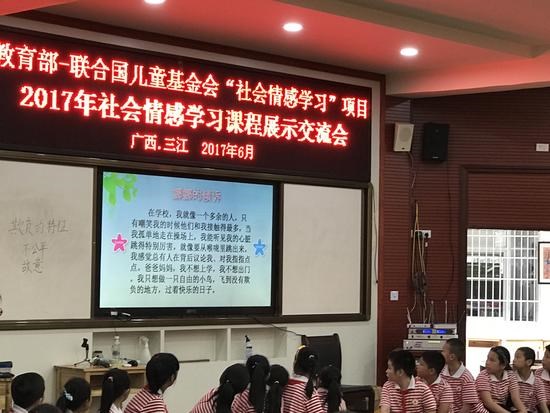
A social and emotional learning (SEL) class is given to students at Sanjiang Ethnic Experimental School in Sanjiang Dong Autonomous County. [Photo/Xinhua]

At a school in south China’s Guangxi Zhuang Autonomous Region, several children shed tears as they share their experience of being bullied.

“He broke my pencil without any reason, punched me, and gave me a bloody nose after I asked him to pay for my pencil,” a fourth-grader recalls.

The boy takes off his glasses, briefly wipes his tears then bursts out crying again. His teacher walks over and gives him a hug.

The class at Sanjiang Ethnic Experimental School in Sanjiang Dong Autonomous County is called social and emotional learning (SEL). It is a joint project run by the Ministry of Education and UNICEF.

SEL is about helping students develop skills such as self-recognition and confidence, understanding and managing emotions, and maintaining positive relationships with others. “Say ‘no’ to bullying” is one of the topics.

During the course, Zhou Lihong, the teacher, tells a story of an imaginative but introverted girl’s long-term bullying and asks students for ways they would help the girl.

Some suggest making friends with her, some advise her to turn to teachers or parents for help, someone suggests “an eye for an eye.”

“Bullying is constant and intentional, initiated by the stronger against the vulnerable. We should learn to protect ourselves, and meanwhile, never bully others,” Zhou tells the children.

UNICEF educationalist Guo Xiaoping says that since launch of the SEL project in 2013, the number of participating schools has increased to over 500.

These schools are mainly in less-developed middle and western parts of the country, said Guo.

“With the support from local education authorities and experts, some schools that are not included into the pilot have also joined in,” she said.

Wu Xinyun, head of the primary section at the Sanjiang school, says students receive an SEL lesson every two weeks, using textbooks provided by the project.

“We have found there is less physical conflict among the children,” she said.

Each class has around 60 students, more than the advised national maximum of 45. “Physical contact is very frequent in the classroom, and often led to fights in the past. SEL helps students understand each other, so brawls are much more infrequent,” Wu said.

Guo says a study of US primary and high schools and kindergartens in 2011 found SEL participants did 11-percentage points better than control groups.

Wei Jiaqi, 12, has drawn a picture of a classmate holding an umbrella for her in rain. She names the drawing, “Thanks for caring about me.”

“I was upset as my mom had scolded me that day. It was my classmate who kept me company,” she says.

“I changed my girl pal into a boy, because drawing a boy is easier,” she says, adding that they like the SEL courses very much.

Li Fuzhuo, head of teacher education at Guangxi Normal University, said SEL is meant to create an atmosphere in which students feel, experience, think and acquire the related skills. Competent teachers are vital.

To address this issue, the ministry and UNICEF organize training and demonstration courses for school heads and teachers.

The project also encourages parents to participate and the team is compiling articles about SEL to be released via the UNICEF WeChat account.

In this way, parents, especially migrant workers who have left their children behind, will be able to join in the SEL project.

Huang Guizhen, an official at the education ministry, believes SEL not only improves teaching competence, but enables vulnerable groups, such as left-behind children, to feel more care and love from school and the family.

“We want to expand the project to more schools, so that more children benefit from it,” she said.

Aircraft carrier fleet to visit HK for anniversary

Aircraft carrier fleet to visit HK for anniversary [File Photo/Xinhua]

A port call in Hong Kong by China’s aircraft carrier fleet to mark the 20th anniversary of the People’s Liberation Army Hong Kong Garrison has been described by experts as a sign of good will and firm determination.

The fleet, which is on a routine training mission at sea before the port call, is expected to arrive early this month and be open to the public for the first time during its stop in Hong Kong to mark the anniversary, which fell on Saturday, Liang Yang, a spokesman for the PLA Navy, said on Sunday.

The formation comprises the CNS Liaoning, China’s first aircraft carrier; the CNS Jinan and CNS Yinchuan missile destroyers; the CNS Yantai missile frigate; and J-15 carrier-borne fighter jets and helicopters.

By participating in the anniversary celebrations, the PLA Navy can demonstrate its achievements in defense and military construction to the Hong Kong people, Liang said.

This will further invigorate Hong Kong compatriots’ patriotism and love for the city, and inspire national spirit, he added.

The garrison was formally stationed in Hong Kong and assumed defense duties on July 1, 1997, when its sovereignty was returned to China from the United Kingdom.

It currently has about 6,000 personnel and is commanded by Lieutenant General Tan Benhong.

Major General Ma Gang, a professor at the PLA National Defense University, said the fleet’s visit demonstrates the PLA Navy’s good will, and showcases its firm determination and capability to protect all Chinese people.

“Hong Kong was taken from China by foreign colonial powers in the 1840s, and the Qing government could do little about it because its naval forces were weak,” Ma said.

“Now, China has its own aircraft carrier fleet, and its visit to Hong Kong signals a strong sense of reassurance that Hong Kong cannot be taken away again.”

Chen Xingxin, a researcher of law and Hong Kong affairs at the Chinese Academy of Social Sciences, said it is understandable and in good will that the carrier fleet is visiting Hong Kong for the anniversary, because both the carrier and the return of Hong Kong are proud milestones in Chinese history.

The CNS Liaoning is a refitted Soviet-era vessel that was commissioned by the PLA Navy in 2012. China also launched its first domestically built aircraft carrier in April.

Long March 5 rocket fails after launch

The flight of China’s latest heavy-lift carrier rocket, the Long March 5-Y2, failed on Sunday evening when an anomaly occurred after its 7:23 pm blastoff from Wenchang Space Launch Center in Hainan province.

Experts are working to discover exactly what happened.

The Long March 5, China’s largest rocket to date, made its maiden flight in November, sending its payload into a preset orbit. The Y2 designation of Sunday’s rocket signifies the second in the series.

News story: Billion pound connectivity boost to make buffering a thing of the past

Brits will soon see the back of internet buffering and painfully slow download times, following the launch of a new fund today, which will support the rollout of cutting-edge connections across the country.

The government’s £400 million Digital Infrastructure Investment Fund (DIIF) will unlock over £1 billion for full fibre broadband, and kick-start better broadband connections across the country.

Ministers seek to revolutionise Britain’s digital infrastructure, making internet access more reliable for homes and businesses, and enabling more people to work remotely without disruption. The flexibility to work remotely is pivotal for driving our economy forward; reducing overheads and helping businesses to start and grow.

The government has already invested £1.7 billion to spur industry to rollout superfast broadband across the UK. This new fund will take that to the next level.

Launching the fund during a visit to Peterborough today, the Exchequer Secretary to the Treasury Andrew Jones MP will say:

We are investing £400 million to make sure the UK’s digital infrastructure is match-fit for the future. As technologies change and people’s habits move with them, it is crucial we play our part to ensure Britain stays at the front of the pack.

Gone will be the days where parents working from home see their emails grind to a halt while a family member is gaming or streaming Game of Thrones in the next room. Full fibre will provide us with the better broadband we need to ensure we can work flexibly and productively, without connections failing.

Further Information

This investment, announced at Autumn Statement 2016, will be in addition to the government’s £23 billion National Productivity Investment Fund aimed at improving productivity, which is key to raising living standards.

Traditionally in Britain, full fibre has been difficult to finance because the industry is relatively young and a lack of certainty around future demand makes investment hard to secure. This has held back alternative providers from entering the market and consumers have been left with limited choice, which in turn, has restricted their ability to benefit from this latest technology.

The fund, which is expected to more than double the government’s £400 million investment, and unlock over £1 billion of capital in the sector, will be managed and invested on a commercial basis by private sector partners, generating a commercial return for the government. It will ignite interest from private finance to invest in the sector, resulting in more alternative providers entering and expanding in the market.

Britain’s homes are mostly connected to the internet via underground copper wires to a green cabinet on the street. Full Fibre networks seek to run fibre connections straight to the doors of customers’ homes or businesses, via laser light flashes through glass or plastic tubes, making broadband stronger and more consistent. Unlike broadband run through copper wires which can be degraded by distance or the number of people accessing the internet at any one time, full fibre networks are much more resilient.

Peterborough was the winner of Smart City of the Year at the 2015 World Smart City Awards. It has a 120 km full fibre network, built by an independent network builder and operator, CityFibre, following a successful demand aggregation campaign, which saw 25% of the city’s businesses register an interest and enabled the network to be extended to all 6 of Peterborough’s business parks. Currently 300 sites of sites in Peterborough, including schools and hospitals, have been connected to the network. 4,000 businesses also have access.

With the Peterborough core network established and successful, benefiting from a motivated local authority and demand aggregation, the city is now a prime candidate for further extension of the network to residential areas, which the DIIF could help finance.

Two leading infrastructure investment firms have been appointed to manage the fund. Amber Fund Management Limited, part of the Amber Infrastructure Group, and M&G Investments, part of Prudential PLC. M&G Investments includes Infracapital, who have partnered with Cameron Barney; and M&G’s infrastructure debt team.

The government has worked closely with industry to create this fund, which by catalysing private sector investment will become self-sufficient.

Speaking on their roles as fund managers, John Mayhew, M&G Investments, says:

We are pleased to be working with HM Treasury in order to play our part in delivering world class, high-speed broadband infrastructure in the UK. This approach ensures that Britain is ready for the future and brings benefits to families and businesses across the country who rely on fast and greater connectivity, as well as ordinary savers through the returns generated for their pension funds.

Giles Frost, Amber Infrastructure:

We are delighted to be partnering with HM Treasury and look forward to helping the community of businesses building the next generation of digital networks to scale up and accelerate the rollout of ultrafast connectivity across the UK. Amber will apply its experience in implementing core economic and social infrastructure projects alongside public sector partners to deliver this landmark initiative.

Ed Clarke, Infracapital:

High-speed broadband is an essential ingredient in driving the competitiveness of the UK. Infracapital has already made significant investments in the sector, both in the UK and Europe, and we are delighted to be working with HM Treasury on this hugely important initiative, in partnership with Cameron Barney.

Those who are interested in accessing the fund are encouraged to contact the Fund Managers directly, who will be able to advise on how the investment process will work.