SW China earthquake affects 15,000 people

image_pdfimage_print

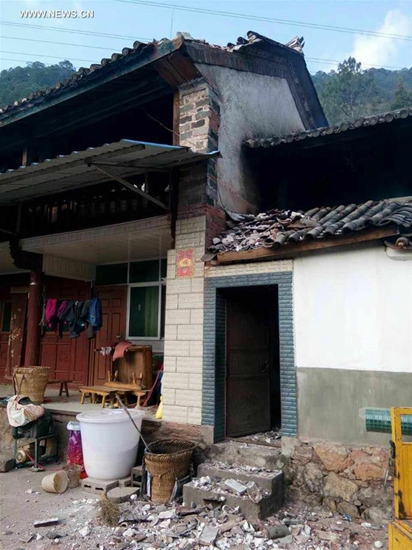
Photo taken on March 27, 2017 shows damaged houses at quake-hit Puping Village of Yangbi County in southwest China’s Yunnan Province. [Photo/Xinhua]

A magnitude 5.1 earthquake that hit southwest China has affected the lives of 15,786 people, according to the latest government tally.

The tremor jolted Yangbi County in Yunnan Province at 7:55 a.m. Monday.

One person was injured by falling tiles, and has been treated in time.

Damage was reported in eight townships under Yangbi. Houses collapsed, cracks appeared on walls, while schools, dams, and water facilities were also impaired. The local government said the lives of 2,105 people in 469 households were seriously affected.

Economic loss of the quake was initially estimated at 202 million yuan (29 million U.S. dollars).

The epicenter, at depth of about 12 km, was monitored at 25.89 degrees north latitude and 99.8 degrees east longitude, according to the China Earthquake Networks Center. Four tremors measuring 3 to 4.7 on the Richter scale hit the same region before and after the magnitude 5.1 quake.

A multi-sector rescue team, which include firemen, armed police and disaster relief personnel are working at the quake zone.

The first batch of relief goods including 50 tents, 300 quilts, 100 overcoats, 100 cartons of food, 500 kilograms of rice are on the way to the area.

Beijing offers free green burials for the first time

image_pdfimage_print

People place flowers on a lawn for the deceased in Chaoyang District’s Changqing Cemetery.

Beijing held a “natural burial” ceremony to inter ashes of 31 deceased persons on March 25, officially providing a free method of the burial for the first time.

The deceased would rest in the lawn of Chaoyang District’s Changqing Cemetery, with their ashes placed into a biodegradable container, which will dissolve in about six months. The ashes will become part of the soil. The public need not pay if choosing this method of interment.

The cemetery can house 15,000 caskets, equaling ten urns per square meter, which helps to restore hundreds and thousands of acres used for traditional cemeteries.

Relatives who choose the lawn burials can obtain bronze commemorative plaques engraved with the person’s name and a QR code.

Upon scanning the code, one can view online the person’s photos, videos, biography, family tree and leave condolences in a message section.

In 2016 Beijing organized 61 sea-burial funerals, which is also free, for the cremated remains of 2,456 deceased persons.

News story: New £1 coin becomes legal tender

image_pdfimage_print

The new £1 coin becomes legal tender from today.

This is the first new £1 coin to be introduced in more than 30 years and will be the most secure of its kind in the world – highlighting the UK’s position as a world leader in innovation.

The new coins are being produced by The Royal Mint, in South Wales, at a rate of up to four million per day. The public can now expect to find them in their change in the coming days and weeks.

Around 1.5 billion new £1 coins are being produced by The Royal Mint and these will be distributed to banks and retailers over the next 6 months. Round £1 coins will be returned to The Royal Mint – some of which will be reused to make the new coin.

Commercial Secretary to the Treasury Baroness Neville-Rolfe said:

This is a giant step forward to help stamp out counterfeit coins and save businesses and the taxpayer millions of pounds every year.

Today marks the start of the six-month transition period, so I’d urge everyone to make sure they spend, return or donate their old round pounds before 15 October. We have been working hard with businesses over the last three years to help make this changeover as smooth as possible.

Adam Lawrence, chief executive of Royal Mint, said:

It’s an historic day for UK coinage, and one that The Royal Mint has been working towards, together with businesses and industry, for a number of years. From today, the public will start to encounter for themselves the most innovative and secure coin ever produced by The Royal Mint.

It’s been designed to be fit for the future, using security features that aim to safeguard our currency, and currencies around the world, for years to come. Staying ahead of sophisticated counterfeiters remains a constant challenge and this coin helps in that battle.

David Smith, Head of Public Affairs and Research at the British Parking Association, said:

The BPA has been working closely with The Royal Mint and HM Treasury to ensure that its members, who include local authorities, parking operators, and parking machine manufacturers, are ready to accept the new £1 coin wherever possible at launch. Most of the major parking machine manufacturers are positive they will be able to manage the upgrade in a timely manner, having begun upgrades over 12 months ago.

Evidence suggests a significant number of motorists prefer using cash and they should feel confident that they can pay for parking wherever they choose to park when the new £1 coin is launched.

The Royal Mint and HM Treasury have been working with businesses for the past three years to help them prepare for the change. Although many will have upgraded their machines to accept the new coin from 28 March, not all machines will accept the new coin from the date of introduction.

The new 12-sided £1 is highly secure and looks very different. New security features on the one pound coin include a hologram-like image that changes from a ‘£’ symbol to the number ‘1’ when the coin is seen from different angles. It also has micro-lettering and milled edges.

Further information

It is important that all round £1 coins are returned before 15 October 2017 when they lose their legal tender status. People will still be able to return old coins to their bank after this time.

Businesses, as well as members of the public, wishing to find out more information about the support on offer should visit the official new £1 website

Press release: PM meeting with the Prime Minister of Qatar: 27 March 2017

image_pdfimage_print

The Prime Minister welcomed His Excellency Sheikh Abdullah Bin Nasser Al Thani, Prime Minister of Qatar, to Downing Street this afternoon for a bilateral meeting.

Prime Minister May welcomed the close relationship between the two countries. And she reiterated the commitment she made at the Gulf Cooperation Council Summit in December to step up the UK’s relationship with the Gulf.

They discussed our growing trade and investment partnership, and agreed that the Qatar-UK Business and Investment Forum taking place in London and Birmingham this week will provide opportunities to deepen these ties.

They also agreed on the importance of our security cooperation, and committed to strengthening our collaboration on cyber security and defence.

Finally, they discussed regional issues, and the importance of securing lasting political settlements in Syria and Yemen, while ensuring humanitarian assistance reaches those in need.

They ended by looking forward to the Gulf Cooperation Council Summit to be hosted by the UK later this year.