Starving children in famine-facing countries threatened by lack of water, sanitation – UN agency

image_pdfimage_print

29 March 2017 – In African and Middle Eastern countries facing famine, unsafe water is as dangerous for severely malnourished children as lack of food, the United Nations Children’s Fund (UNICEF) today warned, noting that nearly 27 million people are at risk in northeast Nigeria, Somalia, South Sudan and Yemen.

&#8220Unsafe water can cause malnutrition or make it worse, no matter how much food a malnourished child eats, he or she will not get better if the water they are drinking is not safe,&#8221 said Manuel Fontaine, UNICEF Director of Emergency Programmes.

The UN agency is warning that a combination of malnutrition, dirty water and poor sanitation sets off a vicious cycle from which many children never recover.

In northeast Nigeria, where the fight on Boko Haram damaged or destroyed 75 per cent of water and sanitation infrastructure, some 3.8 million people have no access to safe water, according to UNICEF.

In Somalia, about one-third of the population is expected to need access to water and sanitation in the coming weeks, according to the UN agency, pushing the current needs from 3.3 million to 4.5 million of people.

Some 5.1 million people lack safe water, sanitation and hygiene in South Sudan, where half of the water points in the country have been damaged or destroyed.

The fighting in Yemen has displaced at least 14.5 million people, leaving them without basic sanitation and adequate drinking water, UNICEF cautioned. According to the latest figures, almost 2 million children are at risk of diarrheal diseases which, even before the conflict, were the second leading cause of death among children under the age of five.

UNICEF is working with other UN agencies, national authorities and local partners to provide safe water and sanitation to children.

&#8220But without an end to the conflicts plaguing these countries, without sustainable and unimpeded access to the children in need of support and without more resources, even our best efforts will not be enough,&#8221 Mr. Fontaine said.

UN chief confirms the remains found in DRC those of the two missing experts

image_pdfimage_print

29 March 2017 – United Nations Secretary-General António Guterres has confirmed the deaths of Michael Sharp and Zaida Catalan, two members of the Group of Experts on the Democratic Republic of the Congo who had been missing since 12 March, and vowed that the Organization would do &#8220everything possible&#8221 to ensure that justice is done.

In a statement late yesterday, the UN chief expressed his deepest condolences to the families, loved ones and colleagues of Mr. Sharp (United States) and Ms. Catalan (Sweden) and said that the Organization will honour their memory by continuing to support the work of the Group of Experts and the whole UN family in the DRC.

&#8220Michael and Zaida lost their lives seeking to understand the causes of conflict and insecurity in the DRC in order to help bring peace to the country and its people,&#8221 said Mr. Guterres.

He also called on the national authorities to continue to search for the four Congolese nationals who were accompanying the experts and said that the UN would cooperate with them in the continuing search.

Also in the statement, the Secretary General underscored that the UN will conduct an inquiry into the deaths.

&#8220In case of criminal acts, the UN will do everything possible to ensure that justice is done,&#8221 he stressed.

Mr. Guterres also expressed hope that the cause of their deaths will be determined following a thorough examination and that the Congolese authorities will conduct a full investigation into the incident.

On Monday, peacekeepers from the UN Mission in the country (MONUSCO) discovered the two experts’ remains outside the city of Kananga in the DRC’s Kasaï-Central province.

The Group of Experts on the DRC has been supporting the work of a Committee established by the Security Council to oversee sanctions measures, including arms embargo, travel ban and assets freeze imposed upon armed groups in the country.

Shanghai court sentences man for stealing shared bike

image_pdfimage_print
Bike-sharing reinvigorates manufacturers [Xinhua]

Shanghai court sentences man for stealing shared bike. [Photo/Xinhua]

A man has been sentenced to four months for stealing a bike in Shanghai. The convict surnamed Tao stole the bicycle of a bike-sharing company from the roadside and carried it home on a tricycle where he used a saw to cut the lock on Dec 25. The shared bike was valued at 2,265 yuan ($329.31).

The Jinshan District People’s Court sentenced him for four months with five-month probation and fined him 2,000 yuan.

Tao, who was summoned by police on Dec. 28, confessed to his crime. “It’s all because of greed. I saw that the bike was parked on the side of the road for nearly 15 days and I decided to take it home,” he said.

In December, Shanghai Minhang District People’s Court sentenced a man surnamed Han for three months with three-month probation and a fine of 1,000 yuan for stealing a shared bike in September.

In Xiamen, a woman was ordered 10 days detention for painting a yellow shared bike blue in an effort to hide its ownership and keep it illegally.

Migrants’ children face school issues

image_pdfimage_print

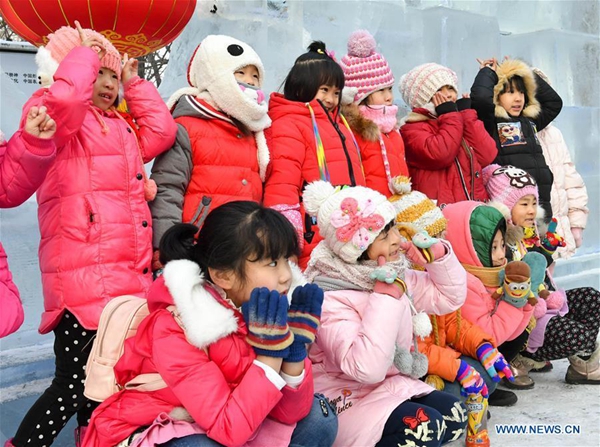
Children of migrant workers visited Zhaolin park during the 43th Harbin ice lantern carnival in January this year. [Photo/Xinhua]

More than 2 million children of migrant workers are unable to enroll in public primary or junior schools in the cities where their parents live, according to a report.

The Blue Book of Migrant Children, released on Tuesday by the Beijing-based 21st Century Education Research Institute, said that only 80 percent of migrant children who qualify for nine-year compulsory education as of 2014 could attend public schools where their parents live.

Others had to turn to private schools or ones set up specifically for migrant workers’ children, which are usually poorly constructed and of low educational quality.

The report showed that the migrant population reached 250 million in October 2015, which means more than one in six citizens work and live outside their hometown.

A previous report released in 2014 by New Citizen Program, a nongovernmental organization dedicated to improving the lives of migrant children, showed that the number of migrant children has increased rapidly.

In 2000, there were 19.8 million migrant children under 18 years old nationwide, while that number grew to 35.8 million in 2010.

“These children’s living conditions and education should receive more attention, as the country is working toward the goal of building a moderately well-off society,” said Xie Shouguang, director of Social Sciences Academic Press, which published the blue book.

Qin Hongyu, a researcher with the 21st Century Education Research Institute, said migrant children’s education has been greatly improved since 2008, as the central government and local authorities have introduced a series of policies to overcome barriers that they face.

In particular, a national plan on urbanization released by the central government in March 2014 stipulated that financial support and teaching resources should be offered to enable most children of migrant workers to receive compulsory education at public schools in the cities where their parents work.

“But more should be done because migrant children still face a lot of barriers when entering other education levels – preschool, high school and higher education,” Qin said.

Entry into higher education, for example, requires students to take the national college entrance examination. But according to current policies, as migrant children don’t have permanent residence permit in the city where their parents work, they have to return to their hometown to take the exam, even though they may have been studying in the city since they were very young.

Although some regions started working to solve the problem in 2012 by issuing policies to help the children take the exams without going back to their hometowns, only very few children met the requirements and were able to do it, said Xiong Bingqi, deputy director of the research institute.

China welcomes more job-seeking foreign graduates

image_pdfimage_print

Four months before getting his Master’s degree in computer science, Irish student Gareth Lacey got a job offer from a Chinese tech start-up in Beijing’s equivalent of Silicon Valley.

It might not sound like a big deal to a science postgraduate student in Beijing, but the offer did not come easily.

China only recently dropped the work experience requirement for foreign postgraduates, opening a floodgate of opportunities, especially to foreign students pursuing higher education degrees in China.

It had been almost impossible for foreign students to be employed right after graduation. Two years of work experience were mandatory in most cases, Beijing-based foreign students said.

Lacey, who has been studying at Beijing Institute of Technology, will be among the first to benefit.

He described the policy as a “welcome change” for himself and many foreign graduates in similar positions.

According to a January circular issued by Ministry of Human Resources and Social Security, Ministry of Foreign Affairs, and Ministry of Education, foreign students with a postgraduate degree or higher from Chinese or “well-known” foreign universities can be offered employment within a year after graduation.

Applicants should be healthy, have no criminal record, obtain a B grade average (or 80 out of a 100-point scale), have a job offer related to the major of study and with an income no lower than the local average.

Successful applicants will be given a one-year work permit, which can be extended to no more than five at renewal.

Lacey said the Chinese job market is a big draw for foreign job-seekers due to competitive salaries and relatively low living costs.

With its rapid development, China’s market has more to offer foreign job-seekers. Typical jobs for expatriates used to be language teachers, multinational executives, and foreign mission staffers, but the range is widening quickly.

Figures on the number of foreign employees in China are not always available. It was estimated that in the first decade of this century, the number of foreigners working in China grew three times to 220,000, according to the Ministry of Public Security, which oversees immigration affairs.

Lacey said that with the new policy, he suspects there will be a large increase in recent graduates seeking work in China.

“I found it hard to understand in the past that multiple scholarships were offered to foreign students to study in China, but after graduating, they had to leave,” he said.

Chinese universities began aggressively enrolling foreign students in 2010. The amount of scholarships has been increased over the years.

The country aims to become Asia’s top destination for international students by 2020, targeting 500,000 foreign students enrolled per year by then.

The Beijing-based think tank Center for China and Globalization estimates that about 398,000 foreign students came to study in China in 2015.

Wang Ying, director of the international student office under Beijing Institute of Technology, said Beijing’s Zhongguancun hi-tech zone had actually started piloting the policy last year and it was well received.

Postgraduates jumped at the opportunity, Wang said. Last year, his school organized eleven job affairs for international students. Each was full packed. Tech giants like Huawei were among the hiring firms.

“Many of our students were thrilled. They told me they wanted to learn Mandarin and work in China,” Wang said.

The appeal of a Chinese job is not confined to metropolises like Beijing, Shanghai, and Shenzhen.

There is enthusiasm in mid-level and even smaller cities.

Ayaz Ali, a Pakistani Ph.D. candidate studying at Northwest Institute of Eco-Environment and Resources under the Chinese Academy of Sciences, said it was his dream to work in the northwest city of Lanzhou.

Ali said other than participating in the world’s leading cryospheric research, he finds the local culture accommodating to Muslims like him. The province of Gansu, where Lanzhou is located, has a relatively large Muslim population, and Islamic rituals and practices are observed.

Ali said many Pakistani students come to study in China, but until now few have been able to stay on after graduation, which remains a cause of concern among Pakistani students in China.

“After all, it is also very hard to find a good job back home,” he said.

Ma Xiaolei, director of the international student affairs office at Beijing Language and Culture University, said lowering the employment threshold for foreign students serves the strategy to reinvigorate China through human resources development.

He said foreign employees will help Chinese enterprises gain an advantage as they expand overseas, and it is logical for foreign graduates of Chinese universities to put to use what they learn in school.

To open its market, China has also been easing the residence and entry policies for foreigners.

Last year, 1,576 foreigners obtained permanent residence in China, rising 163 percent over the previous year. Foreigners with permanent residence will enjoy the same rights as Chinese citizens in areas such as investment, housing purchases and schooling, among other rights.