'Alarming' rise in use of children in 'suicide' attacks by Boko Haram in Lake Chad region – UNICEF

image_pdfimage_print

12 April 2017 – The use of children, particularly girls, by the Boko Haram terrorist group in violent attacks in the Lake Chad region has seen an &#8220alarming&#8221 surge in 2017, the United Nations Children’s Fund (UNICEF) has reported.

According to the UNICEF report, Silent Shame: Bringing out the voices of children caught in the Lake Chad crisis, 27 children have been used to carry out bomb attacks in public places across Nigeria, Chad, Niger and Cameroon in the first quarter of this year. During the same period last year, the number was nine.

&#8220In the first three months of this year, the number of children used in bomb attacks is nearly the same as the whole of last year &#8211 this is the worst possible use of children in conflict,&#8221 the UNICEF Regional Director for West and Central Africa, Marie-Pierre Poirier, said in a news release announcing the grim findings.

&#8220These children are victims, not perpetrators. Forcing or deceiving them into committing such horrific acts is reprehensible.&#8221

Since 2014, 117 children &#8211 more than 80 per cent of them girls &#8211 have been used in ‘suicide’ attacks across the region. As a result of this distressing tactic, girls, boys and even infants have been viewed with increasing fear at markets and checkpoints, where they are thought to carry explosives.

Fear of stigma pushing children into isolation

The UNICEF report documents troubling accounts by children who were held in captivity by Boko Haram and narrates the deep suspicion they are met with when they return to their communities.

[Children] bear their horrors in silent shame and endure isolation as they remove themselves from other groups for fear they might be outed and alienated even furtherUNICEF report Silent Shame

&#8220Many children who have been associated with armed groups keep their experience secret because they fear the stigmatization and even violent reprisals from their community,&#8221 the report noted. &#8220They bear their horrors in silent shame and endure isolation as they remove themselves from other groups for fear they might be outed and alienated even further.&#8221

The report also highlights the challenges local authorities face with children who have been intercepted at checkpoints and taken into administrative custody for questioning and screening, including for prolonged periods.

VIDEO: Surge in girls being used in Boko Haram ‘suicide’ attacks / UNICEF

Voicing concern over such custodies and that, last year, nearly 1,500 children were under administrative custody in the four countries, UNICEF has called on Governments to urgently transfer them to civilian authorities for reintegration and support, and to put in place handover protocols to handle children encountered during military operations.

&#8220All children affected by the crisis need psychosocial support and safe spaces to recover,&#8221 said UNICEF, highlighting the particular need to pay attention to the care and protection of separated and unaccompanied children.

It also underlined that Boko Haram must end grave violations against children, including the recruitment and use of children in armed conflict as so-called &#8220suicide bombers&#8221.

At the same time, UNICEF continues to provide support to the children and families.

Last year, it reached more than 312,000 children with psychosocial support and reunited more than 800 children with their families in the four countries. It is also working with communities and families to fight stigma against survivors of sexual violence and to build a protective environment for former abducted children.

However, its response in the region remains severely underfunded. Last year, its $154 million appeal was only 40 per cent funded.
Engineering firm fined after worker crushed in machinery

image_pdfimage_print

Moy Park Ltd has been fined after a worker was injured at the company’s site in Anwick near Sleaford, Lincolnshire

Lincoln Crown Court heard on the an engineer was checking the blades on the cutting line when the machine restarted and he wasn’t able to move his hand away from the blade he was inspecting when the machine started up. The worker suffered deep laceration to his hand as a result of this incident.

An investigation by the Health and Safety Executive (HSE) found the company failed to implement a safe system of work in relation to isolating procedures when maintaining the machinery in the production line.

Moy Park Ltd of Main Road, Anwick, Lincolnshire have pleaded guilty to breaching Section 2 (1) of the Health and Safety at Work Act 1974 and have been fined £200,000 and ordered to pay costs of £11,924.

Speaking after the hearing HSE Principal Inspector David Butter said: “Duty holders must put measures in place to ensure there are safe procedures in place which are then followed when checking faults on machinery.”

Notes to Editors:


  1. The Health and Safety Executive (HSE) is Britain’s national regulator for workplace health and safety. It aims to reduce work-related death, injury and ill health. It does so through research, information and advice, promoting training; new or revised regulations and codes of practice, and working with local authority partners by inspection, investigation and enforcement. www.hse.gov.uk
  2. More about the legislation referred to in this case can be found at: www.legislation.gov.uk/
  3. HSE news releases are available at http://press.hse.gov.uk

Journalists should approach HSE press office with any queries on regional press releases.

New lease of life for town centre Inns

image_pdfimage_print

Plas yn Dre, Bala has been a family run restaurant since 1990 but has undergone a transformation in 2017 with a complete re-vamp and the addition of 9 Guest Bedrooms, with support of £72,000 from the Tourism Investment Support Scheme.

The Grade II listed building is now fully open for Easter with a restaurant, lounge and bar area. The main works were to convert the upper 2 floors into the 9 en-suite bedrooms.  Having opened the restaurant for the Mother’s Day in March, owner Sion Williams is delighted with the feedback to date and is looking forward to a busy season, he said: 

“The finished article far exceeds our expectations and the customer feedback is unbelievable with rooms being sold out for much of the Easter weekend.”

The Erskine Arms in Conwy will open in May, following a redevelopment which will see the historic inn transformed to include a restaurant and 10 high quality rooms.  The redevelopment of this traditional Georgian Coaching Inn has been supported by the Tourism Investment Support Scheme with £140,000 and will create 23 jobs. 

The Erskine is owned by Stange & Co. Ltd who also own The Cottage Loaf and The Snowdon in Llandudno and The Glengower in Aberystwyth. Stange & Co. Ltd. is a family owned group of character pubs and inns independently run and focus on homemade hearty food on their menu along with local cask ales at the bar.  There will be a strong emphasis on both local and seasonal produce throughout the menu. 

Economy Secretary, Ken Skates, said: 

“I’m delighted that we’ve been able to support the redevelopment of these two traditional Inns.  It’s fantastic that they’ve been given a new lease of life and transformed to become a very high quality product providing employment for the area.  Both are also at the heart of the town in Bala and Conwy – which adds to the appeal and vibrancy of the towns.  I wish both developments the very best for future success.”

News story: World War 1 soldiers finally honoured after over a century

image_pdfimage_print

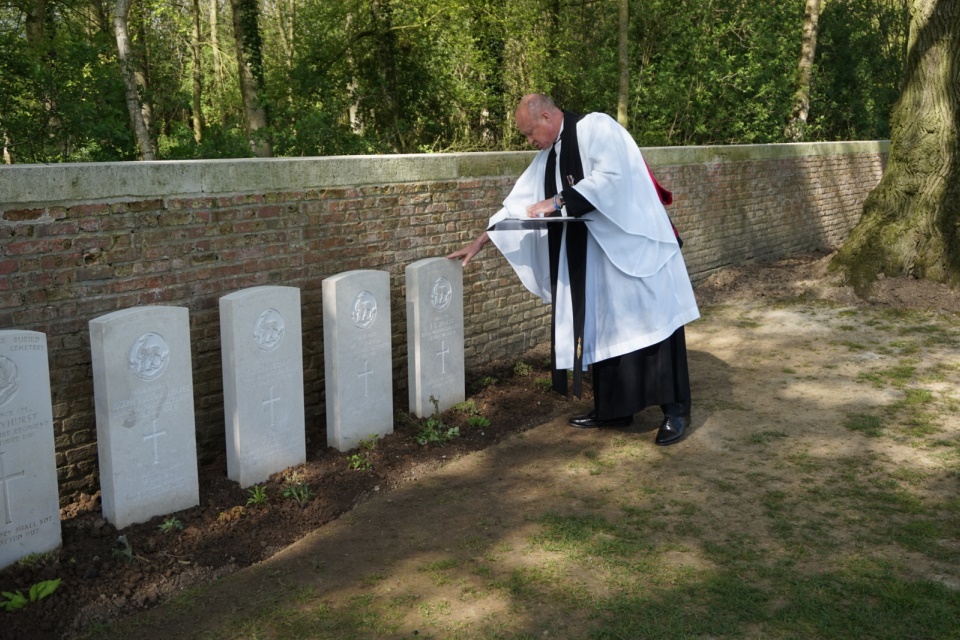
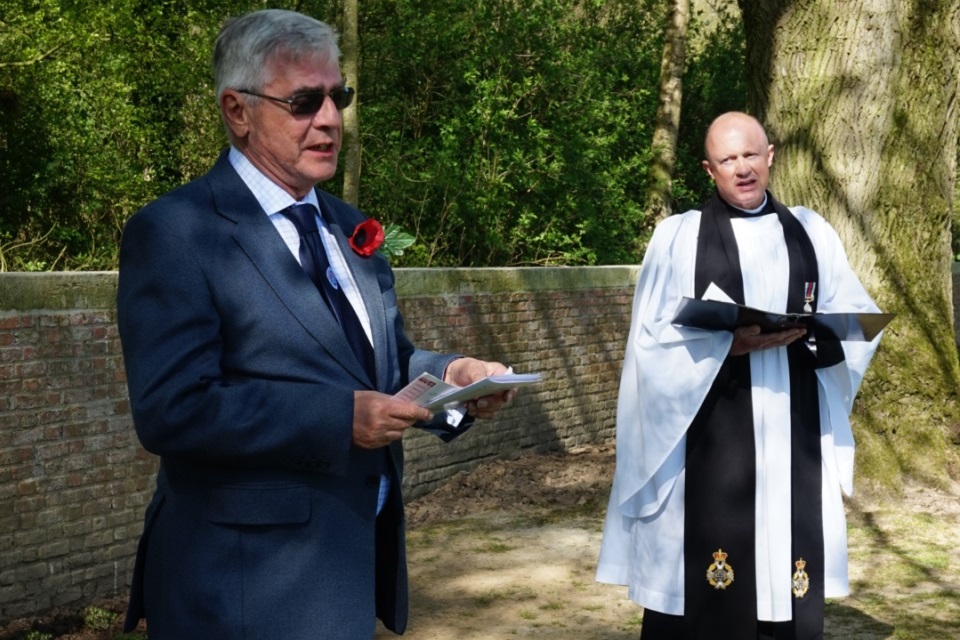
In a moving ceremony at Hebuterne Military Cemetery in France, new headstones were dedicated to Lance Corporal (L/Cpl) James Thomas Spencer, Private (Pte) Joseph Turton Cleaver, Pte Walter Jennings and Pte Reuben Kimberley at a service arranged by the MOD’s Joint Casualty & Compassionate Centre (JCCC) and led by the Reverend Justin Bradbury, Regimental Chaplain of The Queen’s Royal Hussars.

Bob Bristow relative of of Pte Cleaver with Rev Justin Bradbury, Crown Copyright, All rights reserved

All 4 soldiers were killed on 1 July 1916, the first day of the Battle of the Somme but their final burial location has until now been unknown. War Diaries from the Warwickshire Regiment provide evidence that 14 soldiers of the 1/7 Battalion were killed that day and whilst it was believed all were buried in Hebuterne Military Cemetery, it wasn’t possible to confirm this positively for each individual.

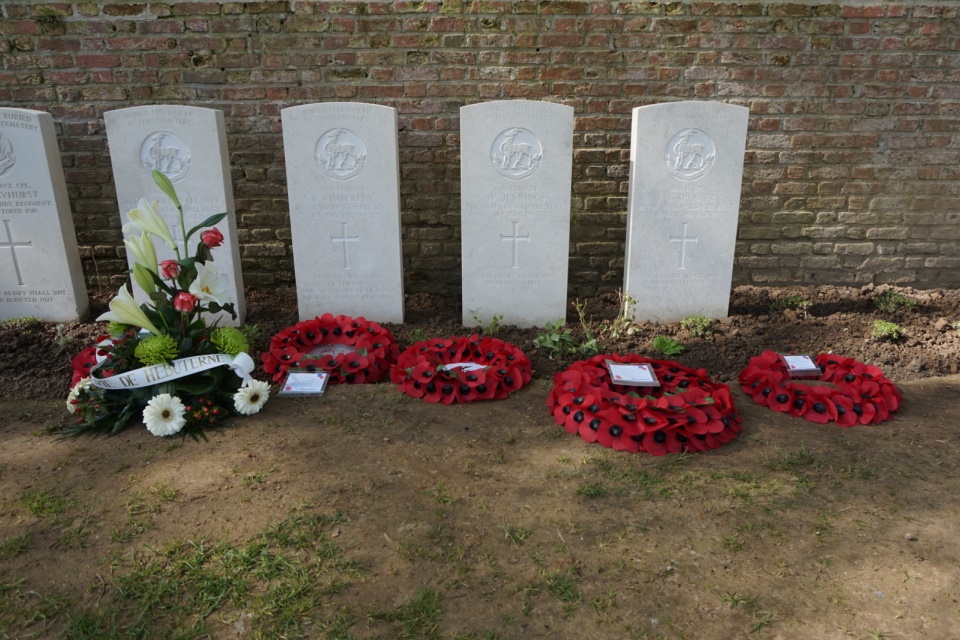
However, a more recent review of the evidence, including historical records, has allowed JCCC to be able to say there is now firm evidence the 4 soldiers are indeed buried at Hebuterne. Although it still hasn’t been possible to confirm in which of the many unknown soldier’s graves they are buried, the new headstones, provided by the Commonwealth War Graves Commission (CWGC), mean there is now a permanent memorial to them within the cemetery.

New headstones at Hebuterne Cemetery, Crown Copyright, All rights reserved

All 4 men were from Coventry. Two of them, Pte Kimberley and Pte Cleaver, had been friends from childhood, joined the Royal Warwickshire Regiment together, served and later died together.

Rev Justin Bradbury conducting the service, Crown Copyright, All rights reserved

Rev Justin Bradbury said:

It has been a privilege to conduct this rededication ceremony in such a beautiful cemetery and finally recognising their final resting place.

Nicola Nash, from the Joint Casualty & Compassionate Centre (JCCC), said:

We feel very lucky to have been able to attend such a moving ceremony for these four Warwickshire soldiers, made even more poignant that two were very close friends and died together on the first day of the Battle of the Somme.

News story: World War 1 soldiers finally honoured after over a century

image_pdfimage_print

In a moving ceremony at Hebuterne Military Cemetery in France, new headstones were dedicated to Lance Corporal (L/Cpl) James Thomas Spencer, Private (Pte) Joseph Turton Cleaver, Pte Walter Jennings and Pte Reuben Kimberley at a service arranged by the MOD’s Joint Casualty & Compassionate Centre (JCCC) and led by the Reverend Justin Bradbury, Regimental Chaplain of The Queen’s Royal Hussars.

Bob Bristow relative of of Pte Cleaver with Rev Justin Bradbury, Crown Copyright, All rights reserved

All 4 soldiers were killed on 1 July 1916, the first day of the Battle of the Somme but their final burial location has until now been unknown. War Diaries from the Warwickshire Regiment provide evidence that 14 soldiers of the 1/7 Battalion were killed that day and whilst it was believed all were buried in Hebuterne Military Cemetery, it wasn’t possible to confirm this positively for each individual.

However, a more recent review of the evidence, including historical records, has allowed JCCC to be able to say there is now firm evidence the 4 soldiers are indeed buried at Hebuterne. Although it still hasn’t been possible to confirm in which of the many unknown soldier’s graves they are buried, the new headstones, provided by the Commonwealth War Graves Commission (CWGC), mean there is now a permanent memorial to them within the cemetery.

New headstones at Hebuterne Cemetery, Crown Copyright, All rights reserved

All 4 men were from Coventry. Two of them, Pte Kimberley and Pte Cleaver, had been friends from childhood, joined the Royal Warwickshire Regiment together, served and later died together.

Rev Justin Bradbury conducting the service, Crown Copyright, All rights reserved

Rev Justin Bradbury said:

It has been a privilege to conduct this rededication ceremony in such a beautiful cemetery and finally recognising their final resting place.

Nicola Nash, from the Joint Casualty & Compassionate Centre (JCCC), said:

We feel very lucky to have been able to attend such a moving ceremony for these four Warwickshire soldiers, made even more poignant that two were very close friends and died together on the first day of the Battle of the Somme.