Xiongan New Area sets up company to fund construction

The management committee of Xiongan New Area has announced that a special company has been established to fund construction of the area.

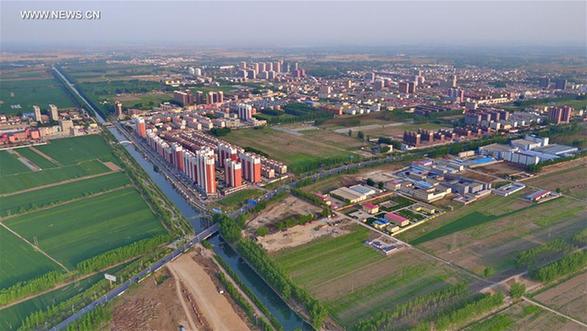
Photo taken on April 21, 2017 shows the scenery of the county seat of Rongcheng, north China’s Hebei Province. China announced the plan for Xiongan New Area, an economic zone about 100 kilometers south of Beijing, on April 1, 2017. The new area will span Xiongxian, Rongcheng and Anxin counties in Hebei Province, eventually covering 2,000 square kilometers. Hebei announced recently it would call for international bids to plan and design Xiongan New Area. Global companies are welcomed to bid with their ideas for a 30-square-km area at initial stage. [Photo/Xinhua]

With registered capital of 10 billion yuan (about 1.47 billion U.S. dollars), China Xiongan Construction & Investment Group is a state-owned company.

The Hebei provincial government approved its founding in July.

The company will raise fund to build houses and apartments, develop the Baiyangdian water area, and to build transport links, energy infrastructure and public facilities in Xiongan.

China announced plans in April to establish the Xiongan New Area, a new economic zone about 100 kilometers southwest of Beijing. It covers Hebei’s Xiongxian, Rongcheng and Anxin counties.

What does the EU want from the Brexit discussions?

You would have thought the rest of the EU would be delighted to learn that the UK, the most reluctant EU member of them all, was leaving. It means they are free to pursue economic, monetary and political union without the UK constantly trying to slow it down, impede or stop it, or demanding special treatment. Better still, that same UK is happy to make her market available tariff free to the rest of the EU who have been so successful at exploiting it.

Instead it appears that the EU is once again misjudging the mood of UK voters. The EU seems to think if it delays and creates difficulties the UK may think again or come creeping back for some version of its membership. The EU has invented the idea that the UK owes the EU a lot of money after we have left when there is no Treaty basis for this. They have proposed that the UK has to continue to accept rulings of the European Court of Justice in the way no other independent country that is an EU trading partner has to accept. They have suggested that EU citizens currently legally settled in the UK would continue to have EU rights policed by the EU instead of enjoying UK rights policed by the UK after exit. These are presumably provocative proposals designed to foment argument within the UK with a view to delaying Brexit.

The EU needs to learn from its recent experiences. It was this mentality which led the EU to turn down Mr Cameron’s modest requests for improvements in the UK/EU relationship and which led directly to the Leave vote. They underestimated the resolve of UK voters then, and are in danger of doing so again. Indeed, their current attitude reinforces the view of many UK voters that they made exactly the right choice. The process of exit is also serving to underline just how far our subservience to EU lawmaking and courts has gone, something hard line pro EU campaigners always denied prior to the decision.

As someone who has undertaken all too many debates on this topic, I was regularly accused of exaggerating the influence and power of Brussels, which was just a kind of large free trade arrangement according to many of its protagonists. Now they tell us it is all so complex and comprehensive it makes getting out all but impossible.

My advice to the EU is simple. The UK has voted decisively to leave, with a massive Parliamentary majority to carry out the wishes of the voters. The UK wishes to be friendly and generous in departure. Indeed, many of us think we will be a better partner and neighbour when we can make our own decisions, than when we were constantly having to fight against imposed collective decisions we did not like. The EU can do a good deal for itself if it wishes. It can secure free trade, defence collaboration, protected rights for EU citizens settled in the UK and much more. If it doesn’t want to do that we will be leaving anyway.

Flood leaves 7 dead, 2 missing in NW China

Seven people have died and two others remain missing after a flood in northwest China’s Gansu Province, local authorities said Tuesday.

Rainstorms hit three townships in Wenxian county in Longnan city from Sunday evening to Monday morning, resulting in geological disasters including landslides. [Photo/CGTN]

Rainstorms hit three townships in Wenxian county in Longnan city from Sunday evening to Monday morning, resulting in geological disasters including landslides.

Nearly 1,000 residents have been relocated to safety. The rain also left roads blocked, houses collapsed or damaged, and power supply and communication interrupted.

The local government has dispatched thousands of people to participate in rescue and relief work.

Was 1st Quarter growth in the UK understated? Bank of England predicts steady growth in business investment

Some have made much of the slowing in UK growth to 0.2% in the first quarter of 2017. It picked up a bit thereafter.

In the Bank of England’s Inflation Report for August we find the following interesting quote:
Quarter 1 growth “slowed sharply to 0.2%. The GDP backcast, which takes into account the revision properties of the official data and information surveys, suggests that growth in Quarter 1 was higher, at 0.4%”.

The Inflation Report also reveals a worse balance of payments position in the first quarter than the Bank expected, with more imports than in their forecast. This meant international trade subtracted 0.4% from our GDP, given the continued high level of imports. This puts a different slant on the picture from the loss of confidence myths.

Contrary to some comments on the current position, the Bank was relatively positive on business investment, though would like it to rise faster. They said ” Business investment is estimated to have risen by 0.6% in Quarter One…. Investment is projected to continue to grow at a steady pace in the near term”.

The UK economy could clearly benefit from more investment in capacity, both to replace imports and to meet export demand. The rising profitability of business in general and the availability of low cost credit should encourage more such investment.

10,000 new NHS dental places to be created in Wales

The additional places are being created as part of a wider package of investment to develop new and improved NHS dental services across Wales.

As part of this investment, £450,000 will go to Cardiff and Vale University Health Board and £300,000 to Aneurin Bevan University Health Board to provide access to new NHS dentistry places. Cardiff has seen significant population growth and this additional funding will help meet a growing need. New access is also planned in the areas of greatest need across the Aneurin Bevan University Health Board area. 

In addition, new investment is being made to strengthen specialist children’s dentistry services. This will see new consultant and specialist appointments being made to work with existing community and hospital-based services. This will help increase access to specialist paediatric dental services closer to home and ensure those children with highest treatment need have timely access to treatment. 

The new specialists will work closely with general dental practice teams to improve children’s preventive care and treatment services in NHS dental services in Wales. It’s expected up to 3,000 additional patients per year will be able to access specialist paediatric dentistry services as a result, which will reduce waiting times for hospital-based services.

Other investments as part of a wider reform of the way in which NHS dental services are delivered include:

  • Funding for courses to equip all dentists in Wales with the skills and knowledge they need to lead their teams in the delivery of effective preventive treatment and care
  • A clinically-led dental e-referral management system for Wales that will improve the quality of patient care and reduce waiting times for treatment
  • Improving dental information to better understand variation in provision and to link the use of services by patients to improve the value of services and outcomes of care
  • Widening access to training and education for communities by offering opportunities for people who want to train and work as dental care professionals. 

Health Secretary Vaughan Gething said:

“Improving NHS dental services and patients’ access to them is a priority for the Welsh Government. 

“I’m really pleased that the investment I’m announcing today will create 10,000 new NHS dental places. This will improve access to NHS dental services for people in some of the most deprived areas of Wales.

“We’re also investing in new specialist paediatric dentistry to ensure the needs of the most vulnerable children are met. The investment in specialist paediatric dentistry will help improve NHS dental treatment and care for those children who are affected by dental disease.”