Labour will protect the high street by ending damaging bank closures

image_pdfimage_print

Labour will introduce major changes to bank law to prevent banks forcing
through closures of vital high-street banks

As part of Labour’s plans to rejuvenate the high street and
protect local communities, the next Labour Government will make major changes
to the banking law that will prevent banks closing their vital high-street
branches and damaging local communities and small businesses.

Despite
the introduction of an “Access to Banking Protocol” to prevent closures by this
Conservative Government, the Consumers Association reports that 1,046 local
bank branches closed in the UK between December 2015 and January 2017, with
another 486 already scheduled for closure this year.

But
the Big four banks made over £11bn profits from their high street banks in
2015, and can afford to provide this vital customer service instead of
prioritising cost-saving measures that damage communities and small businesses.

Over
two-thirds of small businesses claim that a local bank branch is important and
lending to small businesses has been found to drop by 63 per cent in areas with
a recent bank branch closure. For deprived communities and households, loss of
a local bank branch significantly diminishes their abilities to access even
basic financial services. Older people are significantly less likely to use
internet or phone banking services.

Labour
believes tougher action is needed on our major banks to prevent them putting
their profits first and making short-sighted and damaging decisions. We will
replace the toothless Access to Banking Protocol with the force of the law to
bring banks into line.

Shadow
Chancellor John McDonnell, will say:

“High
street bank closures have become an epidemic in the last few years, blighting
our town centres, hurting particularly elderly and more vulnerable customers,
and local small businesses whilst making healthy profits for themselves. It’s
time our banks recognise instead that they are a utility providing an essential
public service.

“Only
Labour will put in place the legal obligations needed to bring banks into line
and stand up for our high streets, communities and small businesses.”

Emeritus
Professor, Prem Sikka, University of Essex, who advised on the policy
, said:

“Banks
receive considerable financial support from the public and in return should be
required to provide financial infrastructure that meets the needs of
individuals and businesses.”

ENDS

Notes:

 1.   A future Labour government will broaden the duties of the
Financial Conduct Authority (FCA) and amend relevant provisions of the
Financial Services and Markets Act 2000 (FSMA), particularly Part 4A of the
Act, which authorises banks to carry on the regulated activity (i.e. the
‘banking licence’). These amendments would require banks to accept the
conditions laid down below:

a.   Prior to the closure of any branch, banks must undertake
a consultation with all customers of the branch which it proposes to close. It
must also    consult representatives of the relevant local
council.

b.   The bank must publish details of the reasons for closure,
including financial calculations showing the revenues and costs of the relevant
branch. The share of central costs (e.g. accounting systems, IT, cyber
security, personnel function) allocated to the branch must be separately
identified, especially many of these costs are relatively ‘fixed’ and are not
proportionate to the number of branches.

c.   The consultation process must be overseen by the FCA, and
the FCA must ensure that the closure of the branch does not degrade the local
financial infrastructure. The closure of the branch must not make the local
community worse-off.

d.  The FCA’s approval will be needed for any branch closure.

e.   Upon approval by FCA, customers and local communities
must be given 3 months’ notice to enable them to make appropriate arrangements.

 2.   Labour will amend the statutory objectives, as given at
s.9B of the FSMA 2000, of the Financial Policy Committee should include a new
objective, the “Consumer Protection Objective”, which will oblige the FPC
to oversee (i) the accessibility of financial services to geographic
communities in the UK, and (ii) the availability of financial services to all
sectors of the population.

3.   The
British Bankers Association found that 68 per cent of small businesses survey
thought that having a bank branch on the high street was important. See Barty,
J and Ricketts,T. (June 2014), Promoting competition in the UK banking
industry

4.   Move
Your Money research found that “Before a branch closure, lending for SME’s
within a given postcode grows from one quarter to the next by 2.13 per cent on
average. But after a branch closure in that postcode, average Q-2-Q growth in
SME lending drops to only 0.79 per cent – a staggering 63 per cent reduction.”
Travers-Smith, F. (July 2016), Abandoned Communities: the crisis of UK bank
branch closures and their effects on local communities

5.   The Social Market Foundation found that 11% of the
population (7m people) use no other banking service than their local high
street branch, and that these are overwhelmingly older and/or poorer. See
Evans, K. (January 2016), Bricks and Clicks: Understanding How Consumers
Manage Their Money
, London: Social Market Foundation

6.  
Bank branch closure figures from Goodman, R. (December 2016), “Revealed: 1,000
bank branches shut in two years”, Which?

7.   Banking high street profits given in Travers-Smith,
F. (July 2016), Abandoned Communities: the crisis of UK bank branch closures
and their effects on local communities
, p.13

China SOE watchdog sets up Xiongan working group

image_pdfimage_print

The State-owned Assets Supervision and Administration Commission (SASAC) of the State Council, China’s top state-owned enterprises (SOEs) regulator, has announced to establish a special working group to support the construction of Xiongan New Area.

China’s centrally administered SOEs are encouraged to make the most of their strengths to map out future development strategies for the area, the SASAC said in a statement released Friday after a meeting gathering its leaders earlier this week.

The economic zone, about 100 kilometers south of Beijing, will cover 2,000 square kilometers in the long term with a population of 2 to 2.5 million.

“The centrally administered SOEs are encouraged to lend strong support to construction of the zone in areas like energy security, infrastructure, electricity, telecommunications, rail transport, ecological protection, information-based network and smart city,” noted the statement.

Great support will be given to these central SOEs in locating their newly-registered high-tech, new technology and high-end service businesses into Xiongan New Area, and better coordination between the central SOEs and local authorities will be promoted, it added.

China currently has 102 central SOEs. The plan to set up the new area is a major strategic decision which will open a new era of development.

THE FUTURE OF LOCAL SERVICES IS AT STAKE – ROWLEY

image_pdfimage_print

14 April 2017

Scottish Labour campaign manager Alex Rowley today urged Scots to use their vote in the forthcoming council election, warning ‘the future of our local services is at stake’.

Postal ballots started landing on doorsteps across Scotland this morning, with tens of thousands of Scots expected to cast their vote by post. To apply to vote by post, click here.

Mr Rowley said voters face a choice between electing a local champion with Labour or an SNP councillor who will only care about another divisive independence referendum.

The SNP has cut £1.5billion from local services since 2011, including £170million this year alone.

Speaking after a photo-call to mark the start of postal voting, Scottish Labour deputy leader and local election campaign manager Alex Rowley said:

"As postal votes begin to land on doorsteps, people must start to seriously think about what these elections are about.

“This is a vital election and it is crucial that people get out and vote. The future of our local services is at stake.

"Voters can send Nicola Sturgeon a message that they want her to focus on the things that really matter – like getting people into work, investing in local schools, and growing the economy.

"Instead of trying to impose another divisive referendum that the people of Scotland don't want, the SNP should focus on the job of government.

"Every Labour councillor elected will be a local champion for more investment in local services like schools and care of the elderly. Every SNP councillor will put another divisive independence referendum first.

"That's the choice voters face. Only Labour can stop the SNP. If people want more investment in local services and councillors who will put their community first, then they have to vote Labour."

News story: Vaisakhi 2017: Theresa May’s message

image_pdfimage_print

I send my best wishes to everyone in Britain and around the world celebrating Vaisakhi, one of the most important dates in the Sikh calendar and a time when families and friends come together to commemorate the birth of the Khalsa.

As Sikhs across the globe take part in spectacular processions, and neighbourhoods and gurdwaras burst forth with colour, I would like to take this opportunity to celebrate the immense contribution British Sikhs make to our country. Whether it’s in the fields of business, the armed forces or the charitable sector, you consistently follow the pillars of your faith and in so doing set an example to us all.

Your values – of equality and respect, of fairness and helping those less fortunate than yourselves – are values we need more than ever, as we forge a new, ambitious, role for Britain in the world.

I am determined to build a country that works for everyone; a country where no matter who you are, you can achieve your goals, and the Sikh community is a vital part of that mission.

So as the dancing and the festivals begin, at home and abroad, I’d like to thank you for all that you do and to wish you a very happy Vaisakhi.

Beijing-Tianjin-Hebei restricts construction coatings

image_pdfimage_print

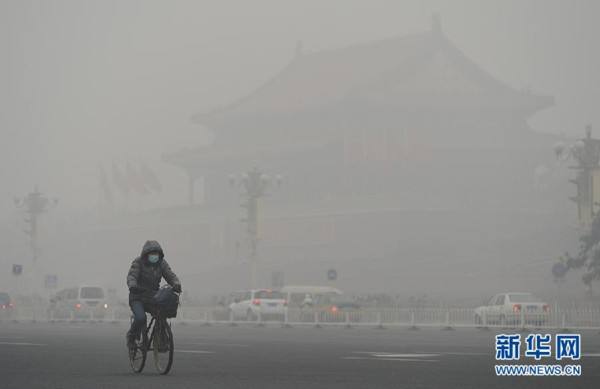
Heavy smog hits Beijing. [Photo/Xinhua]

To curb air pollution, Hebei Province, Beijing and Tianjin will enforce a unified standard to reduce the use of coatings and adhesives in construction.

According to the standard issued Thursday, the amount of volatile organic compounds (VOCs) must not exceed set levels in manufacturing, storage and in use of construction coatings and adhesives. The measure is estimated to reduce VOCs in the air by 20 percent.

The Beijing-Tianjin-Hebei region sits at the heart of the North China Plain where air pollution, particularly winter smog, often occurs as a result of the high concentration of industrial and vehicle emissions, static air circulation and the burning of coal.

“VOCs are a key component of the ozone and PM2.5 — fine particulate matter with diameter smaller than 2.5 micrometers,” said Yu Jianhua, chief engineer of the Beijing Municipal Environmental Protection Bureau.

He said that rapid urbanization had led construction coating and adhesives to constitute a major part of VOCs in cities. In 2015, 5.16 million tonnes of construction coating was consumed nationwide, an eight-fold increase since 2000.

Yu said Beijing had its rules on the use of coatings and adhesives but the latest standard upgraded restrictions and widened the jurisdiction to cover Tianjin and Hebei where rules had been more relaxed.

The standard is the first jointly-issued rule for the three areas to fight air pollution.

By 2017 the region must cut PM2.5 density by 25 percent from 2012 levels, according to a government action plan issued in September 2013.

Beijing has been struggling to reach its target of an average PM2.5 density of 60 micrograms per cubic meter. In the first three months, its PM2.5 density averaged 84 micrograms per cubic meter.

However, Beijing’s air quality is already ranked the best among 28 cities in the three areas.