Fortress house opens its doors to the world

Lin Rigeng brims with pride every time he tells visitors the story of his house.

“I never get tired of it. Actually, I enjoy it,” he said.

The four-story clay building that Lin, 66, shares with 77 others covers an area of 5,000 square meters, or nearly three quarters of a soccer field. It was built in 1912 by his grandfather’s brothers.

These buildings are known as tulou, which means “building made of earth” in Chinese. In July 2008, they were added to the UNESCO World Heritage list as examples of unique residential architecture in Fujian province.

Lin’s house in Hongkeng was among the 46 representative structures presented to the World Heritage Committee.

“My house belongs to the world. I want everyone to learn about it,” Lin said.

Tulou can take many forms, including rings, triangles, squares, rectangles, and pentagons. Lin’s home is one of the most common ring-shaped buildings.

It is believed that the first tulou were built in the 11th century by people escaping war in central China. This is one explanation for why they have an extremely thick outer wall. The wall around Lin’s home is 1.3 meters thick. The buildings functioned as fortresses to protect residents from invaders and wild animals.

There are more than 20,000 tulou in Yongding county, about a 2.5-hour drive from Xiamen, which recently hosted the Ninth BRICS Summit.

The oldest existing tulou in China was built 600 years ago. The largest has 384 rooms and can accommodate at least 800 people.

Lin’s house was dubbed Zhencheng Lou by his grandfather. It has 208 rooms arranged according to the bagua, an eight-point diagram that determines auspicious locations for various functions to balance the energy within the house.

Fifteen families live in the building; all are involved in tourism-related businesses, including working as tour guides, running home accommodations, selling farm produce (tea, mushrooms, dried vegetables and persimmons) and souvenirs.

“We are richer. Our life is better. So is our living environment,” said Lin, speaking of the changes tourists have brought to his family.

According to Yongding county records, a model of Zhencheng Lou has been displayed since the 1980s at an international architectural model expo held periodically in Los Angeles.

Locals tell the story of fortress houses, especially the ring-shaped ones, being spotted by US satellites and mistaken for missile silos or nuclear devices during the Cold War.

“In my opinion, that tale originally helped attract international attention to tulou,” Lin said.

Lin, the son of a farmer, has a name that means “plowing every day”.

He was born in Zhencheng Lou, and is a hospitable host. Back in the 1980s, when few people knew about the buildings, he began voluntarily guiding visitors, treating them to homegrown tea, food and wine and telling them the history of the buildings.

“The moment they entered Zhencheng Lou, they were simultaneously shocked and excited. They could not imagine how people could build such a large house to accommodate a whole clan,” Lin said. “Only then did I realize my house was such a treasure.”

In 1991, Lin became the first tulou tour guide hired by Yongding County Tourism Administration.

He said he learned even more about his own home from early visitors, many of whom were architects or fans of historical buildings.

Despite having only a primary school education, Lin has written a book on tulou.

The recent BRICS summit is expected to bring more international visitors.

“I love to talk with international visitors from all walks of life,” Lin said. “I can learn about the outside world from inside my old house.”
Diseased dead pigs from 2013 dug up

The city government of Huzhou, Zhejiang province, confirmed on Sunday that investigators have dug out the remains of hundreds, and possibly thousands, of rotting carcasses of diseased pigs from three burial sites.

The public security bureau of Huzhou detained five people suspected of the illegal burial of the sick pigs in 2013, and will continue to investigate, according to a statement posted on the city’s micro blog account.

The city was told on Aug 30 by environmental inspectors from the central government that some dead pigs had been illegally buried in Santianmen village. The inspectors had been evaluating Zhejiang province since Aug 11 and received reports about the pigs from members of the public.

The city’s environment inspectors dug up the decomposed carcasses on Aug 30, and then continued digging in two other places identified by the suspects and by others who first tipped off the authorities, the statement said.

As of Friday, investigators had dug in three places and “finished the sorting process”, which yielded “2.24 million metric tons” of material including decomposed pig carcasses and sludge, it said.

“All of them have been removed and burned to protect the biological safety of the environment,” it added.

In addition, the city’s environmental bureau tested the quality of soil and water both at the surface and underground, and health authorities took steps to decontaminate the site.

An initial investigation by the city’s public security bureau found that Huzhou Industrial and Medical Waste Treatment Co had dumped and buried the pigs, which died of disease in 2013 and should have been burned to protect the environment.

Investigators said Shi Zheng, who was manager of the company at the time, ordered the workers to bury the pigs. Shi is currently serving a prison sentence for other crimes. Five other suspects in this case have been detained by the police.

China’s eastern region is a major pig breeding area. Zhejiang and Jiangsu provinces have issued rules to govern the disposal of dead ones.

The case that came to light on Sunday is not the first case involving diseased pigs. In March 2013, thousands of dead pigs were found floating in a section of Shanghai’s Huangpu River. City authorities dragged 5,916 carcasses from the river and the municipality took emergency measure to protect water quality, according to a report by Caixin on Sunday.

UNAIDS asks Chinese to produce drugs

The head of the Joint United Nations Programme on HIV and AIDS has called on China to boost prevention and control in Africa by encouraging the country’s drugmakers to open production hubs on the continent.

Michel Sidibe, executive director of UNAIDS, said the central government should use the China-Africa Development Fund to mobilize key pharmaceutical companies to invest in manufacturing hubs covering many African countries, which will help create a “viable and sustainable” market.

At the same time, medicines for HIV and AIDS produced in China and used by Chinese should be prequalified by the World Health Organization for use in Africa, he added. “We need to create a policy space to make sure those products can be prequalified by the WHO. That is one of the major challenges for the African countries to have easy access to these medicines,” said Sidibe, who also is under-secretary-general of the United Nations.

Shortages of drugs and grassroots healthcare workers pose a major challenge for the control and prevention of HIV/AIDS in Africa, he said, while China also has experience and knowledge in the field that can be passed on.

“Ninety-seven percent of the medicine consumed in Africa is from other continents,” Sidibe said. “We are happy that we have a very good relationship with the Chinese.”

President Xi Jinping proposed intensifying cooperation with Africa in a number of areas, including industrial development, agriculture, finance, poverty alleviation and healthcare, at the 2015 summit of the Forum of China-Africa Cooperation in South Africa.

According to a 10-point action plan, the central government will encourage Chinese enterprises to collaborate with Africa in drug research, development and production, and encourage them to produce drugs in Africa to aid the sustainable development of the local pharmaceutical industry.

Globally, countries are making unprecedented progress in the control and prevention of HIV. For the first time, the world has more people with HIV receiving treatment than people waiting for treatment, and for the first time, HIV transmission from mother to babies is under control.

Moreover, China is committed to improving public health services, Xi said, noting that government health expenditures have increased by 80 percent over the past 10 years, and that it is helping to provide wider access to health services.

High-speed rail trips get easier as network expands

Passengers can now reach most of China’s major cities by bullet train, thanks to a network that includes linkages of a number of rail routes, as well as efficient major transfer hubs.

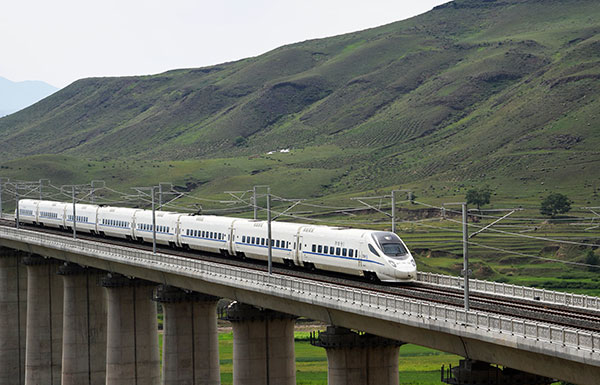
A high-speed train heads to Ulanqab from Hohhot in the Inner Mongolia autonomous region in August, marking the openning of the region's first high-speed railway. [Tang Zhe/For China Daily]

A high-speed train heads to Ulanqab from Hohhot in the Inner Mongolia autonomous region in August, marking the openning of the region’s first high-speed railway. [Tang Zhe/For China Daily] 

According to China Railway Corp, the national rail operator, direct high-speed train services have been arranged between cities with a large number of passengers, including Beijing-Kunming, Harbin-Shanghai and Chengdu-Guangzhou. Those direct services link big cities in different regions by taking more than one rail route.

Service between Dalian, Liaoning province, and Xi’an, Shaanxi province, involves eight high-speed rail routes that link 18 medium-size and large cities.

Running the network is no easy task. A high-speed rail route must not only carry out bullet train services running only on a single line but also on multiple lines.

The major transfer hub design allows easy transfers to other bullet trains. Passengers can make travel plans and buy connected tickets in advance. When they arrive at the transfer station, they can use a transfer gateway to board the next service, with no need to exit the gate and enter again. The major transfer hub design offsets the lack of direct service in some areas, providing more convenient travel choices.

Lanzhou West station, the major transfer hub linking the Xinjiang Uygur autonomous region with the rest of China, is expected to receive more than 5,000 transfer passengers a day, said Wang Jian, the deputy head of the station. The Baoji-Lanzhou rail route opened in July, and Wang estimates daily passengers will reach 25,000. The route links Lanzhou with the high-speed rail network.

No direct service links Xinjiang with most cities beyond Lanzhou. A passenger from Beijing can take a direct service to Lanzhou and then transfer at Lanzhou West station to Xinjiang.

China’s high-speed rail network has surpassed 20,000 kilometers, spanning all provincial level regions except Tibet and the Ningxia Hui autonomous region. Hub cities are scattered around the country and linked by the high-speed network.

The world’s longest high-speed rail service in operation is the 2,760-kilometer Beijing-Kunming service, according to China Railway Corp. Beijing has a distinct spring, summer, fall and winter, whereas Kunming has been called “the spring city” because the weather never gets very cold.

Like the Beijing-Kunming service, departure and arrival cities are different, requiring a different model of bullet train to adjust to diverse local environment.

In the northeastern region’s winter, when the lowest temperature can hit -40 C, bullet trains need to adjust. In the northwest region’s deserts, featuring strong winds and sandstorms, such as along the Lanzhou-Xinjiang line, bullet trains have stormproof designs.

According to a plan released by the National Development and Reform Commission in July 2016, China will expand the high-speed rail network to 30,000 km by 2020, linking 80 percent of major cities. By 2030, the network will link all cities with populations of more than 500,000.

Riding China’s rails

China’s high-speed rail network stretched 22,000 kilometers as of 2016, accounting for 65 percent of the world’s total high-speed railway.

The world’s longest bullet train service reaches 2,760 kilometers from Beijing to Kunming, Yunnan province.

The world’s longest continuous high-speed rail track reaches 2,298 kilometers between Beijing and Guangzhou, Guangdong province.

China is the only country with trains running at 350 km/h. Service on several Chinese lines have reached that speed, including Beijing-Tianjin, Beijing-Shanghai and Shanghai-Ningbo.

Chinese scientists planning jumbo launched rocket

A new solid fuel rocket, launchable from the Yun-20 transport plane is being developed by Chinese scientists, reports China Central Television (CCTV).

The Y-20, or Transport-20 is China’s first domestically made jumbo air freighter, designed to be used as a workhorse by the Chinese air force. It’s capable of carrying out various long-distance air transportation tasks involving both cargo and passengers. 47-meter in length, 15 meters high, and with a 50-meter wingspan, the Y-20 has maximum take-off weight of over 200 tons and a maximum payload of 66 tons.

In addition to being used as a transport plane, the Chinese air force makes it available as a test platform for new technology. According to experts at the China Academy of Launch Vehicle Technology (CALVT), they are developing a new solid fuel rocket which could be launched by the Yun-20 in flight, sending a 100-kg load into near-earth orbit. Military expert, Wang Mingliang, says it’s also possible the Yun-20 will be used to carry drones in the future.

It’s anticipated that the Yun-20 could be refitted as refueling plane carrying over 90 tons of fuel, as well as airborne early warning aircraft with larger radar and a cabin for passengers.