Tag Archives: political

image_pdfimage_print

Rural boy commits suicide due to father’s blame

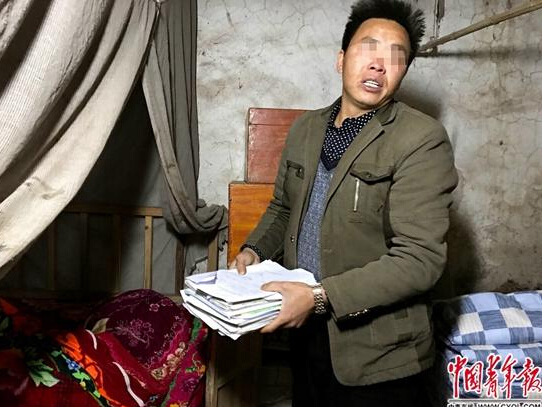
A new tomb without a tombstone chills the festive air of a family in Yanxi Village, Zhenxiong Town, Yunnan Province. The family lost a son to suicide on the Eve of Spring Festival, which fell on Jan. 27 this year.

Xiao Bao’s father collects his son’s effects. [Photo:China Youth Daily]

The boy was named Xiao Bao (pseudonym), a left-behind child growing up with his paternal grandparents in the village while his parents worked odd jobs in Kunming, the capital of Yunnan Province.

In his last words, Bao claimed, “I was still young and I didn’t want to die, but I can’t handle the complaints. Dad, you must be happy when I die. It is you rather than anyone else to be blamed for my death.”

In a dilapidated house, Bao’s grandmother couldn’t help shedding tears when talking about the tragedy of her eldest grandson, who was raised up by her and her husband since he was one year old.

Despite his rare opportunities to be reunited with his parents, Bao never ignored his responsibilities at the family farm.

His grandparents never imagined that their eldest grandson would have swallowed pesticide to end his life.

The two recalled that after dinner on that particular day, Bao shut himself alone in his room, where the ceiling is spotted with cobwebs. Later in the night, his grandma heard him vomiting. When she opened the door she was shocked by a strong smell of pesticides – the boy had drunk down half a bottle of dichlorvos.

The grandparents, who tried to send the agonized boy to hospital, were only informed by the doctor through a phone call that it was too late.

Some villagers later recalled that they had spotted Bao buying pesticides and even two chicken legs.

read more

The IFS offers more gloom

The IFS tells us in their latest forecasts that we can look forward to more years of tax rises and spending cuts. They expect the UK economy to slow this year, and slow again next year.  They are out of touch with the mood to banish austerity and go for growth.

They are more pessimistic about the Eurozone than about the UK. They have lowered their 2017 growth forecast to 1.5% for the Euro area, whilst proposing 1.6% for the UK. They run one scenario which looks at what weak European banks and Brexit could do to their forecast – an unusual pairing with no explanation of why they are lumped togather or the relative contributions to their extra gloom on this basis.

They do confess that there are “increasing chances that the forecasts may be too pessimistic”. They accept that the UK consumer carried on spending post the referendum when most forecasters said they would not. They admit that business investment rose a little faster after the vote, instead of falling off the cliff as in many forecasts. They agree that trade which had performed disappointingly last year might add a bit to our economy in 2017.

They confess that “real levels of day to day public service spending have actually fallen very little overall in the last three years”. If they checked the Red Book figures they would see the cash growth in overall public spending actually rose faster than inflation over that time period.  They now think removing the deficit should be the priority, which leads them to conclude political parties have to offer some combination of higher taxes and lower spending.

Politically it is much more attractive to square the circle with more growth. More growth brings in more tax revenue without tax rate rises. It cuts the costs of benefits as people move from no pay to low pay, and from low pay to better pay. The issue before us should be what more can we do to promote growth.

I do not accept that growth will be as low as they say in 2017 or 2018. That still makes me keen to find more measures which can promote more growth. A tax rate cutting budget could help, especially if we cut those tax rates that are damaging the revenue collected. Spending enough on social care and health is a cross party priority, and we have to accept these services will continue to need  more cash in the future. Investing more when long term interest rates  are still so low should make sense, though the state needs to show commonsense over projects chosen and where possible harness the private sector to ensure a proper profit test on the project.

read more

South Sudan, Africa’s largest refugee crisis, needs urgent response – UN agency

10 February 2017 – With already more than 3.5 million displaced within and outside the borders of South Sudan and thousands more driven to neighbouring countries every day, the United Nations refugee agency has appealed for an urgent peaceful resolution to what has now become Africa’s worst refugee crisis.

&#8220Recent new arrivals report suffering inside South Sudan with intense fighting, kidnappings, rape, fears of armed groups and threats to life, as well as acute food shortage,&#8221 William Spindler, a spokesperson for the Office of the UN High Commissioner for Refugees (UNHCR) told the media at a regular briefing in Geneva.

&#8220More than 60 per cent of the refugees are children, many arriving with alarming levels of malnutrition &#8211 enduring devastating impact of the brutalities of the ongoing conflict,&#8221 he added.

However the crisis, third only to the displacements in Syria and Afghanistan and now in its fourth year, has received less attention and is plagued by chronic levels of underfunding.

UNHCR said that its response capacities are overstretched in the countries hosting the refugees and the lack of funds is affecting critical and life-saving efforts such as providing clean, drinking water, food, health and sanitation.

Last month, the agency revised upwards its funding requirements for 2017 to $781.8 million (some $297.9 million or 61 per cent higher than the earlier budget) in light of new needs of those who have been displaced due to renewed fighting, increased violence and resulting food insecurity since July last year.

The agency’s last year funding appeal of $649 million received only 33 per cent of the amount needed.

500,000 displaced in four months &#8211 more than 4,000 every day

The period between September and December 2016 saw almost half a million South Sudanese seeking refuge in neighbouring countries &#8211 an average of almost 4,100 people every day for four months.

According to Mr. Spindler, as the global displacement trends reflect, those fleeing South Sudan are being hosted by the poorest communities in the neighbouring countries, under immense pressure with scarce resources.

Noting that the welcome South Sudan refugees received in the neighbouring countries &#8220is encouraging&#8221 he cautioned that the lack of resources to respond is also extremely worrying.

The majority of the refugees are being hosted by Uganda (about 698,000), followed by Ethiopia (about 342,000), Sudan (305,000), Kenya (89,000), the Democratic Republic of the Congo (68,000) and the Central African Republic (4,900).

&#8220We are working with authorities in South Sudan’s neighbouring countries to provide life-saving support and look after the basic needs of those arriving in desperate conditions,&#8221 the UNHCR spokesperson said, renewing a call on donor countries to step up support to the humanitarian efforts for the South Sudan situation.

South Sudan has faced ongoing challenges since a political face-off between President Salva Kiir and his then former Vice-President Riek Machar erupted into full blown conflict between forces loyal to each in December 2013. The crisis has produced one of the world’s worst displacement situations with immense suffering for civilians.

Despite the August 2015 peace agreement that formally ended the war, conflict and instability have also spread to previously unaffected areas.

read more

‘Year of Pulses’ closes with call to build on strong momentum among famers, private sector – UN

10 February 2017 – Although the International Year of Pulses has helped raise awareness globally of the many benefits of pulses, such as beans, lentils and chickpeas, gains must be further strengthened to achieve the international community’s new development goals, the United Nations Food and Agriculture Organization (FAO) said today.

&#8220It is essential to maintain the momentum,&#8221 FAO’s Deputy Director-General Maria-Helena Semedo told the Year’s official closing ceremony today, which was hosted by Burkina Faso, according to a news release.

Realizing that pulses &#8211 defined as edible dried seeds of plants in the legume family &#8211 are &#8220small but powerful allies&#8221 in achieving the Sustainable Development Goals (SDGs), the UN General Assembly designated 2016 as the International Year and nominated FAO to lead implementation.

Since the Year’s launch, connections have been fostered among key actors from farmers’ organizations to the private sector to facilitate information exchange and policy dialogue on the production, trade and consumption of pulses.

Leaders in policy and research have tackled the top pulse issues at several international forums, and national committees have been established. A technical pulses database was created, a cookbook featuring recipes from international chefs was published, and the official multilingual website, with over half a million visits, promoted a rich array of information on pulses.

Though the Year has now officially closed, there has been a sound call to keep the momentum alive and continue activities beyond 2016.

&#8220Training programmes on the value of pulses should be supported, particularly for schoolchildren, farmers and extension workers. Policies and programmes should focus more on pulse producers, particularly small-holder farmers and young people,&#8221 Ms. Semedo said, noting that FAO will carry on working with stakeholders from governments to family farmers to promote pulses.

Pulses are packed with minerals such as iron, zinc and folate and have been an important part of diets around the world for centuries.

Pulses are a valuable ingredient in achieving UN Sustainable Development Goal 2 which aims to end hunger, achieve food security and improved nutrition, and promote sustainable agriculture.

The plants contribute to climate change adaptation and mitigation. They add large amounts of beneficial nitrogen to the soil and require little fertilizer. Growing pulses with other crops enhances soil fertility, improves both crops’ yields, and contributes to a more sustainable food system.

In addition, pulses have a very low water footprint compared to other protein sources, can be grown in very poor soils, and help reduce the risk of soil erosion and depletion. For poor farmers, growing pulses contributes to stable livelihoods, additional income and improved nutrition.

Burkina Faso’s President, Roch Marc Christian Kaboré, said: &#8220To better cope with the triple problem of soil fertility management, reducing the adverse effects of climate change and the issue of food security, producing and consuming pulses is a great opportunity, especially for the most vulnerable people.&#8221

Overall, global pulse production has been slowly but steadily increasing. In 2014, global production reached 77 million tonnes, up 21 million metric tonnes since 2001.

read more

Senior UN officials call for close cooperation to address migrant, refugee flows in Libya

10 February 2017 – The heads of the United Nations agencies for human rights, migrants, and refugees, and the UN envoy for Libya, today met in Geneva calling for international solidarity to address the flows of migrants and refugees in the North African country.

The senior UN officials stressed the need &#8220for a comprehensive approach to address the situation of migrants and refugees in Libya as well as to assist the hundreds of thousands of Libyans displaced and impacted by the crisis,&#8221 according to a press release.

The meeting was between the Director-General of the International Organization for Migration (IOM), William Lacy Swing; the UN High Commissioner for Refugees, Filippo Grandi; the UN High Commissioner for Human Rights, Zeid Ra’ad Al Hussein; and the Special Representative of the UN Secretary-General for Libya, Martin Kobler.

They called for close cooperation at the regional and international levels, and highlighted the need to protect and rights of migrants and refugees.

&#8220Along with many Libyans, migrants and refugees are heavily impacted by ongoing conflicts and the breakdown in law and order in Libya,&#8221 the four senior UN officials said.

They noted that untold numbers of people &#8211 particularly those smuggled or trafficked, and those in detention outside of any legal process &#8211 face &#8220grave human rights abuses and violations.&#8221

Migrants and refugees are also exposed to malnutrition, extortion, torture, sexual violence and other abuses, according to the joint press release.

read more