Tag Archives: Governmental

image_pdfimage_print

Rural boy commits suicide due to father’s blame

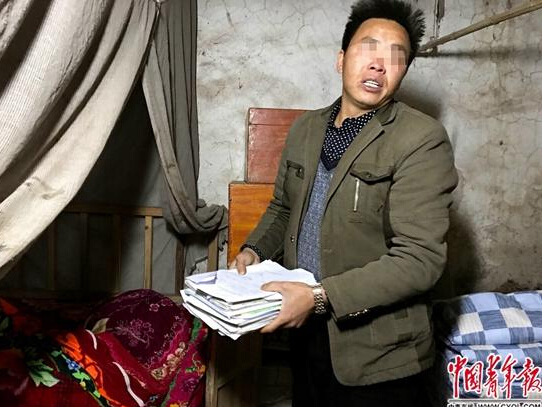
A new tomb without a tombstone chills the festive air of a family in Yanxi Village, Zhenxiong Town, Yunnan Province. The family lost a son to suicide on the Eve of Spring Festival, which fell on Jan. 27 this year.

Xiao Bao’s father collects his son’s effects. [Photo:China Youth Daily]

The boy was named Xiao Bao (pseudonym), a left-behind child growing up with his paternal grandparents in the village while his parents worked odd jobs in Kunming, the capital of Yunnan Province.

In his last words, Bao claimed, “I was still young and I didn’t want to die, but I can’t handle the complaints. Dad, you must be happy when I die. It is you rather than anyone else to be blamed for my death.”

In a dilapidated house, Bao’s grandmother couldn’t help shedding tears when talking about the tragedy of her eldest grandson, who was raised up by her and her husband since he was one year old.

Despite his rare opportunities to be reunited with his parents, Bao never ignored his responsibilities at the family farm.

His grandparents never imagined that their eldest grandson would have swallowed pesticide to end his life.

The two recalled that after dinner on that particular day, Bao shut himself alone in his room, where the ceiling is spotted with cobwebs. Later in the night, his grandma heard him vomiting. When she opened the door she was shocked by a strong smell of pesticides – the boy had drunk down half a bottle of dichlorvos.

The grandparents, who tried to send the agonized boy to hospital, were only informed by the doctor through a phone call that it was too late.

Some villagers later recalled that they had spotted Bao buying pesticides and even two chicken legs.

read more

The IFS offers more gloom

The IFS tells us in their latest forecasts that we can look forward to more years of tax rises and spending cuts. They expect the UK economy to slow this year, and slow again next year.  They are out of touch with the mood to banish austerity and go for growth.

They are more pessimistic about the Eurozone than about the UK. They have lowered their 2017 growth forecast to 1.5% for the Euro area, whilst proposing 1.6% for the UK. They run one scenario which looks at what weak European banks and Brexit could do to their forecast – an unusual pairing with no explanation of why they are lumped togather or the relative contributions to their extra gloom on this basis.

They do confess that there are “increasing chances that the forecasts may be too pessimistic”. They accept that the UK consumer carried on spending post the referendum when most forecasters said they would not. They admit that business investment rose a little faster after the vote, instead of falling off the cliff as in many forecasts. They agree that trade which had performed disappointingly last year might add a bit to our economy in 2017.

They confess that “real levels of day to day public service spending have actually fallen very little overall in the last three years”. If they checked the Red Book figures they would see the cash growth in overall public spending actually rose faster than inflation over that time period.  They now think removing the deficit should be the priority, which leads them to conclude political parties have to offer some combination of higher taxes and lower spending.

Politically it is much more attractive to square the circle with more growth. More growth brings in more tax revenue without tax rate rises. It cuts the costs of benefits as people move from no pay to low pay, and from low pay to better pay. The issue before us should be what more can we do to promote growth.

I do not accept that growth will be as low as they say in 2017 or 2018. That still makes me keen to find more measures which can promote more growth. A tax rate cutting budget could help, especially if we cut those tax rates that are damaging the revenue collected. Spending enough on social care and health is a cross party priority, and we have to accept these services will continue to need  more cash in the future. Investing more when long term interest rates  are still so low should make sense, though the state needs to show commonsense over projects chosen and where possible harness the private sector to ensure a proper profit test on the project.

read more

Senior UN officials call for close cooperation to address migrant, refugee flows in Libya

10 February 2017 – The heads of the United Nations agencies for human rights, migrants, and refugees, and the UN envoy for Libya, today met in Geneva calling for international solidarity to address the flows of migrants and refugees in the North African country.

The senior UN officials stressed the need &#8220for a comprehensive approach to address the situation of migrants and refugees in Libya as well as to assist the hundreds of thousands of Libyans displaced and impacted by the crisis,&#8221 according to a press release.

The meeting was between the Director-General of the International Organization for Migration (IOM), William Lacy Swing; the UN High Commissioner for Refugees, Filippo Grandi; the UN High Commissioner for Human Rights, Zeid Ra’ad Al Hussein; and the Special Representative of the UN Secretary-General for Libya, Martin Kobler.

They called for close cooperation at the regional and international levels, and highlighted the need to protect and rights of migrants and refugees.

&#8220Along with many Libyans, migrants and refugees are heavily impacted by ongoing conflicts and the breakdown in law and order in Libya,&#8221 the four senior UN officials said.

They noted that untold numbers of people &#8211 particularly those smuggled or trafficked, and those in detention outside of any legal process &#8211 face &#8220grave human rights abuses and violations.&#8221

Migrants and refugees are also exposed to malnutrition, extortion, torture, sexual violence and other abuses, according to the joint press release.

read more

Haiti: Peacekeeping chief points to changes in mandate of UN mission

10 February 2017 – While the security situation in Haiti is &#8220not perfect,&#8221 solid progress has been made over the past few years, the head of United Nations peacekeeping operations has said, stressing that the Organization is considering a change in the mandate of the UN Stabilization Mission in the island nation, known as MINUSTAH.

Wrapping up a week-long visit during which he attended the swearing in of the new Haitian President, Jovenel Moïse, and carried out an out an evaluation of Mission, Hervé Ladsous, the Under-Secretary-General for Peacekeeping Operations, told reporters yesterday in Port-au-Prince: &#8220The military component of MINUSTAH is likely to disappear in the relatively near future. We are looking at the modalities.&#8221

At the heart of the Mission’s work is ensuring stability, he continued, noting that the recent elections had gone off with few incidents, thanks to MINUSTAH and particularly the Haitian National Police, and the Provision Electoral Council. &#8220I think this is something to be noted,&#8221 he said.

He recalled that in October 2016, when the UN Security Council renwed MINUSTAH’s mandate, it had expressed its wish to examine the mandate of the Mission in mid-April. The Secretary-General is to make recommendations to the Security Council on 15 March.

“I think that when we look at the situation in this country compared to what it was a few years ago, we have made a lot of progress,” Ladsous said. “Security is not perfect, but I think it is much better.”

Mr. Ladsous went on to note that the regular strength of the Haitian National Police is set to reach 15,000 and that efforts will continue to strengthen the capacities of this police.

read more