New ‘carrier killer’ delivered to fleet

The People’s Liberation Army Navy on Sunday commissioned its fifth Type 052D guided missile destroyer to the North Sea Fleet.

Rear Admiral Zhang Wendan, commander of the North Sea Fleet, views the guard of honor on the CNS Xining in Qingdao, Shandong province, on Sunday. [Photo/China Daily]

Rear Admiral Zhang Wendan, commander of the North Sea Fleet, views the guard of honor on the CNS Xining in Qingdao, Shandong province, on Sunday. [Photo/China Daily]

The PLA Navy said in a news release on Monday that the CNS Xining, which has a hull number of 117, was delivered to a destroyer flotilla of the North Sea Fleet at a naval base in Qingdao, Shandong province.

The fleet’s new commander, Rear Admiral Zhang Wendan, who was deputy chief of staff of the PLA Southern Theater Command, conferred the flag to Captain Zhou Minghui, commander of the Xining.

The news release said that the Xining has a stealth design and can act as a flagship for a strike group. It is capable of conducting anti-ship, anti-submarine and air defense operations, it said.

The Type 052D class is deemed by military experts to be the mightiest destroyer and the most capable fleet escort deployed by the PLA Navy. With a large load of anti-ship and land attack cruise missiles, it has been described by some Western observers as a “carrier killer”.

According to military sources, a Type 052D destroyer has a full displacement of nearly 7,000 metric tons and a wide range of weapons, including a single-barrel 130-mm naval gun and a close-in weapon system as well as a total of 64 HHQ-9 long-range anti-aircraft missiles and YJ-18 or YJ-83 anti-ship cruise missiles. Adopting a host of cutting-edge technologies, the vessel features a low radar signature, a high information level and a state-of-the-art phased array radar.

The first Type 052D destroyer, the Kunming, joined the PLA Navy in March 2014. The second, the Changsha, started active service in August 2015. The third, the Hefei, was delivered to the Navy in December 2015 while the fourth, the Yinchuan, was commissioned in July last year. All of them belong to the South Sea Fleet. The Xining is the first such vessel to serve with the North Sea Fleet.

A Navy officer told China Daily on condition of anonymity that compared with other Chinese warships he has served with, the Type 052D class features better performance in terms of target detection, air defense, strike precision and joint operations.

China to start 15 new major water conservation projects

China will start 15 new major water conservation projects in 2017 amid efforts to boost investment and stabilize growth, the country’s top economic planner said Monday.

Total investment in major water projects under construction should exceed 900 billion yuan ($131.3 billion) by the end of this year, compared with the current level of 800 billion yuan, said Wu Xiao, an official with the National Development and Reform Commission (NDRC), at a conference.

In 2016, 21 major water projects were started.

With its economy slowing, China views infrastructure investment as significant in boosting growth.

China’s fixed-asset investment continued to cool in 2016, growing 8.1 percent year on year, down from 10 percent in 2015 and 15.7 percent in 2014.

However, investment in infrastructure construction accelerated by 0.2 percentage points, growing 17.4 percent year on year in 2016, official data showed.

China beats target by creating 13m urban jobs

China created 13.14 million new jobs for urban residents last year, exceeding the official target, but the country faces challenges this year to create jobs for a historic high of almost 8 million university graduates.

University graduates attend a job fair in Shanghai early this month.[Photo/Xinhua]

University graduates attend a job fair in Shanghai early this month.[Photo/Xinhua]

The registered unemployment rate in Chinese cities stood at 4.02 percent at the end of last year, down from 4.04 percent three months earlier, Lu Aihong, an official with the Ministry of Human Resources and Social Security, told a news conference on Monday.

He said the country has “obtained obvious achievements” in promoting entrepreneurs to create jobs through the construction of incubation bases, and the government has also encouraged migrant workers to start businesses in their hometowns.

The government pledged to keep the whole-year registered unemployment rate below 4.5 percent and create at least 10 million jobs last year.

According to the Ministry of Human Resources and Social Security, China created 13.12 million jobs in 2015, and the registered unemployment rate in cities stood at 4.05 percent.

“The employment situation this year is stable, but there is also something to be worried about,” Lu said.

Though the Chinese laboring population has been declining since 2012, some laborers entered the market comparatively late due to educational reasons, which will keep the demand for jobs high in cities this year, and the rural laborers who are entering cities for work also increase the demand, he said.

He said employment pressure also comes from the task of re-employing workers laid off from a reduction in capacity and the downward pressure on the economy.

Meanwhile, Lu said he is expecting more jobs to be created as the country reforms its economy amid the acceleration of urbanization and the promotion of the Belt and Road Initiative.

This year, there will be 7.95 million university graduates-300,000 more than last year.

Lu said the ministry will encourage graduates to work in grassroots organizations and encourage them to start their own businesses.

Chen Yang, 27, a senior postgraduate at the School of Government, Nanjing University, said he thinks the employment situation this year will be “not that bad”.

“As far as I am concerned, one-third of the 2017 graduates have guaranteed themselves a job, though they are still several months away from graduating,” he said.

Chen, who hasn’t found a job yet, doesn’t show much interest in working for grassroots organizations, though it’s “possible” that there might be good opportunities there, he said.

China’s hi-res SAR imaging satellite put into use

China’s first high-resolution Synthetic Aperture Radar (SAR) satellite has passed all its in-orbit tests and is now operational, according to the State Administration of Science, Technology and Industry for National Defense on Monday.

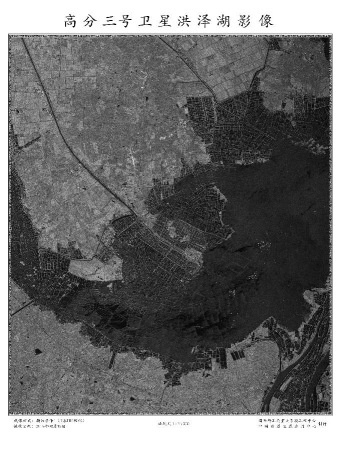
Released photo shows the image of east China's Hongze Lake, which is received from China's first high-resolution synthetic Aperture Radar (SAR) satellite on Aug. 15, 2016. (Xinhua/State Administration of Science, Technology and Industry for National Defense)

Released photo shows the image of east China’s Hongze Lake, which is received from China’s first high-resolution synthetic Aperture Radar (SAR) satellite on Aug. 15, 2016. (Xinhua/State Administration of Science, Technology and Industry for National Defense) 

The Gaofen-3 satellite, which is accurate to one meter in distance, was launched in August 2016.

Tong Xudong, a senior engineer with the administration, said the satellite covers the globe with an all-weather, 24-hour observation service and will be used for disaster prevention and reduction, ocean monitoring, and the protection of maritime rights.

Gaofen-3 is China’s first low orbit remote sensing satellite to have a long lifespan.

With 12 imaging modes, Gaofen-3 has the most imaging modes in the SAR imaging satellite family. The high-definition observation satellite is capable of switching freely between various imaging modes, taking wide pictures of both earth and bodies of water, and detailed photographs of specific areas.

Gaofen-3’s spatial resolution ranges from one meter to 500 meters and its largest viewing swath is 650 kilometers.

According to the administration, Gaofen-5 hyerspectrual satellite is planned to be launched in September 2017.

More than words, ending Yemen crisis needs results, UN envoy says, concluding mission in capital

23 January 2017 – The United Nations Special Envoy for Yemen, Ismail Ould Cheikh Ahmed, today concluded a mission to Yemen with a call for a comprehensive political settlement of the crisis and the restoration of the cessation of hostilities, and underlined the need allow access of civilian commercial aircrafts to and from Sana’a airport.

“It is mandatory that the parties end the violence to ease the suffering of the Yemeni people and pave the way for a peacefully negotiated settlement,” said Mr. Cheikh Ahmed.

In his meetings, Mr. Ould Cheikh Ahmed urged his interlocutors to enter into detailed discussions on the withdrawal of forces and handover of medium and heavy weapons.

“There is an urgent need for Ansar Allah and the General People’s congress to provide a well elaborated plan on security, withdrawal and handover of medium and heavy weapons,” he said, noting that the plan constitutes an essential part of the comprehensive peace agreement which is the UN is aiming to implement.

“What we need at this stage is more than words, what we need is commitment and results. Delays in providing the plan will result in delays to achieving peace and allow for more deaths and further economic and humanitarian deterioration,” he added.

Further, the UN Special Envoy called on all relevant actors to take necessary measures to lift restrictions on civilian commercial aircrafts to access Sana’a International Airport.

Restrictions on travel in and out of Sana’a airport have prevented scores of Yemenis from receiving badly-needed medical treatment and have also left many others stranded outside the country.

“This cannot continue,” he stressed, calling on the Government of Yemen to “allow the resumption of commercial flights to Sana’a without further delay and for all parties to ensure the safety of the airport and air traffic.”