China to build 6M homes for shantytown-dwellers in 2017

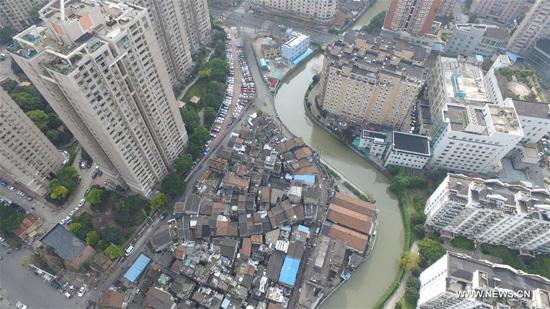
Aerial photo taken on Jan 9, 2017 shows view of Zhangqiao, one of the largest shantytowns, and surrounding estate in Hongkou district, East China’s Shanghai. [Photo/Xinhua]

China will build 6 million new homes for residents of shantytowns before the end of 2017, said Chen Zhenggao, Minister of Housing and Urban-Rural Development, at a news briefing in Beijing on Feb 23.

The Chinese central government started a three-year project to rebuild urban shantytowns in 2015, aiming to construct a total of 18 million new homes in all. In 2015, construction began on 6.01 million new dwellings, and another 6.06 were started in 2016.

According to Chen, the Ministry of Housing and Urban-Rural Development (MHURD) kicked off this year’s shantytown transformation work on Jan. 16. The central government has provided 224.3 billion RMB in subsidies for the work in 2017, an increase of 15 billion RMB compared with last year.

China is determined to reconstruct all of its existing shantytowns by 2020. MHURD is working with relevant departments to conduct a thorough investigation and make the planned transformation a reality.

The need for decent banks

It has been fashionable to bash banks and bankers ever since the 2008 crash. Politicians have often been keen to criticise, as they enjoy finding a category of people more unpopular than themselves. The commercial banks were a useful whipping boy when there had been a  monumental failure of monetary policy. The Regulators had allowed or encouraged the banks to expand credit and investment banking activity too far too fast, and had then sought to collapse the asset bubble and bank sheets too quickly when they changed their minds. They obviously wished to public to concentrate on the banks that failed to manage within this unreliable framework, rather than on those who had created a boom bust cycle.

Today the US banks are largely mended and capable of financing a reasonable recovery. The UK banks have much stronger balance sheets and have taken much of the pain for past bad loans and wrongful trading practices. RBS still struggles to make a profit and to put it itself in a strong enough position to return to the private sector. On the continent there are more weak banks.

A successful economy needs a group of competing commercial banks capable of offering low risk savings products to savers, and lending the money on to individuals and companies that can afford to borrow. The hatred of debt that is often manifest in many modern commentaries is unrealistic. A growing and flourishing economy needs some debt. Young people need to borrow to buy a home or to establish a business. They can repay the debts out of future earnings.  Larger companies need to borrow to put in large scale modern plants to meet future demand. They can repay the debts out of future revenues and profits from the plants. Property companies need to borrow to put up good modern buildings, which they can let to other users in the society to pay off the borrowings.

Some worry about the overall level of debts. This should not be a reason to deny new borrowers who have plenty of unpledged income the opportunity to buy a home or capital asset on borrowed money. If 35-50 years olds have borrowed too much, there is no need to take it out on 20-35 year olds who may have good cause to borrow. If a government  has borrowed too much – and the UK government has not – it need not prevent individuals and companies in that country borrowing more.

Mr Trump and his Treasury team are wanting to relax the credit creating banks a bit. That will be a healthy development. The US needs more investment in productive capacity, homes and infrastructure. There are companies and individuals who could afford to borrow to help do this. The UK too needs to ensure a sensible pace of additional private borrowing to continue a decent rate of economic growth.

UN rights experts urge action to curb ‘invisible threat’ of toxic air

24 February 2017 – United Nations human rights experts are calling for strong, urgent action by States to ensure that people around the world can enjoy the human right to live in environments free from contamination.

&#8220Air pollution is a major threat to human rights worldwide and toxic air pollutants are associated with an increased risk of disease from stroke, heart disease, cancer and respiratory diseases, including asthma,&#8221 the UN Special Rapporteur on human rights and hazardous substances and wastes, Baskut Tuncak, said in a news release issued today by the Office of the UN High Commissioner for Human Rights (OHCHR).

Three million deaths each year are linked to exposure to outdoor air pollution, according to estimates from the World Health Organization (WHO). There is also growing research evidence indicating that air pollution has become the leading environmental cause of death in the world.

Joining Mr. Tuncak in the appeal are Dainius Puras, the Special Rapporteur on the right of everyone to the enjoyment of the highest attainable standard of physical and mental health, and John H. Knox, the Special Rapporteur on the issue of human rights obligations relating to the enjoyment of a safe, clean, healthy and sustainable environment.

Silent pandemic

&#8220Children and people in vulnerable situations, including women of reproductive age, the elderly, those in poor health and those living in less wealthy communities remain the most vulnerable,&#8221 the experts warned.

According to the UN Children’s Fund (UNICEF), 300 million children &#8211 almost one in seven of the world’s total, live in areas with the most toxic levels of outdoor air pollution, a situation paediatricians describe as a ‘silent pandemic.’

A threat like this can no longer be ignored

&#8220A threat like this can no longer be ignored,&#8221 they said. &#8220States have a duty to prevent and control exposure to toxic air pollution and to protect against its adverse effects on human rights.&#8221

The experts said that impunity for those responsible for air pollution is rampant today, with recent reports of environmental ministers even denying its effects, in spite of overwhelming evidence to the contrary.

They stressed the need for cross-border cooperation to promote the adoption of preventive and control measures in the energy, industrial and transportation sectors, as well as the need for investment in infrastructures and long-term incentives.

&#8220Improving the regulation of toxic emissions from industrial sources and vehicles, strengthening waste management and recycling practices, and promoting renewable energies are crucial steps to effectively address air quality issues and public health,&#8221 the experts concluded.

Special Rapporteurs and independent experts are appointed by the Geneva-based UN Human Rights Council to examine and report back on a specific human rights theme or a country situation. The positions are honorary and the experts are not UN staff, nor are they paid for their work.
To win power to rebuild and transform Britain, Labour will go further to reconnect with voters, and break with the failed political consensus – Corbyn

Jeremy Corbyn MP, Leader of the Labour Party,
commenting on the Stoke-on-Trent Central and Copeland by-elections, said:

“Labour’s victory in Stoke is a decisive rejection of UKIP’s
politics of division and dishonesty. But our message was not enough to win
through in Copeland. 

"In both campaigns, Labour listened to thousands of
voters on the doorstep. Both constituencies, like so many in Britain, have been
let down by the political establishment.

“To win power to rebuild and transform Britain, Labour will go
further to reconnect with voters, and break with the failed political
consensus.”