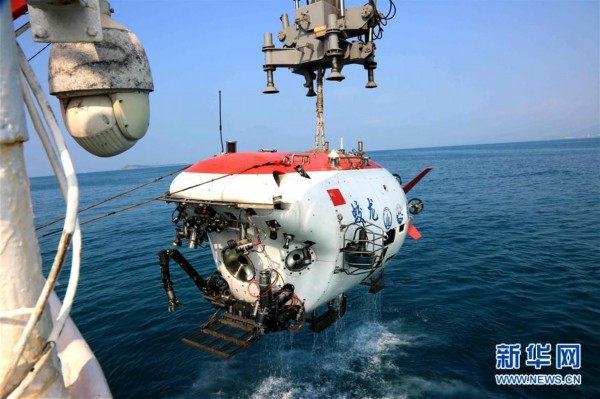
Chinese submersible Jiaolong completes S. China Sea dive

Jiaolong submersible goes through a dive simulation in Sanya, Hainan Province, on April 22. [Photo/Xinhua]

Jiaolong, China’s manned submersible, completed a dive Wednesday in the South China Sea.

Departing its mother ship Xiangyanghong 09 at around 7 a.m., Jiaolong stayed underwater for nine hours and twelve minutes for the dive before returning at around 4:19 p.m.

It managed to bring 16 liters of sea water samples collected near the seabed, eight sediment samples and two rock samples back to Xiangyanghong 09, in addition to high-definition photos and video footage shot during the mission.

Wednesday’s dive marks the first dive by Jiaolong in the second stage of China’s 38th ocean scientific expedition, which will last until May 13.

The maximum depth of the Jiaolong mission on Wednesday was 1,741 meters below sea level, and the submersible spent some seven hours on the seabed.

Three staff, including one seasoned crew member, Tang Jialing, and two interns, Liu Xiaohui and Yang Yifan, were on board the submersible.

“This is almost Jiaolong’s longest underwater mission,” said Tang.

In an interview with Xinhua prior to the drive, Yang Yaomin, chief scientist for the second stage expedition, said experts had planned to choose a site for experimenting with the collection of polymetallic nodules during the mission.

“We are working to avoid damaging the marine environment in mining,” said Yang. “The expedition will help develop technology for environmentally friendly deep-sea mining.”

Polymetallic nodules are mineral resources that are generally deposited more than 4,000 meters deep beneath the sea’s surface and contain manganese, iron, copper, nickel, cobalt as well as rare earth elements.

During the expedition, manned deep-sea submergence was also conducted in the seamount chain and continental slope areas in the South China Sea, according to scientist Shi Xuefa.

“We plan to carry out geological and biological surveys in the region,” said Shi. “The submersible will take photos of the distribution of polymetallic nodules, deep-sea life and seafloor terrain.”

The rock samples collected from the seamount will be used in research in chronology, mineralogy and geochemistry on the South China Sea, advancing the study of the region’s structural evolution, according to Shi.

The 38th oceanic scientific expedition started on Feb. 6. Jiaolong completed a dive in the northwestern Indian Ocean earlier this year in the mission’s first stage. It will also conduct surveys in the Yap Trench and the Mariana Trench in the third stage.

Named after a mythical dragon, Jiaolong reached its deepest depth of 7,062 meters in the Mariana Trench in June 2012.
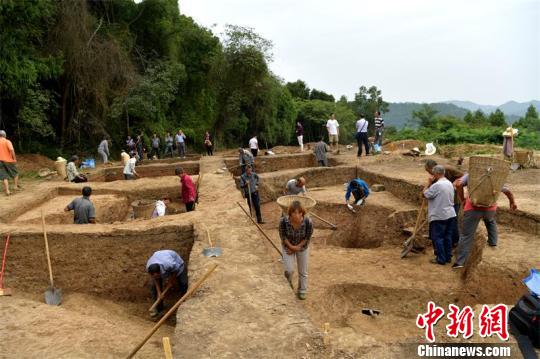
5,000-yr-old ruins found at SW China construction site

The ruins is found on Lingshan Mountain in the ancient city of Langzhong last July, when villagers were building a reservoir. [Photo/Chinanews.com]

Archaeologists announced Wednesday neolithic ruins dating back 4,500 to 5,000 years had been found in southwest China’s Sichuan Province.

The ruins was found on Lingshan Mountain in the ancient city of Langzhong last July, when villagers were building a reservoir, said Sun Zhibin, from the Sichuan Provincial Cultural Relics and Archaeology Research Institute.

A team led by Sun excavated the ruins from Sept. 2016 to Jan. 2017.

A total of 108 items were found at the ruins, including porcelain pots and plates, and stone tools, such as axes and spears.

“The discovery has provided new material for the research on cultural blending in the Sichuan Basin and its surrounding culture,” he said.

The discovery, the first ruins dating back to the late neolithic period near the middle reaches of Jialing River, has put back human activity at Langzhong from 3,000 years ago to 4,500 to 5,000 years ago, said Sun.

China seeks breakthroughs in combatting smog

Heavy smog hits Beijing. [Photo/China.org.cn]

Heavy smog hits Beijing. [Photo/China.org.cn]

China will increase research on smog in its battle against air pollution in Beijing and surrounding areas.

Government agencies, including environmental protection authority, academies and institutions will work together to integrate resources, according to reports of a State Council executive meeting presided over by Premier Li Keqiang on Wednesday.

Scientists working on anti-smog research may be given extra funding from the central budget.

The work will focus on causes of the heavy seasonal air pollution, emission control and health.

The government hopes to improve air quality and explore transferable pollution control systems for all parts in the country which suffers from smog.

China is addressing air pollution with stricter measures on emissions and an emphasis on clean energy. The Minister of Environmental Protection Chen Jining said earlier this week that Chinese cities reported more “good air” days in 2016.

Inequalities between rich and poor temper broad success of immunization – UNICEF

26 April 2017 – Even though billions of doses of vaccines for children across 100 countries around the world were supplied in 2016, millions of children – especially those in conflict zones – still miss out on life-saving inoculations, the United Nations Children’s Fund (UNICEF) has warned.

“All children, no matter where they live or what their circumstances are, have the right to survive and thrive, safe from deadly diseases,” Robin Nandy, the Chief of Immunization at UNICEF, said in a news release.

Access to immunization has led to a dramatic decrease in deaths of children under the age of five from vaccine-preventable diseases, and has brought the world closer to eradicating deadly scourges like polio and measles but despite this progress, 1.5 million children still die from diseases which can be prevented by vaccines.

According to estimates, 19.4 million children around the world still miss out on full vaccinations every year.

Around two thirds of all unvaccinated children live in conflict-affected countries. Weak health systems, poverty and social inequities also mean that one in five children under the age of five is still not reached with life-saving vaccines.

On top of this, persisting inequality between rich and poor children further exasperate the problem.

In countries where 80 per cent of the world’s under-five child deaths occur, over half of the poorest children are not fully vaccinated. Globally, the poorest children are nearly twice as likely to die before the age of five as the richest.

“In addition to children living in rural communities where access to services is limited, more and more children living in overcrowded cities and slum dwellings are also missing out on vital vaccinations,” said Dr. Nandy.

“Overcrowding, poverty, poor hygiene and sanitation, as well as inadequate nutrition and health care increase the risk of diseases such as pneumonia, diarrhoea and measles in these communities; diseases that are easily preventable with vaccines,” he added.

Furthermore, given predictions that one in four people could be living in urban poor communities, mainly in Africa and Asia by 2030, the focus and investment of immunization services must be tailored to the specific needs of these communities and children, noted UNICEF.

This re-focusing of efforts is all the more important given that efforts in these communities would be crucial for the implementation of the Sustainable Development Goals (SDGs).

Labour announce candidate for seat where members have no faith in Corbyn

26 Apr 2017

JCChoice

Labour have announced their candidate to fight the East Renfrewshire seat in the upcoming Westminster election – even though members there don’t have any faith in their leader.

Blair McDougall will contest the seat in June’s vote.

However, he will have to convince voters to back Labour despite the fact the party’s own branch doesn’t endorse Jeremy Corbyn.

In an open letter, 14 members across Eastwood said Corbyn “cannot provide the leadership” to form a government.

They added: “We need a credible, competent opposition, but Jeremy Corbyn is currently unable to fill all positions on his front bench. Jeremy Corbyn wants to captain a ship for which he has no crew. For the good of the party and, more importantly, the country, he must step aside.”

And McDougall himself has been a regular critic of Corbyn.

During the leadership election he backed Owen Smith on the basis “we cannot win with Jeremy”.

He also described as “fantasy” a remark by Corbyn that Labour were ahead in the polls last year.

Scottish Conservative deputy leader and MSP for Eastwood Jackson Carlaw said:

“How can the Labour candidate in East Renfrewshire expect people’s votes, when members themselves won’t back Jeremy Corbyn?

“It demonstrates the chaotic state the Labour party finds itself in.

“Even Blair McDougall thinks Jeremy Corbyn can’t win, which tells voters across East Renfrewshire everything they need to know.

“Only our candidate, Paul Masterton, can beat the SNP here, as we did at last year’s election.”


The open letter from Labour members is available here: http://labourhame.com/scottish-labour-members-call-for-corbyn-to-go/

The Scottish Conservative candidate for East Renfrewshire is Paul Masterton.

To see a list of critical tweets and retweets by Blair McDougall about Jeremy Corbyn, visit:

https://twitter.com/blairmcdougall/status/767111872025878529 https://twitter.com/blairmcdougall/status/763811597554941952 https://twitter.com/blairmcdougall/status/759477962714513408 https://twitter.com/blairmcdougall/status/766772372955357184 https://twitter.com/blairmcdougall/status/768759041514405888