Thousands of children out of school as classrooms shelled in eastern Ukraine – UNICEF

image_pdfimage_print

7 February 2017 – With thousands of children forced out of school in eastern Ukraine due to last week’s surge in fighting, the United Nations Children’s Fund (UNICEF) and its partners have strongly condemned the indiscriminate shelling of schools, and called for all sides to immediately recommit to the ceasefire signed in Minsk in August 2015.

&#8220The shelling of schools, the one place where children find safety and normalcy during conflict, is unacceptable and has to stop,&#8221 said UNICEF’s Representative in Ukraine, Giovanna Barberis, in a news release. &#8220Children in eastern Ukraine have suffered enough and we must ensure that they have safe spaces to seek solace and support.&#8221

At least five schools and two kindergartens have been damaged by heavy shelling and 11 other schools have had to close, according to humanitarian organisations supporting the emergency education response in Ukraine.

More than 2,600 children from 13 schools in government-controlled areas in eastern Ukraine have been affected by the sharp escalation in fighting, along with hundreds more from schools in non-government controlled areas.

&#8220Schools being shelled has tragically become commonplace in this conflict,&#8221 said Save the Children’s Representative in Ukraine, Michele Cecere. &#8220There are reports of large numbers of unexploded ordnance in the streets, putting children at enormous risk when going to school, even when they can reopen. It’s vital that children can get safely back to school as soon as possible so they don’t miss out on any more learning.&#8221

In the town of Avdiivka, seven schools and kindergartens remain shut, with almost 1,400 children out of school. Families in Avdiivka and other villages in the area are afraid of sending their children to the schools that remain open, due to the heavy fighting and fears of unexploded ordnance in the streets.

The latest closure of schools has worsened the ongoing education crisis already affecting more than 600,000 children in eastern Ukraine. After nearly three years of conflict, more than 740 school &#8211 one in five &#8211 have been damaged or destroyed, resulting in girls and boys missing many months of schooling due to displacement and the effects of conflict.

UNICEF and Save the Children urged all parties to the conflict to respect international humanitarian law and ensure that schools and other civilian infrastructure are never attacked or in the line of fire.
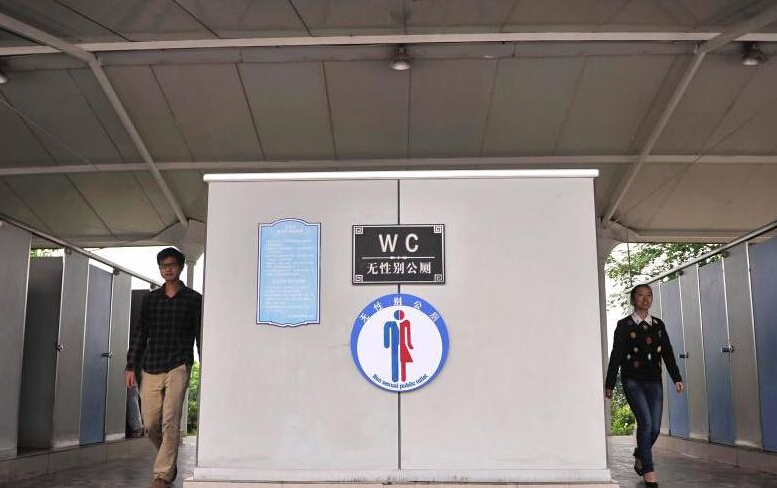
Top attractions to install unisex toilets

image_pdfimage_print

Pedestrians use unisex toilets in Chongqing City on April 24, 2015.[Photo:gmw.cn] 

China’s top-ranking tourist attractions should be equipped with unisex toilets to meet higher standards, said a top tourism official on Feb. 4.

As part of a “toilet revolution” scheme that aims to boost tourism through cleaner and better-managed public conveniences, China will build 271 unisex toilets and renovate 333 at the country’s 5A scenic spots, according to Li Jinzao, head of the China National Tourism Administration.

As an alternative to gender segregated restrooms, unisex toilets are installed for people with disabilities, the elderly, the young and anyone who may require the assistance of someone of another gender.

A typical unisex restroom is equipped with a 45-centimeter toilet, a 70-centimeter safety pole, a clothes hook and an emergency call button to meet the needs of different people.

China is making steady progress to improve toilet sanitation nationwide since the “revo-loo-tion” began in 2015.

A total of 50,916 toilets have been installed or upgraded so far, 89.33 percent of the official target the government announced for the three years through to 2017, said Li.

Beijing receives over 2 bln cubic meters of water from Yangtze

image_pdfimage_print

As of 10 a.m. on Feb 1, the middle route of the South-to-North Water Diversion Project had supplied Beijing with over 2 billion cubic meters of water, of which nearly 70 percent are for drinking.

Water plants got 1.369 billion cubic meters, accounting for 68 percent of the total. Currently the average daily flow into Beijing hit 1.05 million, with 0.93 million supplied to water plants.

11 million people in Beijing have got access to water from the Yangtze River. In addition, 284 million cubic meters were stored in reservoirs, with the rest used for groundwater, rivers and lakes.

Beijing attracted 671 new ‘cutting-edge’ projects in 2016

image_pdfimage_print

A night view of Zhongguancun Science Park in Beijing. [Photo/China.org.cn]

A total of 671 major projects in high-tech and sophisticated industries were registered in Beijing last year, according to the annual work meeting of the city’s investment promotion bureau.

In the same period, the bureau managed to attract 747 foreign-funded projects, with a combined value of US$7.02 billion, up by more than 10 percent year on year. Newly registered enterprises paid 15.2 billion yuan (US$2.22 billion) in total in tax last year,

“Since 2016, the investment promotion bureau has been endeavoring to remove the city’s non-capital functions to make the city more livable,” said Zhou Weimin, director of the Beijing Investment Promotion Bureau.

Zhou said these endeavors were the reason that the bureau put a priority over high-tech industries, high-end and high-quality service industries, and high-value cultural industries last year.

The business sector’s growing willingness to invest in Beijing reflects the perfect, amicable business environment of the Chinese capital. In particular, the city’s business administration, tax, finance, among other government agencies are exploring innovative, new measures that could provide good templates for other cities to follow.

For example, among the 40 innovative, new measures in the city’s service sector, there is China’s first aircraft maintenance company formed by a joint-venture and China’s first joint-venture tourism agency dealing with Chinese citizens’ overseas trips.

While the city keeps promoting cutting-edge industries and projects, local enterprises have accelerated their pace in going overseas. Data shows that in the first three quarters of last year, foreign direct investment (FDI) totaled US$13.75 billion, a 94-percent year-on-year increase. The FDI figure was basically on par with US$12.62 billion, the amount of investment Beijing attracted over the same period.

Zhou Weimin said that in 2017, the investment promotion bureau will continue to serve the city’s objective of developing the service-based economy, knowledge-based economy, green economy and headquarters economy, helping control the city’s population, contribute to stable growth and facilitate private investment.

Beijing vows to clear out non-capital functions

image_pdfimage_print

Beijing Mayor Cai Qi addresses a symposium with state media on Sunday.  

Beijing Mayor Cai Qi vowed to remove Beijing’s non-capital functions at a symposium with state media on Sunday.

Cai said that to remove non-capital functions of Beijing is to do the supply-side structural reform, to make structural adjustments and transform the economical growth pattern, as well as to clear out outdated industries and fill in advanced industries.

The task also entails improving the quality of urban development and living environment as well as the ease of tensions between population, resources and environment, Cai added.

He said Beijing will perform better as the capital and make headway in development through the move.

Beijing will remove non-capital functions for optimization of economic and spatial structure, stepping on a new path featuring sound structure, high quality and efficiency.

For the next step, Beijing will focus on scientific and technological innovation and boost sophisticated industries.