Western Sahara: UN chief Guterres urges Morocco and Polisario Front to de-escalate tensions in buffer strip

image_pdfimage_print

25 February 2017 – Deeply concerned about increased tensions in the vicinity of Guerguerat in the buffer strip in southern Western Sahara between the Moroccan berm and the Mauritanian border, United Nations Secretary-General António Guterres today called on Morocco and Frente Polisario to &#8220take all necessary steps&#8221 to avoid escalation.

According to a statement issued by UN Spokesman Stéphane Dujarric, armed elements of both Morocco and Frente Polisario (Polisario Front) remain in close proximity to each other, a position they have been in since August 2016, monitored during daylight hours by the UN Mission for the Referendum in Western Sahara (MINURSO).

&#8220The Secretary-General calls on both of the parties to exercise maximum restraint and take all necessary steps to avoid escalating tensions, be that through the actions of military or civilian actors,&#8221 the statement said, adding that Mr. Guterres also underlined that regular commercial traffic should not be obstructed and that no action should be taken, which may constitute a change to the status quo of the buffer strip.

Strongly urging the parties to unconditionally withdraw all armed elements from the buffer strip as soon as possible, to create an environment conducive to a resumption of the dialogue in the context of the political process led by the UN, the Spokesman said Mr. Guterres further called on the parties to adhere to their obligations under the ceasefire agreement and to respect both the letter and the spirit of it.

Western Sahara is located on the north-west coast of Africa bordered by Morocco, Mauritania and Algeria. The colonial administration of Western Sahara by Spain ended in 1976. Fighting later broke out between Morocco and the Polisario Front. A ceasefire was signed in September 1991. MINURSO was deployed that year to monitor the ceasefire between the Government of Morocco and the Polisario Front and organizing, if the parties agree, a referendum on self-determination in Western Sahara.

A revised settlement plan was proposed by the United Nations after seven years of diplomatic consultations was rejected by one of the parties in 2004. In approving the current phase of direct negotiations in 2007, the UN Security Council called for &#8220a just, lasting and mutually acceptable political settlement which will provide for the self-determination of the people of Western Sahara.&#8221

East China hotel fire traps people

image_pdfimage_print

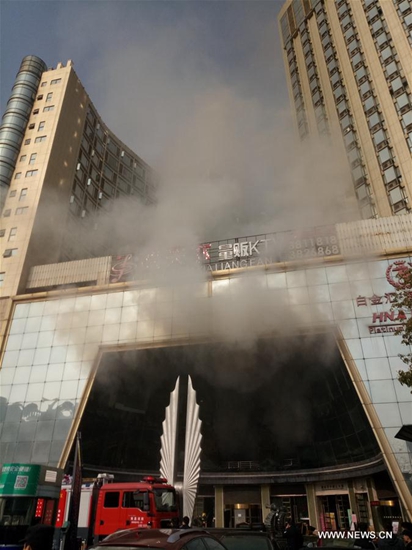
Photo taken on Feb. 25, 2017 shows the fire site in a hotel in Nanchang, capital of east China’s Jiangxi Province. The fire broke out Saturday morning, trapping an unknown number of people. [Photo: Xinhua]

A fire broke out in a hotel Saturday morning in Nanchang, capital of east China’s Jiangxi Province, trapping an unknown number of people, authorities said.

The fire was spotted on the second floor of the HNA Platinum Mix Hotel in the Honggutan New District at about 8 a.m., firefighters said.

More than 10 construction workers were working on a decoration project on the second floor when the fire broke out, said a woman who escaped from the fire.

A man who broke the window to jump from the second floor was injured and rushed to hospital.

The four-story hotel is connected to a 24-story apartment building, where people are also found trapped, as Xinhua reporters saw on the site.

About 10 fire trucks are working to put out the fire.

Blueprint for a better Beijing set

image_pdfimage_print

Beijing should improve city planning and construction to build a “harmonious, world-class capital city” and better meet the demands of its residents, said President Xi Jinping, also general secretary of the Communist Party of China Central Committee, on Friday.

The city should take comprehensive measures to tackle problems that people care about most, such as air pollution, traffic jams, surging housing prices and too large a population, he said at a meeting after a two-day inspection.

Beijing should improve people’s livelihoods and provide better public services for the people, he said while presiding over a high-profile meeting in the Great Hall of the People to discuss how to improve Beijing’s city management and preparation work for the 2022 Winter Olympics.

“Whether its city planning and construction are good should be measured by how satisfied people are,” he was quoted by China Central Television as saying.

During the two-day inspection tour, Xi visited the construction site of Beijing’s new airport in the southern suburban district of Daxing and major stadiums that are to host Winter Olympics events.

He also visited Tongzhou district, the administrative sub-center of Beijing.

At the airport construction site, Xi urged workers and managers to adopt the strictest standards to ensure building quality.

Xi also stressed city planning and urged officials to study and devise effective policies to ensure Beijing’s sustainable development.

Beijing should stick to improving its core functions as the capital and move its non-capital functions out of the city to ease its population and environmental pressures, he said at the meeting.

On Thursday, Xi listened to a report by municipal departments on the traffic integration of Beijing, Tianjin and Hebei province.

The government put forward a national strategy in 2014 to promote coordinated development of the three regional economies so that the Beijing-Tianjin-Hebei region will grow into a major growth engine for the national economy.

Zhang Liqun, an economist of the State Council’s Development Research Center, said, “The government now emphasizes development of city clusters, and megacities must help neighboring regions develop.

“In the next stage, integration of traffic and water and power supply systems will pick up speed.”

Nurses detained for locking up public-use bikes

image_pdfimage_print

A public-use bike is seen locked at a residential building in Hefei, Anhui province, in January. [Photo provided to China Daily]

Two nurses in Beijing are under administrative detention for putting their own locks on two publicly shared bikes.

“The two nurses who put private locks on public-use bikes disturbed the public order,” said Liu Lin, a lawyer at Beijing Shuangli Law Firm, because it prevented other people from using the bikes.

Those who intentionally damage property may face a five- to 10-day administrative detention, according to the Law on Public Security Administration Punishments.

Tang Ke from the publicity office of OFO, the company that owns the bikes, confirmed the news and said further investigation was underway.

The market for public-use bikes – which are stored along sidewalks and can be accessed through an app – has boomed in China since the middle of last year. The new mode of transportation has brought a greener and more convenient mode of urban transportation, but the model has also caused many problems including illegal parking, theft and vandalism. Parking violations are also a common problem, followed by violation of traffic rules.

“Once users scan the app and click ‘accept’ when they rent the bike, they have signed an agreement with the service provider and should follow the rules,” Liu said.

OFO has introduced a blacklist banning users who break its rules.

Many cities such as Beijing, Shanghai and Shenzhen are proposing draft regulations to manage the market for public bikes. The Shenzhen traffic police department has also announced fines for the illegal parking of bikes.

Beijing-Tianjin-Hebei region to roll out 6 measures to fight smog

image_pdfimage_print

Beijing is gulfed by heavy smog. [Photo/Xinhua]

The Beijing-Tianjin-Hebei region will take six new measures to continue combating smog in 2017, said Zhao Yingmin, vice minister of environmental protection.

The concentration of PM2.5 — fine particulate matter that is hazardous to human health — decreased by 7.8 percent in the region in 2016, with Beijing reducing 9.9 percent, Tianjin 1.4 percent and Hebei 9.1 percent. But the region still needs to beef up efforts in improving its air quality, especially in winter, Zhao said.

The region will adopt the following six measures in 2017. First, a total of 28 “route” cities, or cities near the Beijing-Tianjin-Hebei region that can impact the air, should meet the requirement of reducing their steel capacity ahead of schedule, and the small yet heavily polluting plants scattered around the region should be closed down by the end of October. Second, the region will promote clean heating in winter, build “coal-free zones,” close down small coal-fired boilers, and make coal consumption in the 28 “route” cities realize a negative growth. Third, the region will enhance its comprehensive work in fighting industrial air pollution, with key industries meeting emission caps and the region taking the lead in issuing pollutant discharge permits. Fourth, while cement and casting industries in the region continue to halt production in winter, cities such as Shijiazhuang, Tangshan, Handan and Anyang will also slash half of their steel capacity during winter heating seasons. Fifth, car emissions will be controlled. Sixth, dust at construction sites should be reduced in 2017.