UN report details ‘devastating cruelty’ against Rohingya population in Myanmar’s Rakhine province

image_pdfimage_print

3 February 2017 – In a report issued today, the United Nations human rights arm said that the widespread human rights violations against the Rohingya population by Myanmar’s security forces in the country’s northern Rakhine state indicate the very likely commission of crimes against humanity.

The flash report – issued today by the Office of the UN High Commissioner for Human Rights (OHCHR) based on its interviews with people who fled Myanmar after attacks on a border post in early October, the ensuing counter military operations and a lockdown in north Maungdaw – documents mass gang-rape, killings, including of babies and young children, brutal beatings, disappearances and other serious human rights violations by the country’s security forces.

“The devastating cruelty to which these Rohingya children have been subjected is unbearable – what kind of hatred could make a man stab a baby crying out for his mother’s milk. And for the mother to witness this murder while she is being gang-raped by the very security forces who should be protecting her,” said UN High Commissioner for Human Rights Zeid Ra’ad Al Hussein, noting the report suggests the recent level of violence to be unprecedented and added:

The gravity and scale of these allegations begs the robust reaction of the international communityHigh Commissioner Zeid

“What kind of ‘clearance operation’ is this? What national security goals could possibly be served by this?”

OHCHR noted that more than half of the women its human rights team interviewed reported having suffered rape or other forms of sexual violence. Many other interviewees reported witnessing killings, including of family members and having family who were missing.

Houses deliberately set on fire, people pushed inside burning houses – report

The report also cites consistent testimony indicating that hundreds of Rohingya houses, schools, markets, shops, madrasas and mosques were burned by the army, police and sometimes civilian mobs. Witnesses also described the destruction of food and food sources, including paddy fields, and the confiscation of livestock.

It also noted that several people were killed in indiscriminate and random shooting – many while fleeing for safety.

Army or Rakhine villagers locked an entire family, including elderly and disabled people, inside a house and set it on fire, killing them allReport

“Numerous testimonies collected from people from different village tracts…confirmed that the army deliberately set fire to houses with families inside, and in other cases pushed Rohingyas into already burning houses,” the report states.

“Testimonies were collected of several cases where the army or Rakhine villagers locked an entire family, including elderly and disabled people, inside a house and set it on fire, killing them all.”

Many witnesses and victims also described being taunted while they were being beaten, raped or rounded up, such as being told “you are Bangladeshis and you should go back” or “What can your Allah do for you? See what we can do?”

Violence follows a long-standing pattern of violations and abuses – OHCHR

According to the UN human rights wing, the violence since 9 October follows a long-standing pattern of violations and abuses; systematic and systemic discrimination; and policies of exclusion and marginalization against the Rohingya that have been in place for decades in northern Rakhine state, the report notes.

OHCHR also noted that after the repeated failure of the Government of Myanmar to grant it unrestricted access to the worst-affected areas of northern Rakhine state, High Commissioner Zeid deployed a team of human rights officers to the Bangladeshi border with Myanmar, where an estimated 66,000 Rohingya have fled since 9 October 2016.

It further noted that according to reports, operations by security forces in the area have continued into January 2017, although their intensity and frequency may have reduced.

Perpetrators and those who ordered them must be held accountable – UN rights chief

Calling on the international community for robust reaction given the gravity and scale of the allegations, High Commissioner Zeid stressed:

“The Government of Myanmar must immediately halt these grave human rights violations against its own people, instead of continuing to deny they have occurred, and accepts the responsibility to ensure that victims have access to justice, reparations and safety.”

“The killing of people as they prayed, fished to feed their families or slept in their homes, the brutal beating of children as young as two and an elderly woman aged 80 – the perpetrators of these violations, and those who ordered them, must be held accountable.”

Violations of children’s rights ‘totally unacceptable’ – UNICEF

Also today, expressing serious concern at the level of violations of children’s rights as documented in the report, the United Nations Children’s Fund (UNICEF) called for thorough investigations into the allegations and prosecution of the violators.

“Such violations of children’s rights are totally unacceptable,” the UN agency said, underscoring: “Every child has the right to protection, irrespective of their gender, ethnicity, religion or nationality, in every circumstance […] child victims need and deserve support.”

Death toll rises to 6 in China homes collapse

image_pdfimage_print

Two survivors were rescued and six found dead after a residential building collapsed in Wenzhou, east China’s Zhejiang Province, local authorities said Friday.

Part of a five-storey residential building in Dahui village of Wencheng County collapsed at about 8 a.m. Thursday, burying nine people from two families.

A 63-year-old woman was pulled out from the debris at about 10:40 p.m. Thursday and another female survivor was rescued at about 7 a.m. Friday. Both have been rushed to hospital for medical treatment.

There was one still buried under the rubble.

With the help of eight cranes and excavators, more than 400 paramilitary officers, fire fighters, township officials and medical workers have been carrying out rescue operation.

“The scene is quite chaotic, as if the place was leveled by an earthquake,” a rescuer told Xinhua. “We have to work very carefully because the wreckages of the ruined building are joined to homes still standing.”

One of the adjacent homes, he said, was already damaged with a big hole in its outer wall.

A total of 58 people living nearby were evacuated to safe places.

Local authorities have launched an investigation into the cause of the building collapse.

Bad traffic slows return journeys

image_pdfimage_print

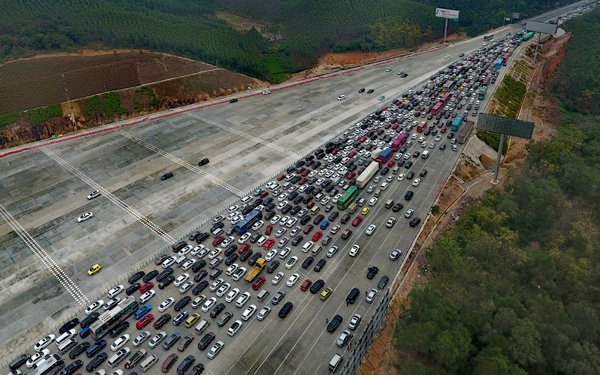
Traffic slows to a crawl on the Liuzhou-Nanning Expressway in the Guangxi Zhuang autonomous region on Thursday as the highway is overwhelmed with travelers returning home. [Photo/Xinhua] 

Traffic slowed to a crawl on major highways on Thursday as tens of millions of people returned home after the Spring Festival holiday.

According to China Central Television, about 94.2 million people were expected to travel on Thursday.

Traffic was slow on several major highways, including Beijing-Hong Kong-Macao Expressway and Shanghai-Chongqing Expressway, according to the Ministry of Transport, with traffic jams in some sections extending for dozens of kilometers.

In Henan and Hunan provinces, some highways were partly closed due to snow or smog.

According to the ministry, the rush of traffic into major urban areas, including the Yangtze River Delta, Pearl River Delta and Beijing-Tianjin-Hebei region, was expected to last past 10 pm.

About 1.5 million vehicles were expected on highways in Central China’s Hubei province on Thursday as many parts of the province experienced light rain.

Chen Ying, who was heading to Hubei’s capital Wuhan from the province’s Enshi Tujia and Miao autonomous prefecture, encountered a traffic jam after passing Yichang city.

“I don’t know whether it was because of the weather or there was an accident ahead, but the traffic was terrible,” the 53-year-old said.

She said the traffic was so slow that some people even got out of their cars and did some exercise, and many service zones were so packed that it was hard to find somewhere to park.

The 340 kilometers from Yichang to Wuhan, which usually takes about four hours, took Chen nine hours. “At its worst, we moved only about 5 km in 80 minutes,” she said.

China Railway Corp was expected to log 11.5 million trips on Thursday, 11.3 percent more the last day of Spring Festival in 2016. The company had to add 819 temporary trains to meet the high demand.

About 8.48 million people left Beijing during Spring Festival – 39 percent of the city’s population – according to the Beijing Municipal Commission of Transport. Now, their return is putting stress on the capital’s transportation system.

Almost 1,700 flights were expected in Beijing on Thursday. According to the commission, 224 trains a day arrived at Beijing South Railway Station during the Spring Festival holiday.

The commission said it has taken various measures to help travelers get back home using the capital’s public transport system. From Feb 1 to 4, 1,000 taxis will be dispatched to Beijing South Railway Station and the operation of the subway’s Line 4 will also be extended.

Nation plays bigger role in global health

image_pdfimage_print

From exporting low-cost, effective vaccines to sending doctors to combat outbreaks of disease, China is increasingly benefiting the world with its enhanced medical capacities and expertise, according to an international health expert.

Seth Berkley, CEO of the Global Alliance for Vaccines and Immunization, said Chinese vaccines are “significantly cheaper” than those made by many other countries.

The Chinese-made vaccine for Japanese encephalitis, for example, is up to 95 percent less expensive than those produced in the West, he said.

Transmitted by mosquitoes, Japanese encephalitis is the leading cause of viral encephalitis in Asia and the Western Pacific.

With an average price of 42 cents a dose, the live attenuated vaccine made by the Chengdu Institute of Biological Products is providing lifesaving protection to millions of children in low-in-come countries, including Laos, Nepal and Cambodia, under the alliance’s program, Berkley said.

The alliance has committed to using 27.7 million doses of the vaccine. In light of this, Berkley hailed China’s efforts to move on from being an alliance recipient of vaccines to being a key supplier.

The nation’s Japanese encephalitis vaccine became available on the global market after the World Health Organization endorsed China’s vaccine regulatory body in 2011. Two years later, the product became the first prequalified Chinese vaccine to be licensed for use on children.

“We’re seeing huge potential for China to supply the global public vaccine market via WHO prequalification, including for emergency outbreaks such as yellow fever and Ebola,” Margaret Chan, director-general of the WHO, said last month.

During the Ebola outbreaks, China sent 1,200 medical workers to affected regions. Chinese experts also trained more than 13,000 local medics to treat patients in nine countries in Africa.

Chinese make a record 6.15m trips overseas during holiday

image_pdfimage_print

A record 6.15 million trips were made by Chinese mainland tourists to overseas destinations during the seven-day Spring Festival holiday. [Photo/China.org.cn] 

A record 6.15 million trips were made by Chinese mainland tourists to overseas destinations during the seven-day Spring Festival holiday, which ended on Thursday, according to the China National Tourism Administration.

That is an increase of 7 percent compared with last year’s Spring Festival. About 374,000 trips were organized by travel agencies, a 2.5 percent increase.

The administration also reported growth from individual and high-end travelers and said that in addition to first-tier and coastal cities, inland cities-such as those in the Guangxi Zhuang autonomous region-became important source markets for China’s out-bound tourism industry.

With many Chinese now traveling abroad for Spring Festival, their choice of destinations has expanded along with their growing interest in exotic cultures and services.

Those traveling to Japan, for example, where “shopping spree” became a catchword in 2015, now prefer a physical checkup or experiencing Japanese culture.

Meng Fanhai, owner of a tourism agency in Tokyo, said his agency arranged more than 200 physical checkups and medical treatments in 2016, up 50 percent from the year before and accounting for about one-third of his agency’s business from Chinese tourists.

Li Xuejing, the agency’s marketing manager, said Chinese tourists are increasingly willing to experience local culture and characteristic services, including staying in private homes, appreciating bonsai and watching monkeys in hot springs.

Yang Min, a partner of a tourism agency specializing in receiving Chinese tourists in Kenya, said the country was unfamiliar to most Chinese in 2005. However, since 2010, more Chinese tourists have chosen the African country as a destination to experience its biodiversity.

A Chinese tourist surnamed Guo, who was vacationing on an island in the Philippines, said she now pays more attention to relaxation and enjoyment during the holidays instead of shopping or choosing gifts for relatives.

“When I book a hotel, I will take into consideration the massage, the spa and other special services … to enjoy myself,” she said.

Another choice is Britain. Though the devaluation of the pound is a factor, Britain’s rich history and famous education tradition have caught the eye of Chinese.