Low and middle income countries bear disproportionate burden of cervical cancer – UN agency

image_pdfimage_print

2 February 2017 – Noting that cervical cancer kills more than 250,000 women every year and that 85 per cent of these deaths occur in low- and middle-income countries, the United Nations health agency underlined the importance of vaccinating girls against the cancer-causing virus and screening programmes to detect and treat precancerous lesions.

The agency also stressed the need to overcome cultural norms and dispel gender biases that are challenging the effectiveness of vaccination initiatives.

&#8220In high-income countries, widespread screening has radically reversed the trends, and cervical cancer incidence and mortality have declined sharply [with] the impact of vaccination in reducing human papillomavirus (HPV)-related diseases is already being documented,&#8221 said the UN World Health Organization (WHO)’s International Agency for Research on Cancer (IARC) in a news release.

&#8220But in developing countries, where the burden of the disease is heaviest, cervical cancer control is often not seen as a priority within tight health budgets, and women are not given life-saving access to adequate prevention and treatment,&#8221 it added.

While HPV vaccination has shown it can protect women from chronic infection caused by HPV16 and HPV18 (the two main types of the virus known to cause cervical cancer), vaccination programmes have not been implemented nationally in many low- and middle-income countries in Asia and Africa.

As a result, women are left vulnerable to the risk of developing cervical disease, which &#8211 given the inadequacy of screening and treatment services in many countries &#8211 is likely to go untreated.

&#8220Unless we act rapidly, thousands of women will develop cervical cancer because they are not vaccinated,&#8221 says Rolando Herrero, head of Early Detection and Prevention Section at the IARC.

&#8220In countries where early detection and screening are difficult to implement due to a lack of proper infrastructure, vaccination has a vital role to play in protecting women from cervical cancer,&#8221 he added, urging government commitment to implement HPV vaccination regimes.

In many countries, women are often the only breadwinners, and therefore protecting them is of huge human and economic importanceHead of IASC’s Screening Group Dr. Sankaranarayanan

Also, in some regions, cultural norms and fear that &#8220vaccination would promote sexual activity&#8221 is also a barrier in vaccinating young girls as are low schooling rates, which can limit the reach of immunization programmes, which often take place in schools.

On top of these hurdles, &#8220gender bias&#8221 and perception that &#8220women are a less important population to invest in&#8221 in many countries is making matters much worse.

&#8220It is vital that governments address these barriers,&#8221 said Rengaswamy Sankaranarayanan, Special Advisor on Cancer Control and Head of IARC’s Screening Group, stressing: &#8220In many countries, women are often the only breadwinners, and therefore protecting them is of huge human and economic importance.&#8221

Drawing attention to the need to make vaccines cheaper, particularly for the development world, to step up vaccination coverage, IARC Director Christopher Wild stressed: &#8220Competition between potentially new and existing vaccine manufacturers is urgently needed in order to reduce costs and enable countries to better protect women against cervical cancer.&#8221

The International Agency for Research on Cancer (IARC) is part of the World Health Organization. It is responsible to coordinate and conduct research on the causes of human cancer, the mechanisms of carcinogenesis, and to develop scientific strategies for cancer control. It is also involved in both epidemiological and laboratory research and dissemination of scientific information on the disease.
Iran: Halt imminent execution of juvenile offender, urge UN human rights experts

image_pdfimage_print

2 February 2017 – Calling on the Government of Iran to immediately halt the execution of a juvenile offender whose trial was reportedly marred with lack of due process and fair trial guarantees, a group of United Nations human rights experts have urged the authorities to adopt a moratorium on juvenile executions.

According to the Office of the UN High Commissioner for Human Rights (OHCHR), the offender, Hamid Ahmadi, was 17 years old when he was sentenced to death in 2009 for the fatal stabbing of a young man in a fight between five boys, the year before. The court relied on confessions reportedly obtained under torture and ill-treatment at a police station. Mr. Ahmadi was also denied access to a lawyer and his family.

&#8220To our knowledge, in the case of Hamid Ahmadi, the most stringent guarantees of fair trial and due process contained in international human rights instruments have been disrespected and, the allegations of torture and confessions extracted under duress were not taken into consideration nor did the lead to any investigation,&#8221 the human rights experts said.

&#8220Any death sentence undertaken in contravention of a Government’s international obligations, and particularly when a conviction is based on confessions extracted under torture, is unlawful and tantamount to an arbitrary execution,&#8221 they stressed.

Mr. Ahmadi’s execution, planned to take place &#8211 by hanging &#8211 on Saturday, 4 February, is the third time it has been scheduled. In the two previous instances, they were halted at the last minute.

OHCHR further noted that the Iranian Supreme Court had overturned the death sentence in 2009 due to some doubts about the testimony of several key witnesses but ultimately upheld the death sentence a year later.

Furthermore, following the adoption (in 2013) of new juvenile sentencing provisions of the Islamic Penal Code, Mr. Ahmadi was granted a retrial but was eventually re-sentenced to death by a Provincial Criminal Court in December 2015.

Unprecedented rate of scheduling and even conducting executions of juveniles

The experts also condemned that execution of juveniles continue to be scheduled and even conducted at an unprecedented rate in the country since the beginning of the year.

&#8220On 17 January, we already intervened to halt the execution of another juvenile,&#8221 they noted.

&#8220Since then, we have learned that two other juveniles have been hanged on 15 and 18 January. Arman Bahr Asemani and Hassan Hassanzadeh were both juveniles at the time they allegedly committed the offence for which they were sentenced to death.&#8221

Underlining that that international standards unequivocally forbid the imposition and execution of the death penalty on persons below 18 years of age, the UN experts urged Iran to observe its international obligations by putting an end to the execution of juvenile offenders &#8220once and for all.&#8221

The human rights experts voicing their concern included:

Independent experts and Special Rapporteurs are appointed by the Geneva based UN Human Rights Council &#8211 an inter-governmental body responsible for promoting and protecting human rights around the world &#8211 to examine and report back on a specific human rights theme or a country situation. The positions are honorary and the experts are not UN staff, nor are they paid for their work.

Dangerous conditions in Ukraine after heavy fighting shuts down power, water – UNICEF

image_pdfimage_print

2 February 2017 – More than 2,500 children in the Donetsk region of Ukraine are without heat, electricity or water, prompting the United Nations Children’s Fund (UNICEF) to call for an end to fighting in the area so that the infrastructure can be repaired.

Intense fighting in the town of Avdiivka on 29 and 30 January disabled electricity and water, including the Donetsk Filtration Station and the backup reservoir.

With temperatures plummeting to 1 degree Fahrenheit (minus 17 degrees Celsius), the situation could have &#8220catastrophic consequences for the residents of Avdiivka,&#8221 according to a statement from UNICEF.

The UN agency’s representative in Ukraine also voiced concern about the fighting, which has also caused six schools and four kindergartens in the area to shut down.

&#8220Not only are the lives of thousands of children in Avdiivka, and on all sides of the conflict, at risk, but to make matters worse, the lack of water and electricity means that homes are becoming dangerously cold and health conditions deteriorating as we speak,&#8221 said Giovanna Barberis.

In addition to the 17,000 residents in Avdiivka, the non-functional filtration station supplied some 400,000 people in area with water.

&#8220Water is now rationed and there is a possibility that the piped household water supply will stop altogether,&#8221 UNICEF said.

The UN Security Council has also voiced concern about the fresh fighting. On 31 January, the Council issued a press statement saying its 15 members were gravely concerned about the situation in the country’s eastern region and its severe impact on the local civilian population.

5-magnitude quake hits Tibet; no casualties reported

image_pdfimage_print

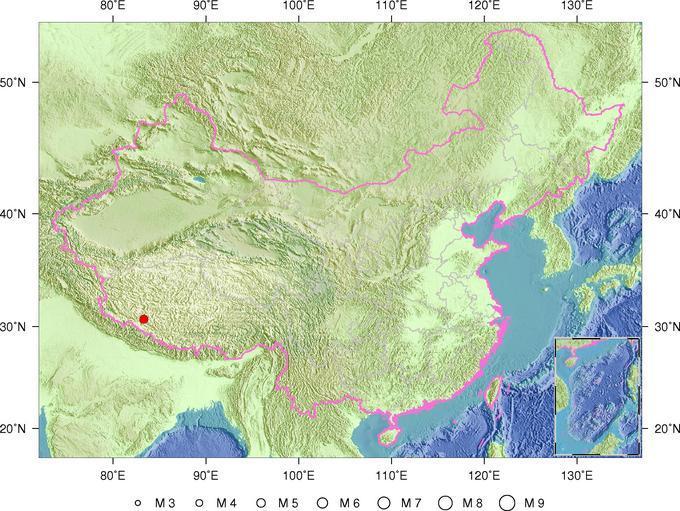
A 5.0-magnitude earthquake jolted Zhongba County in Tibet on Wednesday, February 1, 2017. [Photo: China Earthquake Administration]

A 5.0-magnitude earthquake jolted Zhongba County in southwest China’s Tibet Autonomous Region at 6:07 p.m. Wednesday (Beijing Time). No casualties were reported.

The epicenter was monitored at 30.67 degrees north latitude and 83.34 degrees east longitude. The quake struck at a depth of 8 km, according to the China Earthquake Networks Center.

The epicenter, 124 kilometers from the county seat and 757 kilometers from Lhasa, is in an uninhabited zone and therefore the moderate quake caused no injuries and death of people and livestock, Wei Xince, deputy county governor, told Xinhua by phone.

Local authorities were checking damages to roads and makeshift livestock pens in the summer pasture.

Zhongba, which is in the western-most of Xigaze prefecture and borders Nepal, covers an area of 45,900 square kilometers and has a population of 24,800. It has an average altitude of over 5,000 meters.

China sees rising traffic as holiday nears end

image_pdfimage_print

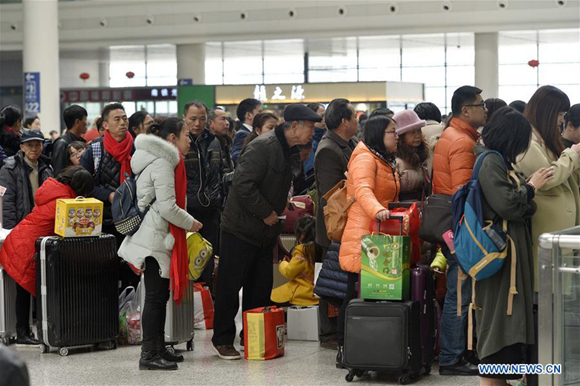
China’s transport system saw rising traffic Wednesday as millions of people started to return to work after the week-long Lunar New Year Holiday.

Passengers wait for trains at the Nanchang West Railway Station in Nanchang, capital of east China's Jiangxi Province, Feb. 1, 2017. (Xinhua/Peng Zhaozhi)

Passengers wait for trains at the Nanchang West Railway Station in Nanchang, capital of east China’s Jiangxi Province, Feb. 1, 2017. (Xinhua/Peng Zhaozhi)

Some 9.7 million passenger trips were estimated on Chinese railways on Wednesday, year-on-year growth of 9 percent, as the week-long holiday draws to a close Thursday, according to China Railway Corporation.

Traffic on expressways around major cities also increased, leading to rising congestion.

During the New Year holiday, hundreds of millions of people go back to their hometowns to meet relatives and old friends, and as Chinese people become more affluent and keen to travel, pressure on the transport system is huge.

Data from the China National Tourism Administration showed some 27.4 million visitor trips were made in China Wedneday, up 14.1 percent year on year.

Tourism revenue reached 34 billion yuan (about 4.96 billion U.S. dollars) on the day.