Too many banquets to handle: an endemic disease

image_pdfimage_print

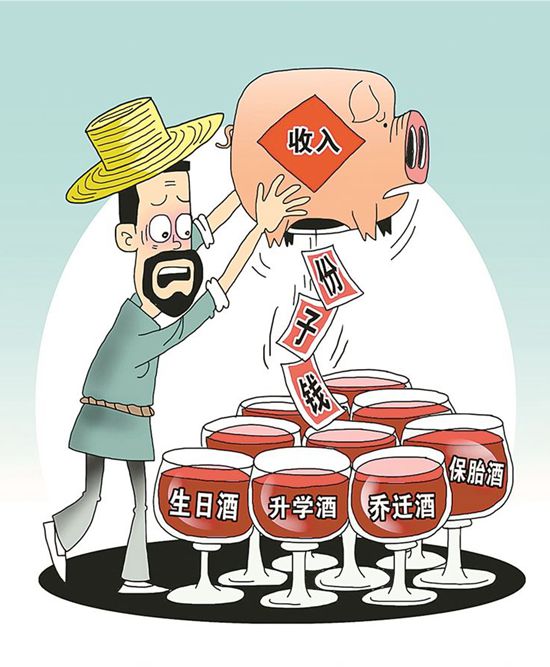
The Chinese tradition of giving monetary gifts on wedding or funeral banquets has been around for centuries, but the hosting of various banquets aiming to make money has become an unbearable burden especially in rural areas.
Hosting banquets under different pretexts aiming to make money has become an unbearable burden especially in rural areas. [Photo: Xinhua]

During important occasions like weddings and funerals, the family would host open-air banquets for friends and relatives, and those who are invited will pay an amount of money, depending on closeness, as a gesture of affection and care.

“I spent over 40,000 yuan (US$ 5,824) last year on various banquets,” said a winery boss surnamed Yang in a small town in central China’s Hunan Province. “This way of returning other’s favor is really costly.”

In some places, however, banquets are also held for various reasons. Moving into a new house, family members getting enrolled into college and celebrating someone’s birthday are some of the justifiable excuses. And there could be also not-so-justifiable ones like hosting a banquet to “prevent miscarriage” for pregnant women and to “start a new life” after being released from prison.

Relief fund used for monetary gifts

Those banquets could be a huge burden for some people, especially in rural areas.

“The average annual income of a farmer is between 30,000 and 40,000 yuan, and some people are spending half of it to pay for monetary gifts on those occasions,” said Lyu Caifu, a farmer at the Three Gorges Reservoir Region in Chongqing Municipality.

Some low-income families are even drawing on their government allowance for those banquets, he added.

Hosting banquets under different pretexts has grown into a vicious cycle. Understandably, those who have paid could rack their brains to find any excuses for others to return the favor.

Tightened regulatory measures

Many places have rolled out measures to cure the “endemic” disease, with some targeting party and government officials and some the general public as well.

Regulations may vary from region to region but they mostly forbid any banquets except for wedding and funerals and limit the scale as well as attendees of those events.

As for punishment, party cadres are regulated based on party discipline. Some have even been removed from their current posts and expelled from party membership; non-party members were often investigated by the public security department or food and drug regulators. For example, a town in the Three Gorges Reservoir Region stipulated that the violator will be disqualified from enjoying subsistence allowances.

Some places have seen preliminary results. “Much of our burden has been lifted since then,” said Yao Qiong, a self-employed business owner in a small town of Chongqing.

In the past, the average annual amount paid on banquets was over 40,000 yuan, and the number has reduced to only 3,000 yuan after the campaign.

There were also some controversial measures adopted during the campaign. Some cities even banned wedding banquets for second marriages and a declaration needs to be filed ahead of hosting a banquet.

“Local government has the responsibility to curb unhealthy customs, but it should never cross the line,” said Li Ping, a professor at Renmin University of China (RUC). Li advised the local community to formulate its own rules after soliciting opinions from the masses and lead the transformation of old habits in a step by step manner.


Social care and the prudence paradox

image_pdfimage_print

If you buy your own home and save for your old age you end up paying for your own stay in a care home should you need one.  If you rent your home and spend all your earnings the state will pay for your time in the care home at the end of your life.

All parties in government have wrestled with this paradox. The prudent pay more tax, and end up losing their capital if they need long term care. All parties have so far concluded it is too dear to offer free stays in care homes to all who need them. All have rightly concluded if someone without any assets needs looking after in old age the state needs to step in to help.

The resulting structure is complex and cumbersome. All individuals have a right to free health care from the NHS. The amounts and cost of NHS care usually escalate dramatically in the final years of a long life. Any time a person spends in hospital provides them with free board and lodging as well as health care. The aim, however, is to enforce a rigid distinction between health care – drugs, doctors time, operations – which are free, and social care including board and lodging which is  only free if you have no money of your own. The elderly person staying in hospital has an adjustment made to their state benefits and pension to reflect their reduced living costs.

The children are third parties in the struggle between  elderly person and the state over what the state will and will not pay for.  With elderly people living into their 90s, the children are often  pensioners themselves by the time the issue gets intense. Some seem to think they have a right to inherit the “family home” or the home of their parents. This is not normally the actual family home they lived in 60 years earlier, as people usually move on. Others say that if the elderly person has moved into a care home and is not going to move back to his or her home, it is only reasonable the property is sold and the money raised is used to pay the care home bills. No-one argues the children have to pay the care home bills of any elderly person who does not have the money to pay, though some chose to.

With social care back on the agenda, I would be interested in further views on what is the right balance between private payments and state assistance. Should prudence be better rewarded? If so, how?

Iraq: UN health agency delivers medical aid to newly retaken areas of Mosul

image_pdfimage_print

16 February 2017 – The United Nations health agency has delivered medical supplies to parts of eastern Mosul, the Iraqi city liberated from the Islamic State (ISIL), where clinics are receiving an influx of people in urgent need of medical care.

The World Health Organization (WHO) said the supplies &#8220will support treatment of patients with infectious diseases, chronic conditions, diarrheal diseases and trauma cases who have been deprived of medical care.&#8221

According to the press release, the supplies are a donation from the Government of Norway and include medicines, emergency health kits, surgical kits and an interagency diarrheal disease kits.

They were delivered to newly retaken areas of Mosul, including 16 primary health centres, one hospital and the Directorate of Health (DOH) of Ninewa &#8211 the governorate which includes Mosul.

WHO has appealed for $65 million to support health interventions in this part of Iraq through the end of the year. So far, $14 million has been received.

New UN report reveals obstacles to combat impunity for conflict-related sexual violence in Ukraine

image_pdfimage_print

16 February 2017 – Lack of laws, capacity and professional experience to effectively investigate and prosecute conflict-related sexual violence in Ukraine is not only resulting in widespread impunity, it is causing survivors of sexual violence to be “victimized twice”, according to a new United Nations human rights report.

&#8220What’s the point of saying what happened to me? No one will be able to help and no one will be able to find those who did it. No one will punish them,&#8221 one survivor of sexual violence quoted in the report said.

The report, issued today by the Office of the UN High Commissioner for Human Rights (OHCHR), also revealed that beatings and electrocution on the genitals, rape, threats of rape and forced nudity were used to punish, humiliate or extract confessions. In the territory controlled by armed groups, sexual violence was also used to compel people in detention to hand over property or to do as the perpetrators demanded, as an explicit condition for their release.

The majority of the documented cases happened when people, both men and women, were detained by either Government forces or armed groups.

&#8220[…] he told me that if I refused to write, perpetrators would bring my […] daughter in and will make me watch how they take turns one after another to rape her. After that I filled in eight pages with the text they dictated to me,&#8221 read the report, citing a woman who was detained on conflict-related charges.

&#8220The investigation and conviction of perpetrators of sexual violence is vital for the victims who are entitled to justice and redress,&#8221 said Zeid Ra’ad Al Hussein, the UN High Commissioner for Human Rights, underscoring that doing so can also have a decisive impact in preventing such crimes.

&#8220Impunity encourages the criminals, for that is what they are, to continue.&#8221

Furthermore, the report also noted that deteriorating economic situation, particularly in conflict-affected regions, combined with a breakdown of community ties due to conflict and displacement, has led some people to use harmful survival strategies and coping mechanisms that may increase the risk of sexual violence and trafficking.

The report was prepared by the UN Human Rights Monitoring Mission in Ukraine (HRMMU) – deployed to the country in in March 2014 upon the invitation of the Government of Ukraine – and looks at the period from 14 March 2014 to 31 January this year and covers all territory of the country, including the Autonomous Republic of Crimea, with a special focus on the eastern regions, parts of which are under the control of armed groups.

Lack of support for victims further complicated by restrictions placed by armed groups

The report also draws specific attention to the lack of support for victims, especially in areas of Donetsk and Luhansk controlled by armed groups.

Furthermore, medical professionals and state institutions throughout the country lack the specific knowledge and skills needed to deal with survivors of torture and conflict-related sexual violence.

In this situation, civil society organizations are stepping in through donor-funded programmes, as well as by various UN agencies and international organizations to offer support to the victims. However, these are mostly confined to urban areas and there is little or no assistance available in smaller towns and rural areas.

On top of this, restrictions imposed by the armed groups have hindered these organizations to carry out their programmes, particularly those linked to protection and psycho-social support and there are no real redress mechanisms available for victims in the territory controlled by armed groups, noted the report.