Expert: Gender equality vital for population planning

image_pdfimage_print

China’s population is expected to reach 1.42 billion by 2020, while the birth gender ratio is expected to be reduced to 112 boys for every 100 girls, according to a population development plan for the 13th Five-Year Plan (2016-20) recently released by the National Health and Family Planning Commission (NFHPC).

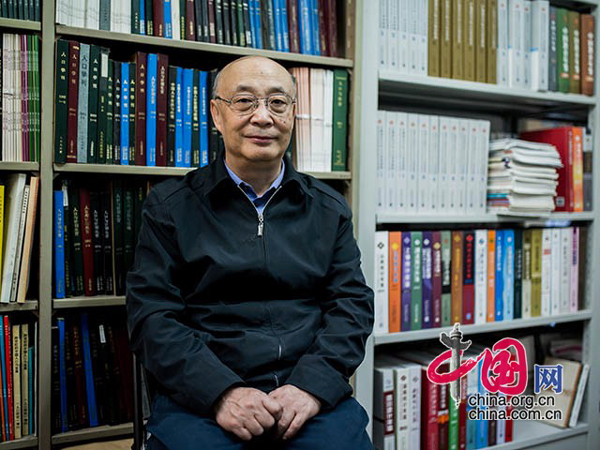
Zhai Zhenwu, vice chairman of China Population Association and professor of sociology and population studies at Renmin University of China. [Photo by Zheng Liang/China.org.cn] 

In a wide-ranging interview with China.org.cn to coincide with the report’s release, Zhai Zhenwu, vice chairman of China Population Association and professor of sociology and population studies at Beijing’s Renmin University of China, discussed the population development planning.

Imbalanced sex ratio at birth since 1985

Prof. Zhai said gender imbalance has become a very acute issue in China with a far-reaching impact on the country’s population structure and social-economic development.

He cited some statistics from the development plan. “Before 1985, the birth gender ratio was 106 or 107 boys for every 100 girls, which was still a normally-accepted gap. However, the number kept growing year-by-year, and in 2000 it reached 120 boys for every 100 girls; in some provinces it was even up to 135 to100.”

Such a big imbalance is rarely seen in the world in terms of degree, duration and scope, he stressed. “The issue has aroused great concern throughout society, and some media have continuously reported that millions of men are facing a ‘bachelor crisis,'” he said.

Thanks to great efforts by all sides, the ratio declined to 113 boys to 100 girls in 2016, the lowest in decades, Professor Zhai added.

Main reasons for imbalance

The professor identified three main reasons for the gender imbalance.

The first is a traditional social attitude that regards men as superior to women, which prevails especially in rural areas like those in Guangdong and Fujian provinces in southern China. This reflects the financial reality that a son will take care of his ageing parents, while a daughter will normally marry and be lost to the family in this regard.

Even though people’s living standards have greatly improved, their deep-rooted attitude in this regard has not changed accordingly.

The second reason is sex-selective abortion, which has made the situation worse. Despite a ban on pre-natal sex tests and gender-based abortions, both have seen a steady rise in some areas since ultrasound technology was introduced. Early sex-selective abortions were performed in many rural hospitals, where pregnant women asked doctors to help identify the sex of the fetus and induce an abortion if it was a girl.

The third reason is an overall decline in the country’s birth rate. This is related to the state family planning policy implemented for nearly four decades known as the “one-child policy.”

Major problems with overseas aid for Eastern European countries

image_pdfimage_print

I was surprised to read in the Sunday press that some people think it a good idea to divert overseas aid to Eastern European members of the EU to “buy” a better  deal with that organisation.

As I have explained before, there is no Treaty power to require a UK leaving payment above and beyond completing our annual payments to their budget for the period of  our continuing membership. Nor is it legal under WTO rules to pay for more favoured trade with a particular country or group of countries than the rest. Payment for trade under WTO rules takes the form of accepting tariffs, and these have to be limited to the current mfn schedules the EU has agreed.

The trade choice is for the rest of the EU to make.  The Uk would be quite happy to carry on tariff free. That will help the rest of the EU more than us. It would mean registering our current trade arrangements as a Free Trade Agreement at the WTO. Or we can trade under mfn arrangements under the WTO. Most of UK trade will be tariff free, whilst EU sales of agricultural products would suffer heavy tariffs into the UK. The UK could agree lower or no tariffs with other cheaper suppliers of food around the world through the WTO process. I have  said it is in the EU’s interest to accept the tariff free offer, and they may  do so after much huffing and puffing.  I have also always said that they might decide to harm themselves by accepting WTO terms instead. Under the general WTO arrangements the UK will be fine.

The overseas aid  idea also falls well foul of the overseas aid rules. The Eastern countries in the EU do not qualify for overseas aid under the international definition, as they are too well off. UK Ministers  by law have to hit the 0.7% Aid target under international definitions, so they could not switch this aid money to Eastern Europe unless they repealed the 0.7% requirement. It would not be easy to achieve repeal, given the likely fact that all the opposition parties would oppose repeal other than perhaps the one UKIP MP. The government might be able to persuade  enough Conservative MPs to get it through the Commons, but the Lords would be likely to have a big majority the other way. As it would not be a Manifesto pledge, and does not stem directly from a referendum, the Lords might become  very difficult.

In circumstances where the EU Commision and one or two large countries were  not wanting a free trade Agreement with the UK for political despite their interests in having one, it is difficult to see how offering to send money to Eastern countries would buy a change of heart.

UN Security Council condemns latest terrorist attack in Mogadishu

image_pdfimage_print

20 February 2017 – Strongly condemning the latest deadly terrorist attack in the Somali capital, Mogadishu, the United Nations Security Council today reiterated that its determination to support peace, security and development in the long-troubled country would not be swayed by this, or any other such attack.

In a press statement that follows yesterday’s terrorist attack at a market in Mogadishu that killed at least 39 people and injured many more, the members of the Council expressed their deep sympathy and condolences to the families of the victims, as well as to the people and Government of Somalia. They also wished a speedy recovery to those injured.

The Council went on to commend the swift response of Somalia’s security and first responders.

It also reaffirmed that terrorism in all its forms and manifestations constitutes one of the most serious threats to international peace and security and underlined the need to bring perpetrators, organizers, financiers and sponsors of these reprehensible acts of terrorism to justice, as well as reaffirmed the need to combat the scourges in accordance with international law.

Further to the statement, the Security Council paid tribute to all Somali and international actors working to bring peace and stability in Somalia. The 15-nation body reiterated its determination to support peace, stability and development in Somalia and underlined that &#8220neither this nor any other terrorist attack would weaken that determination.&#8221