

The international crude oil price of Indian Basket as computed/published today by Petroleum Planning and Analysis Cell (PPAC) under the Ministry of Petroleum and Natural Gas was US$ 54.82 per barrel (bbl) on 02.03.2017.
Mar32017
The international crude oil price of Indian Basket as computed/published today by Petroleum Planning and Analysis Cell (PPAC) under the Ministry of Petroleum and Natural Gas was US$ 54.82 per barrel (bbl) on 02.03.2017.
Mar32017

Mar32017
Chris Skidmore, Minister for the Constitution, has published a range of proposals that will make the anonymous registration scheme in England and Wales more accessible to those escaping domestic abuse, and ensure that survivors can participate in our democracy.
The anonymous registration scheme protects people whose safety would be at risk if their name and address appeared in the electoral register. For example, this might include victims of harassment or stalking, as well as some witnesses in criminal court cases.
The current system has come under criticism for lacking the flexibility and understanding of various scenarios which survivors of domestic abuse often find themselves in. This can include limiting police attestations to police officers at or above the rank of superintendent, and restricting social services attestations to directors of social services.
Among the measures announced today are plans to update the list of court and other orders that are acceptable as evidence of the risk to an applicant, and lowering the seniority required for an attestor from the police or social services.
The minister has been working with domestic abuse charities over the past 6 months, including Women’s Aid, to explore what could be done to ease the process for one of the most vulnerable groups in society. Women’s Aid estimate that the proposals in the policy statement could help thousands of survivors of domestic abuse.
Mehala Osborne, survivor and founder of the Right to Vote campaign, said:
I was denied a vote whilst living in a refuge, and I never realised how much having a vote meant until it was taken away from me. I had already been through enough, and to be disempowered even more was so difficult. I am so proud to have started the campaign that has led to these proposed changes. Survivors in the future will not be denied their voice and democratic right to vote.
Dawn Morville, survivor of domestic abuse who lived in a refuge, said:
When I was living in a refuge, I could never register to vote as I was worried my ex would be able to hunt me down – and if he had been able to find my address, there is no doubt he would have come after me. This would have put not only me but the other women in the refuge at risk. And for years after I left the refuge, I could still not vote, because I knew that he would find me if he could, and seriously harm me and my children. So the proposed changes are great news. It will empower survivors, and give us back something that domestic abuse takes away: our right to have our say, and be heard, without being terrified that voting could mean our abuser comes after us.
Polly Neate, Chief Executive of Women’s Aid, said:
Domestic abuse must not deny women their right to take part in democracy. So, we welcome the changes proposed today on anonymous registration, and we thank the government – particularly the Minister Chris Skidmore, for decisive action on this. The proposed new measures send out a clear message to all survivors of domestic abuse: that their voices matter, and their participation in politics matters.
Chris Skidmore, Minister for the Constitution, said:
This government is committed to removing any barriers that prevent voters from exercising their democratic right. Having met survivors of domestic abuse over the past 6 months, it is clear that the existing system has often let down those affected by domestic abuse.
That is why today we are setting out proposals to reform the anonymous registration scheme in England and Wales to make it more accessible for those escaping domestic abuse. Protecting the safety of survivors by making it easier for them to register to vote without their name and address appearing on the electoral register is a key part of that change.
We are clear that those who have been constrained by their abusers must have full freedom to express themselves in the democratic process – part of this government’s determination to build a democracy that works for everyone.
The government is now welcoming feedback on proposals to expand the evidence to include new types of attestor and new types of documentary evidence, along with other measures in the statement. To share your comments, please contact the Cabinet Office at anonymous-registration@cabinetoffice.gov.uk.
Under provisions of the Scotland Act 2016, the Scottish Parliament will shortly gain legislative competence for electoral registration in relation to Scottish Parliamentary and Local Government elections in Scotland. The Minister for the Constitution will be working with his counterpart in the Scottish government in order to together deliver reforms in respect of the UK Parliamentary electoral register and the local government electoral register in Scotland.
Under provisions of the Wales Act 2017, the National Assembly for Wales will in due course gain legislative competence for electoral registration in relation to elections to the National Assembly for Wales and Local Government elections in Wales. However, the changes proposed to anonymous registration will most likely come into force prior to commencement of these provisions.
Mar32017
 |
|
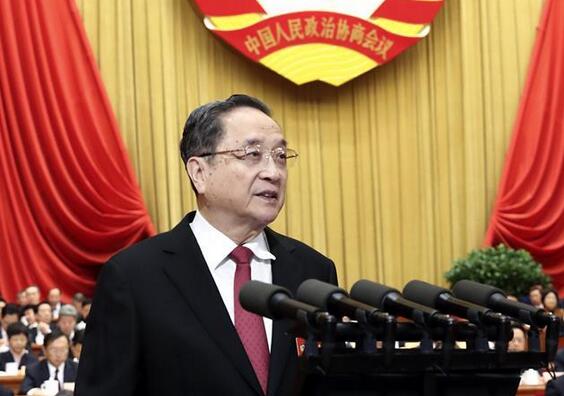
Yu Zhengsheng, chairman of the National Committee of the Chinese People’s Political Consultative Conference (CPPCC), delivers a report on the work of the CPPCC National Committee’s Standing Committee at the fifth session of the 12th CPPCC National Committee at the Great Hall of the People in Beijing, capital of China, March 3, 2017. The fifth session of the 12th CPPCC National Committee opened in Beijing on March 3. [Photo/Xinhua] |
China’s top political advisory body started its annual session Friday in Beijing, ushering in a political high season that will continue with the opening of the country’s top legislature Sunday.
Yu Zhengsheng, chairman of the Chinese People’s Political Consultative Conference National Committee, delivered a work report to more than 2,000 political advisors who gathered to discuss major political, economic and social issues in the world’s most populous nation and second-largest economy.
Top Communist Party of China and state leaders Xi Jinping, Li Keqiang, Zhang Dejiang, Liu Yunshan, Wang Qishan and Zhang Gaoli attended the opening meeting at the Great Hall of the People.
Mar32017
 |
|
Zhao works on Bagua Hill in Jilin province. [Photo/China Daily] |
After spending almost half his life chopping down trees in Jilin province, Zhao Xihai decided it was time to make a change.
In 1989, the former logger and explosives worker formulated a plan to mitigate some of the damage he had done to the environment over the years – he would plant 100,000 trees before turning 70.
In the first spring following his retirement, Zhao bought 46,000 seedlings and set about planting them on a barren tract of land on Bagua Hill, 3 kilometers away from his home.
He set himself the goal of planting 1,000 seedlings per day, waking at 4 am each morning to walk to the hill, armed only with a shovel and some painkillers for his chronic stomach problems.
Every day for 46 days, come rain or shine, Zhao went to the hill to plant more trees, eating only small bites of snacks for sustenance and drinking from nearby streams.
He succeeded in completing his task in the time allocated, despite passing out from hunger and exhaustion one rainy day and having to be carried home by a neighbor.
Once the first 46,000 seedlings had been planted, Zhao continued with his task – albeit at a slower pace.
He persisted even after having a blood clot on the brain in 2004, which left him walking with a stick, telling his son: “I will not stop planting as long as I can move.”
By 2007, Zhao had achieved his goal of planting 100,000 trees, but he did not stop there. Joined by his 36-year-old son Zhao Jingchun, who had recently been laid off, he set himself a new mission – to plant 1 million trees, including a number of rare or unusual species.
Within four years, the pair had managed to cultivate 750,000 seedlings, inspiring Zhao Xihai to present his son with a flag honoring his dedication and symbolizing the passing of responsibility to the younger generation.
In March last year, Zhao Xihai was hospitalized after his blood clot returned. He lost the ability to talk and now requires 24-hour care.
His son has vowed to continue his legacy, however, and is on schedule to plant his 1 millionth tree this year, according to Jilin’s Hongshi Bureau of Forestry.
Some have questioned why Zhao Jingchun continues to plant trees when he has no income and a 13-year-old son to support. The entire family is also reliant on Zhao Xihai’s pension.
“Planting trees will be beneficial for generations to come, therefore it is worth all the hardships – that’s what my father would say,” he said.