Controlling public spending

The government has rightly confirmed that a successful economy requires sensible control of public spending and borrowing. The pressures that require more to be spent on schools and social care do not mean we can afford to relax public spending generally. Growth in the economy will generate more tax revenue to meet the needs of priority services for more money. Action still needs to be taken to remove less desirable public spending, to root out waste, and to run the public sector better.

Conscious that many readers here want to see financial discipline in the public sector, I am today writing about it to give you more opportunity to state what you think could be better done or removed from the budgets. In the middle of this current 5 year Parliament the state will no longer have to send the large gross and net contributions to the EU. From March 2019, assuming a sensible deal or no deal, we will no longer be sending that money to the EU. Of course the UK Parliament will wish to spend money on farming, universities and regional development where we were getting some of our money back from the EU. This will leave us around £12 bn of the net contribution to spend, as I explained with my suggested post leave budget before the referendum vote. This will take some of the pressures off.

There are many other areas to look at to save money. The government could press on more vigorously with its office and property rationalisation programme. It can initiate something for something pay deals to promote smarter working in return for higher pay. It can do more to cut its demands for fuel and other supplies.

I voted against HS2. It looks as if we are now committed to that expensive project. In the light of that the budget of Network Rail should be reviewed. Network Rail can improve efficiency, dispose of more property assets, and encourage more use of existing track to boost revenues. There are opportunities for getting more value for money from the railway budget.

The large overseas aid budget is pledged by Act of Parliament which this Parliament is unlikely to amend. There should be more scope to include as part of this budget the many costs the UK already incurs in helping low income countries and refugees. When our armed forces are undertaking humanitarian or peacekeeping work for a low income country all their costs doing that should be part of the overseas aid budget.

Introducing more Right to buy purchases by tenants of social housing would raise more private capital, to offset the housing budget. There are a range of public sector assets which could be sold as an alternative to additional borrowing.

Atrocities of Japanese Unit 731 revealed in documents

Atrocities committed by Japanese Army Unit 731, a germ warfare unit once stationed in northeast China’s Heilongjiang Province, have been further exposed in newly found historical documents.

The 24 documents collected in Japan were written by members of Unit 731, according to Yang Yanjun, associate researcher at the Unit 731 Research Center of Harbin Academy of Social Sciences.

Unit 731 was established in Harbin in 1935, during the Japanese army’s occupation of northeast China.

Soldiers in the unit took photographs and wrote papers on the region’s wetlands, geology, mountains, and water resources to prepare for germ warfare and provide references for Japanese immigrants.

Other documents include materials collected by the unit on epidemic prevention, geology, transport and laws of the Soviet Union. The documents were produced between March 1937 and November 1939, Yang said.

According to Jin Chengmin, curator of the Museum of Evidence of War Crimes by Japanese Army Unit 731, human experiments, production, experiments and use of germ weapons were the core of Unit 731 activity.

In 1941, a Chinese man named Li Pengge was detained after refusing to help Japanese Intelligence detect Soviet signals, Jin said. Li was sent to Unit 731 and met a gruesome death on an operating table aged 25.

Jin said more than 3,000 people died at Unit 731. The unit conducted experiments on at least 93 Soviet people during World War II. Among them were prisoners of war and civilians, including women and children.

The Japanese government continues to deny the crimes despite the evidence. No one involved with Unit 731 has ever been tried for war crimes.

Ordinary Japanese people feel sorry to war victims after knowing the truth. On this year’s Tomb Sweeping Day, a Japanese delegation including three war orphans visited the exhibition in Harbin.

After the war, many fleeing Japanese left their children behind, who were then cared for by Chinese families. These children, many now at least in their seventies, are called war orphans.

According to the museum, Unit 731 produced around 300 kilograms of plague bacillus, 600 kg of anthrax bacteria, 800 to 900 kg of typhoid bacteria, and thousands of kilograms of other deadly pathogens each month.

Between 1937 and 1942, the unit manufactured more than 2,000 germ bombs, loaded with fleas infected with plague bacillus.

“If war had not ended in 1945 and Japan had begun large-scale germ warfare, that could lead to the disappearance of humans, given the production capacity of Unit 731,” said Yang.

19 killed in south China road accident

Photo taken on July 6, 2017 shows the site of a road accident in Longmen, south China's Guangdong Province. Nineteen people died, and many others were injured after a coach overturned on an expressway Thursday afternoon in south China's Guangdong Province. [Photo/Xinhua]

Photo taken on July 6, 2017 shows the site of a road accident in Longmen, south China’s Guangdong Province. Nineteen people died, and many others were injured after a coach overturned on an expressway Thursday afternoon in south China’s Guangdong Province. [Photo/Xinhua]

Nineteen people died and 30 were injured, when a coach overturned on an expressway Thursday afternoon in south China’s Guangdong Province.

The accident occurred around 1 p.m. on an expressway section in Huizhou, according to city authorities. There were 49 people on the 55-seater bus when the accident happened.

Ma Xiqin, a passenger on the bus, sustained multiple injuries from shattered glass. She was travelling home with her mother-in-law on the double-decker after an operation.

“I had just returned to my seat, when suddenly the bus veered onto the roadside,” recalled Ma, 35. “I tried to pull myself and my mother-in-law out, and I heard many people crying for help.”

It was raining heavily, Ma said, and she and her mother-in-law crawled under the expressway to wait for rescuers.

Of the injured, 24 are being treated in a local hospital in Longmen.

“Six of them were seriously injured,” said hospital director Chen Guoqiang.

Traffic on the expressway section has resumed, and an investigation is underway.

China produces world’s first cloned dog using gene editing

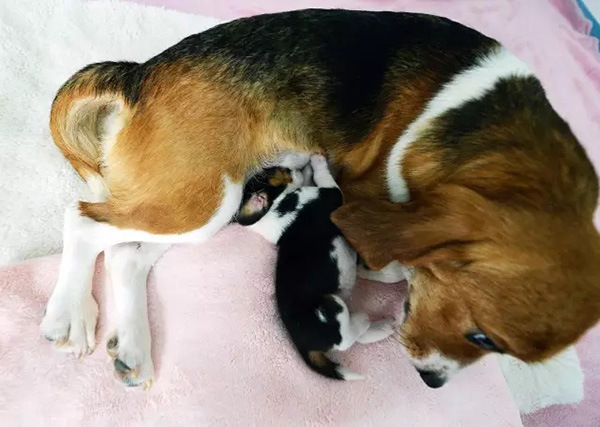
The mohter dog feeds the puppy Longlong. [File Photo]

Already home to the world’s first cloned dog using somatic cell transfer technique, China is now the world’s first country to clone a dog using gene editing, after Sinogene, a Beijing-based biotech company, announced the achievement on July 5, Science and Technology reported.

China is the second country to master somatic cell cloning technology, followed by South Korea, according to Lai Liangxue, a researcher at the Guangzhou Institute of Biomedicine and Health under the Chinese Academy of Sciences.

Dog cloning has always been regarded in the scientific community as the most difficult, despite multiple successes in the cloning other mammals, including sheep, mice, cows, and pigs. Poor oocyte quality and the asynchronous reproduction cycle of the surrogate mother and the cloned embryo limit the application of the technology.

However, Lai’s team of scientists at Sinogene created a disease model using the latest gene-editing technology CRISPR/Cas9 to achieve mass production. It is the first of its kind in the world.

“It is advantageous to combine cloning technology with gene editing, and China has taken the lead,” said a researcher from the Institute of Zoology under the Chinese Academy of Sciences.

The company said it will promote commercial dog cloning services worldwide by establishing a gene-editing development and research base and a bank for somatic cells and genes.

Press Releases: Secretary of State Tillerson Travel to Kuwait


Press Statement

Heather Nauert

Department Spokesperson

Washington, DC

July 6, 2017


At the invitation of the Emir of Kuwait, the Secretary will travel to Kuwait July 10 where he will meet with senior Kuwaiti officials to discuss ongoing efforts to resolve the Gulf dispute.

Follow Secretary Tillerson’s travel via @StateDept on Twitter and visit the State Department’s Flickr account for the latest trip photos. Stay connected at https://blogs.state.gov/engage and keep track of all of the Secretary’s travels at https://www.state.gov/secretary/2017travel.