Woman detained for spreading bird flu rumors

image_pdfimage_print

A woman in central China’s Hubei Province was detained for spreading rumors of a deadly bird flu outbreak, police said Saturday.

A post went viral on China’s biggest social network, WeChat, Thursday saying an outbreak of H7N9 human infection had attacked eight medical workers and some family members after a villager in the suburbs of Xiantao City came down with the epidemic.

The post caused widespread panic and police launched an investigation, only to find it was sheer fabrication.

A woman surnamed Chen surrendered herself to police Thursday night, saying she had fabricated the rumor and spread it on WeChat.

She was put in detention for five days starting Friday.

China has stepped up prevention of human H7N9 avian flu which has led to 87 deaths at least nationwide since January. In addition, 269 H7N9 human infections have been reported in China this year.

The latest case was reported in southwest China’s Guizhou Province on Friday. The patient, 45, was from Danzhai County in the Miao and Dong Autonomous Prefecture of Qiandongnan.

All close contacts were under clinical observation and no signs of infection had been detected so far, the provincial health and family planning commission said Saturday.

Xi calls for overall national security outlook

image_pdfimage_print

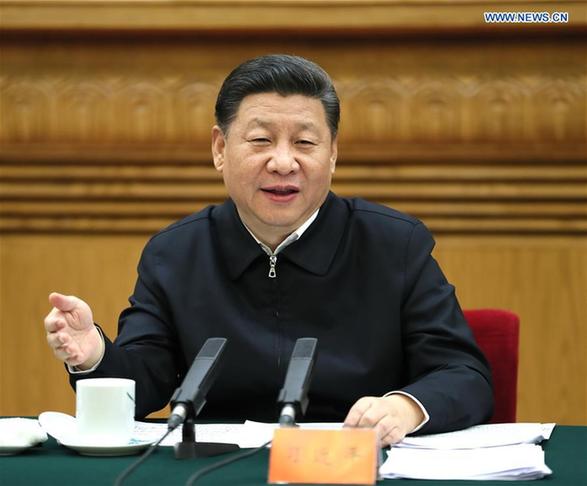
President Xi Jinping on Friday called for an overall national security outlook at a seminar in Beijing, emphasizing the importance of political, economic, territorial, social and cyber security.

Chinese President Xi Jinping, who heads the National Security Commission (NSC), presides over a seminar on national security in Beijing, capital of China, Feb. 17, 2017. (Xinhua/Lan Hongguang)

Xi, who heads the National Security Commission (NSC), presided over the seminar on national security on Friday. Premier Li Keqiang and top legislator Zhang Dejiang, the two deputy heads of the NSC, were present at the seminar.

After listening to reports by Public Security Minister Guo Shengkun, Vice Foreign Minister Zhang Yesui, Hubei Province Party chief Jiang Chaoliang, and Xinjiang Uygur Autonomous Region Party Chief Chen Quanguo, Xi said national security has become more and more important in the work of the Party and the state, adding that national security work is all about the people’s interests.

Xi, also general secretary of the Communist Party of China (CPC) Central Committee and chairman of the Central Military Commission, stressed that safeguarding national security requires the grasp of rules in the context of the great changes in the international order, and that the planning work must give priority to the prevention of risks.

National security planning must consider the general background that China is in a period of important strategic opportunity for development, Xi said.

“The overall direction of multipolarization of the world, the globalization of the economy and the democratization of international relations has not changed,” said Xi.

“No matter how the international situation changes, we must maintain our strategic steadiness, strategic confidence and strategic patience,” the president said.

He called for global vision in national security work, coordinating development and security, combining principles with tactics, and taking the strategic initiative in China’s own hand.

Xi called for enhancing a prevention and control system for public security, improving overall capability in social management, and solving problems and disputes at their roots.

Xi stressed efforts should be made to enhance security in fields including transport and production of hazardous chemicals and improve fire prevention and control so that major accidents do not occur.

A firm fence of cyber security should be consolidated, and efforts should be made to better safeguard cyber security and key information infrastructure, Xi said.

Xi said the development of core technologies should be facilitated and early warning and monitoring of cyber security should be strengthened, in addition to ensuring the security of big data.

Xi stressed the need to proactively shape China’s external security environment, adding the country must strengthen cooperation in security field and guide the international community to jointly safeguard international security.

Xi called for enhanced capacity building in terms of materials, technology, equipment, talent, law and mechanism to safeguard national security.

He underscored that it was a fundamental principle for national security work to adhere to the leadership of the Party, adding local Party leaderships must fulfill their national security obligations.

New diplomatic vehicle regulation increases oversight

image_pdfimage_print

China is beefing up efforts to better manage diplomatic vehicles with the recent release of a new regulation.

The regulation, jointly promulgated last month by the Foreign Ministry and other several ministries, will for the first time control the total number of such vehicles, Foreign Ministry spokesman Geng Shuang told a news briefing on Friday.

Applications for these vehicles will be approved individually and the owners are required to buy third-party liability insurance for an insured amount of at least 1 million yuan ($147,000), the regulation says.

The number of diplomatic vehicles has surged amid China’s opening-up, which has drawn a growing number of diplomats and larger staffs at international organizations, Geng said.

Under the regulation, new license plates will replace the old by May 1, Geng said. On Monday, the Laotian embassy received the first new plates. Previously, diplomatic license plates had the Chinese character for ambassador followed by numbers. Now the order is reversed, and the character is white instead of the former red.

The regulation allows ambassadors to register two such vehicles for private use. Other diplomats may register only one. Administrative and technical staff at diplomatic missions can register only one vehicle per household within the first six months of their terms of office in China.

Seven situations are listed in the regulation that would deprive the vehicle of diplomatic status. For example, a diplomatic vehicle loaned to someone who is not a diplomat forfeits its immunity privileges.

In addition, traffic violations will no longer be condoned as the ministries will closely oversee the purchase, use and traffic law compliance of these vehicles, Geng said.

The new regulation comes against the background of the long struggle to ease traffic jams in Beijing, where one-fifth of the more than 4 million vehicles in the city are restricted from the roads between rush hours on work days, said Sun Lijun, a professor of transportation at Tongji University in Shanghai.

Moreover, the recurrent smog in northern China has government promoting policies that limit emissions and help to improve air quality, he added.

Press release: Prime Minister’s plans to transform the way we tackle domestic violence and abuse

image_pdfimage_print

Theresa May has today announced plans to transform the way we think about and tackle domestic violence and abuse – one of the most widespread and heinous offences, but one where victims are often let down by the legal system.

Domestic violence and abuse shatters lives but the way we deal with it at the moment does not go far enough – with a plethora of different offences and procedures scattered across the statute book. 

This lack of clarity has led to an unacceptable diversity across the country in terms of the degree of effort put in to try and tackle it. Although the prosecution of, and convictions for, such offences have started to improve in recent years, there is inconsistency in the use and effectiveness of the various law enforcement measures across the country.

In recognition of this, the Prime Minister has announced plans for a major new programme of work leading towards bringing forward a Domestic Violence and Abuse Act.  

The programme of work will look at what more can be done to improve support for victims especially in the way the law, and legal procedures, currently work for such victims. Experts in this area will be invited to contribute ideas and proposals for improving the way the system works which is likely to lead to legislation – making it much easier for law enforcement bodies to find and use more consistently the measures at their disposal. The Prime Minister will also ask for any potential ‘quick wins’ in the intervening period to be identified and acted upon. The Prime Minister will directly oversee this work, which will be truly cross-governmental – but co-ordinated by the Home Office and the Ministry of Justice.

Like the Modern Slavery Act, the Prime Minister believes that the measures that come out of this work will raise public awareness of the problem – as well as encourage victims to report their abusers and see them brought to justice.

Prime Minister Theresa May said:

Domestic violence and abuse is a life shattering and absolutely abhorrent crime; tackling it is a key priority for this government – and something I have always attached a personal importance to, both as Home Secretary and now as Prime Minister. I am clear that we need to build on the measures I introduced as Home Secretary – including the new offence of ‘Controlling and Coercive Behaviour’, Domestic Violence Protection Orders, and the Domestic Violence Disclosure Scheme – and ensure that no stone will be left unturned in delivering a system that increases convictions, and works better for victims.

She added:

I believe that the plans I have announced today have the potential to completely transform the way we think about and tackle domestic violence and abuse. There are thousands of people who are suffering at the hands of abusers – often isolated, and unaware of the options and support available to them to end it. Given the central importance of victim evidence to support prosecutions in this area, raising public awareness – as well as consolidating the law – will prove crucial.  

Germany is symbol of tolerance and hospitality for those in need of protection – UN chief Guterres

image_pdfimage_print

17 February 2017 – Speaking to the media in Munich, United Nations Secretary-General António Guterres hailed the important role Germany has placed at a number of multilateral institutions, including the European Union and the United Nations.

“Germany has been extremely active in all aspects in which the international community needs to come together to face the dramatic challenges that are threatening our daily lives,” said Mr. Guterres at a press encounter alongside German Chancellor Angela Merkel.

He further noted that in a world where diversity is perceived as a threat and not a richness and where so many populist, xenophobic demonstrations exist, Germany and Chancellor Merkel had been a symbol of “tolerance” and “hospitality” for people displaced from their homes and who are in need of protection.

“A symbol I would like to see followed in many, many other parts of the world in order for us to be able to respond to the dramatic suffering that we are witnessing because of the terrible conflicts that have spread around the world,” the UN chief added.

“So, in this moment, I would like to say that I am sure that the cooperation that, as Secretary-General, I will have with Germany and its Government will be as solid, as positive, as deep and as successful as the cooperation we had when, as High Commissioner for Refugees, I could be fully in support of the German policy for the protection of refugees.”

In his remarks, Mr. Guterres also underlined the need for global responses to global challenges such as complex and interlinked conflicts, rising terrorism, impact of climate change and enormous movements of people and migration.

He further emphasized the importance of multilateralism and for countries to come together and to use multilateral institutions, in a spirit of solidarity, to overcome the obstacles of today’s world.