Traffic jam eased in most Chinese cities in Q2

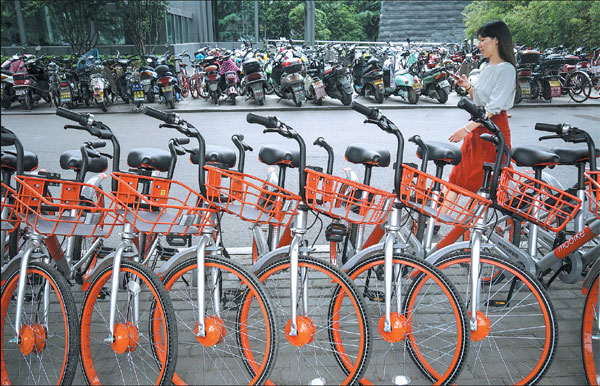
Mobikes are lined up on a street in Zhengzhou, the capital city of Henan Province. [Photo/China Daily]

Nearly 80 percent of Chinese cities saw an easing in traffic jams in the second quarter of the year, mainly thanks to an online car-hailing service and shared bicycle service, according to a report released yesterday.

The report was released by Amap, a major mapping and navigation platform, along with China Academy of Transportation Sciences, the Research Center for Sustainable Transportation set up by Tsinghua University and Daimler, Alibaba Cloud and Ofo.

It showed that, in the quarter, the number of traffic jams in many Chinese cities dropped sharply.

Fifteen cities recorded a drop of more than 8 percent in terms of traffic easing, with Tianjin, Qingdao and Wuhan taking the top three spots. It was the first time such statistics had shown a downward trend since Amap started to survey traffic flows in 2014.

Among the 100 cities in the report, 77 percent witnessed significant traffic easing, especially among first and second tier cities. Even Beijing, notoriously for “forever jam,” recorded a drop of more than five percent in the index on a year-on-year basis.

However, the remaining 23 percent of Chinese cities surveyed saw the worse traffic jams. Most are third or fourth tier cities. The top three cities with the largest rise in traffic jams are Qingyuan, Zhaoqing and Hong Kong. Qingyuan’s traffic jam situation index rose by 12.9 percent.

The report said less traffic jam in most cities is due to new policies involving an online car-hailing services and shared bicycle services, as well as improvement in the urban road networks and efficient internet-aided traffic management.

Press Releases: Eighth U.S.-Laos Comprehensive Bilateral Dialogue


Media Note

Washington, DC

July 25, 2017


The United States and the Lao People’s Democratic Republic held their 8th annual Comprehensive Bilateral Dialogue on July 25 in Washington. Acting Assistant Secretary of State for East Asia and Pacific Affairs Susan Thornton led the U.S delegation, which included representatives from the U.S. Departments of State, Defense, and Commerce; Office of the U.S. Trade Representative; and the United States Agency for International Development. Lao PDR Vice Minister of Foreign Affairs Thongphane Savanphet led the Lao delegation. The two sides affirmed that the U.S.-Lao relationship is stronger than ever and expressed satisfaction at progress in forging greater cooperation as outlined in the 2016 Joint Declaration on the Comprehensive Partnership.

U.S. and Lao officials discussed broader regional developments and threats to regional security, including those posed by the DPRK. Thornton reiterated the enduring U.S. commitment to Southeast Asia, ASEAN, and the Asia Pacific region and to continued close relations with Laos.

The U.S. and Lao delegations reviewed progress in removing unexploded ordnance (UXO) in Laos and welcomed continued U.S. support for clearance efforts, highlighting progress made on a national cluster munition survey which will define and quantify contamination in the most heavily impacted areas. U.S. and Lao officials also reviewed wide-ranging development cooperation in health, nutrition, and education and discussed freedom of expression, religious freedom, and labor rights, emphasizing the important role of civil society and rule of law to good governance, shared prosperity, and stability in the region. The two delegations reaffirmed their support for the Lower Mekong Initiative (LMI), a collaborative agreement between the United States, Laos, Cambodia, Myanmar, Thailand, and Vietnam that facilitates transboundary development and regional integration. The United States thanked the Lao government for agreeing to host the upcoming LMI Regional Working Group in Vientiane in the fall. The two sides pointed to the importance of human rights of vulnerable groups, including disabled persons, as well as the Lao PDR’s efforts to implement its National Action Plan to combat trafficking in persons.

The two delegations agreed to cooperate on the repatriation of Lao nationals subject to final orders of removal, pledging to establish a standing process to review cases and facilitate speedy removals.

The U.S. and Lao delegations agreed on the importance of deepening people-to-people ties, noting the potential of English language training; academic, professional, and youth exchanges; and university partnerships to enhance mutual understanding. They also reviewed mechanisms to facilitate bilateral trade and investment, including their Trade and Investment Framework Agreement, and noted the opportunities for increased business between the two countries. Both delegations look forward to holding the ninth Comprehensive Bilateral Dialogue next year.


Press Releases: Selection of the Sixth Annual U.S. Youth Observer to the United Nations


Media Note

Office of the Spokesperson

Washington, DC

July 25, 2017


The U.S. Department of State, in partnership with the United Nations Association of the USA (UNA-USA), is pleased to announce the selection of the sixth annual U.S. Youth Observer to the United Nations. Ms. Munira Khalif of Minnesota was chosen from a competitive pool of applicants that included top-ranked university students and young professionals from across the United States.

Ms. Khalif studies economics and government at Harvard University. She co-founded a youth-run non-profit organization called Lighting the Way, which works to make education more accessible and equitable for girls in East Africa. She has actively advocated for women and girls’ issues at the United Nations through the UN Foundation’s Girl Up Campaign and is passionate about empowering youth voices through grassroots community initiatives.

The U.S. Youth Observer to the United Nations program was launched in 2012 to increase youth engagement in global affairs. As the Youth Observer, Ms. Khalif will represent American youth at the 72nd UN General Assembly in New York and other UN events throughout the coming year, traveling within the United States and overseas to share her impressions and experiences. Ms. Khalif follows Ms. Nicol Perez, who served as a voice for American youth at major global events in New York, Rome, Dubai, and Berlin as the U.S. Youth Observer for 2016-2017.

For further information, please contact Cain Harrelson, Public Diplomacy Chief for the Bureau of International Organization Affairs, at HarrelsonBC@state.gov. Follow the program and the Department of State’s multilateral engagements on Twitter at @USYouthObserver and @State_IO. Complete details about the U.S. Youth Observer program are available at http://genun.unausa.org/youth_observer.


Xi calls for united efforts to deepen military reform

Chinese President Xi Jinping has called for all-out efforts to push forward military reform with the support of the entire nation and the Communist Party of China (CPC).

Xi, also general secretary of the CPC Central Committee and chairman of the Central Military Commission (CMC), made the remarks Monday afternoon at a group study attended by members of the Political Bureau of the CPC Central Committee.

The group study focused on reform of the military in size, structure, and formation.

Carried out in a bold and resolute way, national defense and military reform has taken historic steps and achieved historic breakthroughs and achievements in major fields, pumping great power into building a strong army, Xi said.

The reform mainly includes optimizing the country’s military size, structure, and formation, and solving structural contradictions that hinder the development of national defense and the armed forces, he said.

As the reform deepens, China will have a smaller army with better combat capability and optimized structure, the president said.

“Quantity should be reduced and quality improved to build a capable and efficient army, and labor intensity should become S&T-oriented,” Xi said, adding that China is developing a joint operation force system with an elite force at its core.

He reiterated that reform on national defense and armed forces is an overall and revolutionary change, with unprecedented strength, depth and breadth.

“We should be resolute, confident, brave and vigorous to achieve victory in such reform,” he said, calling for close following of decisions made by the CPC Central Committee and the CMC.

Xi said that the reform should take the correct direction, inspections should be strengthened, and various reform measures should be put into practice.

He said that the adjustment and reform of policies and systems will directly influence the vital interests of officers and soldiers, the army’s morale, the military’s vitality as well as the reform’s overall performance.

Military authorities should intensify relevant research, map out systematic and proactive reform plans, and enhance the “sense of gain” among officers and soldiers, Xi said.

Xi also stressed consolidation and spread of theoretical, practical and institutional achievements acquired through the national defense and military reform.

China defends VPN management measures

Chinese authorities Tuesday defended their management measures on virtual private networks (VPN), saying the measures will have no negative impact on law abiding businesses and individuals.

All businesses operating within China need to properly register with the authorities and every business with a website needs to obtain an Internet Content Provider license and display it at the bottom on their website.

“Our measures aim to better regulate the behavior of China’s VPN market and they will only target unregistered businesses and individuals providing VPN services for cross-border use,” Zhang Feng, chief engineer of the Ministry of Industry and Information Technology (MIIT), said at a press conference.

Authorities are aware that some foreign trade companies and transnational companies need to use a VPN for office work and they are allowed to have access to VPN service via registered providers, said Zhang.

The chief engineer noted that authorities have set different standards for various services including big data and cloud computing.

“Most of the registered VPN services are available in the cloud and are backed up by data centers. If the data centers [of unregistered providers] lack sufficient protection, there will be huge risks for enterprises,” he said.

While countries differ in their management of VPN services, it is a common practice for authorities to develop an registration system for these services, said Wen Ku, another official with the MIIT, adding there are similar systems for VPN providers based in the United States, European and other Asian countries.

“Chinese law prohibits the spread of harmful, violent and terrorist information,” said Wen.