Submersible Jiaolong completes dives in S. China Sea

image_pdfimage_print

Jiaolong, China’s manned submersible, is about to dive into the South China Sea, south China, May 10, 2017. [Photo/Xinhua]

Jiaolong, China’s manned submersible, conducted its ninth and final dive in the South China Sea Wednesday.

Jiaolong stayed underwater for nine and a half hours in its ninth dive in the second stage of China’s 38th ocean scientific expedition, which will last until May 13.

The maximum depth of the dive was 1,897 meters in the Puyuan Seamount.

Three crew in the submersible brought back samples of seawater from near the seabed, sediment, high-definition photographs and video footage.

The 38th oceanic scientific expedition started on Feb. 6. Jiaolong completed a dive in the northwestern Indian Ocean earlier this year in the mission’s first stage. It will also conduct surveys in the Yap Trench and the Mariana Trench in the third stage.

Named after a mythical dragon, Jiaolong reached its deepest depth of 7,062 meters in the Mariana Trench in June 2012.

China provides update on returned corruption fugitives

image_pdfimage_print

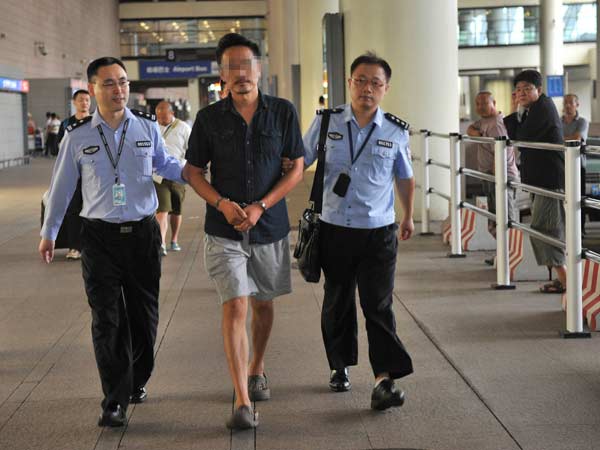
An unidentified fugitive returns from Indonesia to China. [Photo/Xinhua] 

China Wednesday released an update on the cases of 40 corruption fugitives on the Interpol red list who have either voluntarily returned or been extradited to China, including two spared from prosecution.

As of Monday, 15 returnees had already been sentenced to terms of up to life in prison, according to a statement from the office in charge of fugitive repatriation and asset recovery under the central anti-corruption coordination group.

The cases of another nine fugitives have been accepted by courts, but no sentence has yet been given.

Another 13 cases are still under investigation or awaiting review, including the case of Yang Xiuzhu, the No. 1 most wanted on the red notice list, according to the office.

One case was withdrawn in late 2015 after prosecutors confirmed the death of the suspect, Gu Zhenfang, in Thailand.

Among the 15 fugitives already convicted is Li Huabo, a former local finance official in east China’s Jiangxi Province, who was sentenced to life imprisonment in January.

Li’s illicit gains worth 4.83 million yuan (700,000 U.S. dollars) were returned and 5.5 million Singapore dollars (4 million U.S. dollars) was confiscated.

Li, who fled the country in January 2011, remained in Singapore until he was repatriated in May 2015.

In a separate case, Fu Yaobo and Zhang Qingzhao were sentenced to life imprisonment for bribery and embezzlement in August last year.

Zhang Dawei was exempted from criminal prosecution in November 2016 because Zhang had confessed his crime and returned all his illegal gains voluntarily.

Two of the fugitives, Zhu Zhenyu and Zhang Liping, were spared prosecution because Zhu was an accessary to the crime and turned himself in voluntarily, while Zhang’s offense involving falsifying value added tax invoices was minor.

The handling of these cases reflects China’s policy for the fugitive hunt, namely offering leniency to those who voluntarily return to China while meting out harsh penalties for those who are brought to justice after being arrested, the statement said.

The Interpol red notice of 100 Chinese corruption fugitives was released in April 2015.

As a move to close a loophole in China’s renewed anti-corruption drive, which in the past mainly targeted domestic corruption and left out those who have fled the country, China has launched operations such as “Sky Net” and “Fox Hunt” in recent years, focusing mainly on corruption fugitives and assets recovery overseas.

Amid spreading cholera outbreak, UN migration agency aids South Sudanese

image_pdfimage_print

10 May 2017 – United Nations humanitarian workers are responding to a growing cholera outbreak in Ayod, the Greater Upper Nile region of South Sudan, one of multiple counties throughout the country where the disease has spread since June 2016.

The UN International Organization for Migration (IOM) said it deployed a rapid response team to Jonglei late last month, to support local health partners and try to contain the outbreak.

&#8220Conditions are extremely difficult for families in Jiech,&#8221 said Carol Kipsang, an IOM health officer and nurse, referring to a town in Ayad County. More than 230 people are affected there.

&#8220We met one mother who was caring for her new born and her sister’s child, after her sister died from cholera two weeks ago in her community. The young mother walked one hour to the IOM clinic to receive treatment for the children and seek nutritional support for her malnourished daughter.&#8221

The UN agency launched its response after 140 suspected cases of cholera were reported in Ayod during the first weeks of April, threatening the population of some 175,000 people.

&#8220Access to Ayod is difficult during the rainy season, and its proximity to the Nile River increases its vulnerability to outbreaks of water-borne diseases such as cholera,&#8221 IOM said, noting also the ongoing crisis in Jonglei and the lack of health workers and medical supplies.

The majority of suspected cholera cases in Ayod come from communities living in cattle camps along the river.

Since the cholera outbreak was declared in June 2016, more than 7,200 cases of cholera have been reported, including 229 deaths, according to the World Health Organization (WHO) and the South Sudan Ministry of Health.

The disease is also reportedly spreading through swamp water, with millions of people displaced and moving through the swamps to avoid fighters.

WHO has provided response kits, medication and equipment for oral rehydration points and cholera treatment units.

News story: Refocusing Public Health England

image_pdfimage_print

The Health Improvement directorate will be made up of the following teams:

  • Alcohol, Drugs and Tobacco
  • Diet and Obesity
  • Health Equity and Mental Health
  • Healthy People
  • Screening and Quality Assurance
  • Knowledge and Intelligence
  • National Disease Registration
  • Research, Translation and Innovation

Creating a Health Improvement directorate allows PHE to closer align surveillance, data, evidence and research capability with policy expertise.

SNP must publish secret report which blasts CAP payment chaos

image_pdfimage_print

10 May 2017

Peter Chapman

Ministers have been urged to make public a “highly critical” report into the recent CAP cash crisis, which delayed payments worth hundreds of millions of pounds to Scottish farmers.

Members of Holyrood’s rural economy and connectivity committee were today given sight of a report commissioned by the Scottish Government in the wake of the fiasco.

However, the MSPs have been ordered to keep the paper private amid claims publishing it would breach commercial sensitivity.

The Scottish Government adds that the report – carried out by firm Fujitsu – contains details of live contracts which could be jeopardised by its release.

It was triggered after the Scottish Government’s IT system processing CAP payments failed to get the money through to farmers, causing massive delays and pushing many to the brink of going out of business.

Various MSPs who were given an executive summary said it was “damning” and “highly critical”, while convener Edward Mountain said it was “unacceptable” the full report had not been published.

At today’s meeting, Scottish Government civil servants confirmed the report highlighted the need for “remedial action” and that there were “system defects”.

In contrast to the SNP’s secrecy in the issue, the Scottish Conservatives last year pledged in their rural manifesto to hold an official probe into the CAP payments crisis.

Scottish Conservative shadow rural affairs secretary Peter Chapman said:

“This was a scandal which starved Scotland’s rural communities of hundreds of millions of pounds.

“Yet now the SNP appears to want to keep secret a damning report on the issue.

“How is the Scottish Government supposed to improve these systems in future if it’s not willing to be transparent?

“Farmers across the country will be furious at this attempt to bury a report which clearly contains very severe criticism for the SNP and its ability to help Scotland’s rural communities.”


The Scottish Conservatives have been repeatedly critical of the SNP on CAP payments:
http://www.scottishconservatives.com/2017/04/farmer-income-plummeted-as-snp-botched-cap-payments/
http://www.scottishconservatives.com/2016/03/probe-into-cap-payments-fiasco-will-be-at-heart-of-rural-plan/