Writer in court over ‘one mistake one thousand yuan’ pledge

A Chinese writer is facing a bill of over 172 thousand yuan (almost US$ 26,000) after making a promise five years ago to pay a thousand yuan for every mistake found in his book, reports Beijing News.

Zhang Yiyi published his book in February, 2012. A month later, he posted on the Weibo social media platform that “anyone who finds a mistake in my book will receive 1001 yuan.”

In his post, Zhang said that various media insiders were “witness to his words”.

Recently, Bai Ping, a professor of the College of Liberal Arts of Shanxi University, announced that he had found 172 mistakes in Zhang’s book, which included factual errors, grammatical mistakes, and wrongly-written or mispronounced characters.

After negotiations broke down, Bai decided to sue the writer for 172,172 yuan.

The case was accepted by a court in Beijing, and received a first hearing on August 10, 2017.

During the session, Zhang’s lawyer argued that the reward offered by Zhang had a time limit, albeit “not clearly stated,” and suggested that the so-called 172 mistakes were too “subjective,” or lacked evidence.

Bai’s lawyer said his client would accept a discount of 20 percent, but Zhang’s lawyer said only 10,000 yuan reward was on the table.

The two sides failed to reach an agreement in court.

A similar “One mistake, One thousand yuan” dispute occurred in 2010, when Bai Ping spotted 909 errors in a book written by Chinese writer Yan Chongnian, and demanded an 850,000 yuan reward as a result.

The case collapsed after the court decided Yan’s words made during an interview were meant as a “joke” rather than as a “promise”.
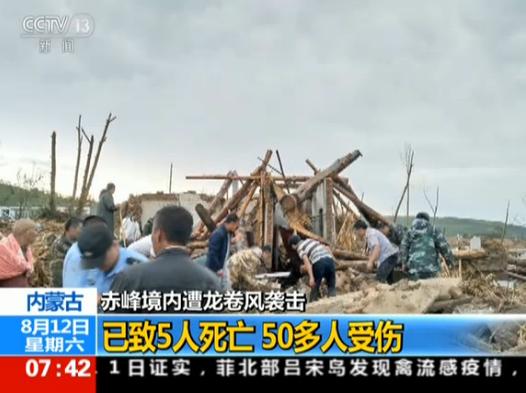
Cyclone kills 5 in N. China

At least five people were killed and 50 others injured after a cyclone swept through parts of north China’s Inner Mongolia Autonomous Region. [Photo/CCTV]

At least five people were killed and 50 others injured after a cyclone swept through parts of north China’s Inner Mongolia Autonomous Region, local government reported Saturday.

The cyclone wreaked havoc in four villages of Hexigten Banner and Ongniud Banner at 4 p.m. Friday, said the emergency response office of Chifeng City, which administers the two banners.

The casualty report was based on assessment as of 1 a.m. Saturday while the loss of properties is still being calculated.

Many houses were severely damaged, the office said.

The injured were taken to hospital while relief work is underway.

Damage to the car market

The latest industrial output figures for the UK are disappointing but not surprising. In part they reflect a general decline in industrial activity, which was more pronounced in France and Germany last month than here.

They also reflect local matters that are longer term and more worrying. A strong domestic car market up to March 2017 has been transformed into a weak one in the four months since by a combination of higher taxes and tougher regulations. The new levels of Vehicle Excise duties for dearer cars has hit that part of the market badly. The new messages against diesels with the longer term threat to both diesels and petrol vehicles has also had an impact. More people are waiting for further clarification, and to see if electric cars are going to become cheaper and easier to use. Meanwhile the Bank of England is tightening the availability of credit to buy or lease a new vehicle. One of the recent successes of the UK economy in increasing car sales and output has just been damaged by a combination of an attack on the idea of the purchase, and tougher controls over innovative ways of financing it.

Those who dislike cars, wrongly seeing them as the source of all the pollution that matters, may be pleased. They usually ignore the pollution coming out of the bus, train and household boiler. Those who fear any kind of borrowing by anyone to do anything may also rejoice. I think it does matter. I see no special dangers in more people leasing a vehicle. All the time they have the income they will make the lease payments and all will be well. If someone loses their job or struggles to meet the payments then the lending institution will take the car back and sell it on to someone else second hand. They will get something for it, and if they have run a sensible business may even get all their money back on that customer. None of this need be bank threatening!

The UK now has a strong car industry with some excellent factories, products and employees. The fact that these are in foreign ownership does not affect the important underlying reality that the factories, jobs, ideas and energy for these businesses are here in the UK. They export a lot to non EU destinations as well despite the absence of EU trade deals with the main markets. Public policy should look after the industry in a sensible way. Working with them to produce greener and better products is fine. Taxing too much and stifling credit is not such a good approach.

Quake a blow to tourism workers

The Sparkling Lake, one of the most popular scenic spots in the Jiuzhaigou National Park, was found dried up after the M 7.0 earthquake hit 3.5 km away from the valley on Wednesday, August 9, 2017. [Photo:scol.com]

While mourning the dead and tending to the injured continues after this week’s magnitude 7.0 earthquake in Sichuan province, authorities are saying that the area’s scenic wonders and the local economy also are victims of the natural disaster, centered in scenic Jiuzhaigou.

Twenty-four people died as a result of the Tuesday night earthquake and 493 people were injured, including about 45 seriously wounded, provincial government officials said on Friday.

Two days later, the famous Nuorilang Waterfalls in Jiuzhaigou collapsed.

Nuorilang, with a height of 24.5 meters and width of 270 meters, was China’s widest waterfall and also was chosen by netizens as one of China’s most spectacular. Jiuzhaigou Valley is a UNESCO World Heritage Site.

Li Lin, a guide in the Jiuzhaigou area, said he realized how bad the quake was when he heard that a young couple from Wuhan, Hubei province, were crushed by falling stones.

“The Wenchuan earthquake (also in Sichuan, in 2008) did not wreak havoc here. But this time, many people will remember the tragedy of the couple and cringe at the thought of visiting Jiuzhaigou,” said Li, a middle-aged guide who has worked in Jiuzhaigou for 12 years.

As the couple from Wuhan were approaching a hotel in the area, falling rocks smashed their car. The wife died instantly and the husband managed to push their daughter, a sixth-grader, out of a window before he died, local media reported.

On Wednesday, the management committee of Jiuzhaigou announced it would temporarily close the scenic spot. By Friday, all 61,500 tourists in Jiuzhaigou had left for home, officials said.

“The earthquake is a heavy blow to Sichuan tourism since tourists won’t come to Jiuzhaigou this year,” said an official from the Sichuan Provincial Tourism Development Commission who asked not to be named.

It will take time for tourism to rebound, as in the case of the Wenchuan earthquake, which killed over 80,000, he said. “After the Wenchuan earthquake, fewer tourists visited Sichuan in the latter half of 2008. But as people forgot the quake the next year, the number of tourists gradually rose.”

During the seven-day National Day holiday running from Oct 1 to 7 last year, Jiuzhaigou was so packed with tourists each day that its administrative committee had to limit the number entering the scenic spot.

In 2016, Sichuan’s tourism earnings surpassed 770 billion yuan ($115.5 billion), more than 800 million yuan of which came from Jiuzhaigou, according to the Sichuan tourism commission.

Mother nabbed after trying to mail baby to welfare house

A woman has been held by police on suspicion of abandoning her child by using a courier service to send the newborn to a local children’s home, according to police in Fuzhou, Fujian province.

The woman, identified by police only as Luo, is said to have packed up her newborn baby girl in plastic bags, put it in a cloth bag, and called a delivery service on Wednesday, saying she wanted to send something to the Fuzhou children’s home.

When the courier requested to see what was inside the parcel, she refused to open the package for inspection.

On his way, the courier heard a crying sound from the bag, which he had hung from his handlebars, and opened it to find a baby with her umbilical cord still attached.

The courier called police for help, and passers-by who saw him standing with a baby offered assistance. Pictures posted online showed the baby girl being held in a woman’s arms, with her lips moistened by a cotton swab to protect her from sunstroke in the 37 C heat.

The baby was soon sent to the Jin’an district hospital, where she had her cord cut and went through health checkups. Doctors said the baby is out of danger and her vital signs remain stable. She has been transferred to the pediatrics department.

Local residents have sent diapers and baby formula to the hospital.

Police said the 24-year-old woman is from Sichuan province, and the baby’s father is unknown.

Luo was quoted by fjdaily.com, the news portal by Fujian Daily, saying that she did so because she thought she couldn’t raise the child on her own and that it could get better care at a welfare house.

She has lost contact with the baby’s father and her family knew nothing about it, she said.

The story made headlines nationwide, with many netizens criticizing the young woman for putting the baby through such an ordeal, arguing that the baby could have died on such a hot day while being wrapped in several layers of plastic.

Wu Ming’an, an associate professor of criminal law at China University of Political Science and Law, said that the woman is alleged to have violated the criminal law.

“She is suspected of infringing on the baby’s personal rights, because the baby’s life was threatened after being wrapped up,” Wu said.