Press Releases: South Africa National Day

image_pdfimage_print

Press Statement

Rex W. Tillerson

Secretary of State

Washington, DC

April 27, 2017


On behalf of President Trump and the American people, I congratulate all South Africans as you observe the 23rd anniversary of Freedom Day.

On this day commemorating your first democratic elections, we reflect on South Africa’s legacy of political and economic leadership in Africa and acknowledge our strong and broad partnership based on shared goals of security, democracy, and prosperity.


President Trump Proposed a Massive Tax Cut. Here’s What You Need to Know.

image_pdfimage_print

We have a once-in-a-generation opportunity to do something big. President Trump has made tax reform a priority, and we have a Republican Congress that wants to get it done. This is something that Democrats should support too because it’s good for the American people.

The President is going to seize this opportunity by leading the most significant tax reform legislation since 1986 – and one of the biggest tax cuts in American history.

The President has focused on three things since his campaign: job creation, economic growth, and helping low and middle-income families who have been left behind by this economy. He understands that there are a lot of people in this country that feel like they work hard and still can’t get ahead. They are sick of turning their paychecks over to Washington and having no idea how their tax dollars are spent. They are frustrated by a tax code that is so complicated that they can’t even do their own taxes.

That’s why tax reform is such a big priority for this President.  He cares about making the economy work better for the American people.

We are going to cut taxes for businesses to make them competitive, and we are going to cut taxes for the American people – especially low and middle-income families.

In 1935, we had a one-page tax form consisting of 34 lines and two pages of instructions.  Today, the basic 1040 form has 79 lines and 211 pages of instructions. Instead of a single tax form, the IRS now has 199 tax forms on the individual side of the tax code alone. Taxpayers spend nearly 7 billion hours complying with the tax code each year, and nearly 90% of taxpayers need help filing their taxes.

We are going to cut taxes and simplify the tax code by taking the current 7 tax brackets we have today and reducing them to only three brackets: 10 percent, 25 percent, and 35 percent.

We are going to double the standard deduction so that a married couple won’t pay any taxes on the first $24,000 of income they earn.  So in essence, we are creating a 0 percent tax rate for the first $24,000 that a couple earns.

The larger standard deduction also leads to simplification because far fewer taxpayers will need to itemize, which means their tax form can go back to that one simple page.

Families in this country will also benefit from tax relief to help them with child and dependent care expenses.

We are going to repeal the Alternative Minimum Tax (AMT). The AMT creates significant complications and burdens by requiring taxpayers to do their taxes twice to see which is higher. That makes no sense; we should have one simple tax code.

Job creation and economic growth is the top priority for this Administration, and nothing drives economic growth like capital investment. Therefore, we are going to return the top tax rate on capital gains and dividends to 20 percent by repealing the harmful 3.8 percent Obamacare tax. That tax has been a direct hit on investment income and small business owners. 

We are going to repeal the death tax. The threat of being hit by the death tax leads small business owners and farmers in this country to waste countless hours and resources on complicated estate planning to make sure their children aren’t hit with a huge tax when they die. No one wants their children to have to sell the family business to pay an unfair tax.

We are going to eliminate most of the tax breaks that mainly benefit high-income individuals.  Home ownership, charitable giving, and retirement savings will be protected – but other tax benefits will be eliminated.

This is not going to be easy. Doing big things never is. But one thing is for certain: I would not bet against this President.  He will get this done for the American people.

Gary Cohn is the chief economic advisor to President Donald J. Trump and Director of the National Economic Council


Anti-poverty effort wins world’s plaudits

image_pdfimage_print
Anti-poverty effort wins world's plaudits

Fabric artist Duan Yinkai (right) speaks to foreign guests who attended a meeting in Beijing on China’s poverty alleviation efforts on Thursday. [Photo/China Daily]

Foreign governmental and private representatives lauded China’s progress in poverty reduction as the International Department of the Communist Party of China Central Committee hosted an event in Beijing showing how the country has done it.

The event, using the example of the CPC Yunnan provincial committee since 2012, attracted about 400 diplomats, foreign politicians and representatives of international organizations on Thursday.

“China’s tremendous success in lifting the majority of the underprivileged people out of poverty in over a little more than 30 years is a feat that is unparalleled and truly inspiring,” said Mark van den Boogaard, senior policy adviser for the United Nations Development Programme.

Van den Boogaard, who has recently returned from a research trip to Yunnan, said the country’s goal to pull all people out of poverty by 2020 is “ambitious” but “realistic”.

“From what we have seen in the north of Yunnan, under the leadership of the CPC, the Chinese authorities are clearly on the right track.” Van den Boogaard cited the “duel approach” of targeted poverty reduction and intervention on one hand, and the nation’s idea of leaving no one behind on the other.

Lennart Nilsson, counselor for agricultural affairs with the Swedish embassy, said the figures for China’s poverty relief are impressive.

“Yunnan province has a fantastic environment. It is also important for the authorities to preserve the ethnic culture and protect the environment during the poverty reduction process,” he said.

Song Tao, head of the International Department of the CPC Central Committee, said at the event that the CPC is willing to share its experience in poverty reduction with the international community and help its neighbors and developing countries to explore their own ways to eradicate poverty.

“Facts have shown that the fundamental strategies by General Secretary Xi Jinping on targeted poverty alleviation are the golden key for China to realize its poverty eradication targets,” he said.

China lifted 55.6 million people out of poverty between 2013 and 2016.

However, more than 40 million still live in poverty, which means that in the coming four years, China would have to pull an average of 10 million people each year out of poverty to reach its target of eradicating poverty by 2020, according to the State Council Leading Group Office of Poverty Alleviation and Development.

Chen Hao, secretary of the CPC Yunnan provincial committee, said provincial authorities have prioritized the preservation of the traditional culture of ethnic groups and the protection of the ecology and environment while reducing poverty. Yunnan’s environmental efforts are crucial since it is the source of a number of important national and international rivers, he said.

The province has managed to reduce its impoverished population from 8 million in 2012 to 3.6 million in 2016.

Chinese bombard Denmark with oyster crisis solutions

image_pdfimage_print
Chinese bombard Denmark with oyster crisis solutions

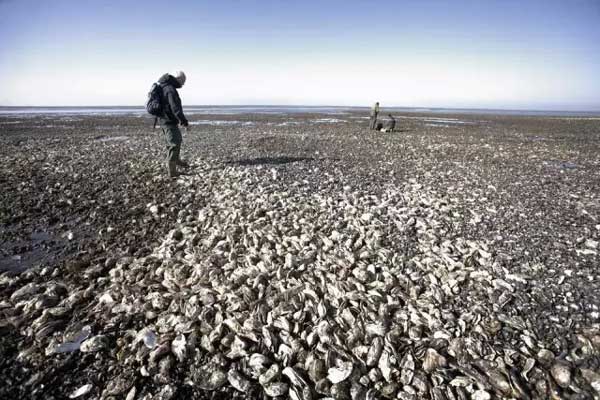
Oysters wreak havoc on Denmark’s seashore. [Photo/Weibo.com]

Danish people would never expect that the oyster crisis confronting their country may turn into a food-lovers’ bonanza in China. The European country’s dilemma may be the last thing Chinese people would ever understand as they see the abundance of seafood as a treat, rather than a problem.

The Danish Embassy published a story on Monday evening on its official Sina Weibo account, China’s twitter-like social network, about the problems for their country caused by an invasion of the exotic oysters. Chinese internet users enthusiastically responded with much discussion about ways to address the issue on Weibo, then WeChat, another popular social media network.

The embassy makes a small joke in the post to invite Chinese people to eat oysters in Denmark which triggered heated debate. Apparently, when it comes to eating, Chinese people are very serious and they already started to make plans for their oyster journey.

The most popular comment came from someone suggesting oyster visas should be issued “with 10 years’ unlimited round trips and one-month-long stay and I can eat up them all in five years” received over 10,000 likes. There are people even recommending visa-free and oyster immigration policies in China.

The oysters, known as Pacific oysters, are a new species in Denmark and have caused huge damage to the seashore’s ecological environment. Their proliferation is unstoppable since they have no natural enemies there. People have to get across them in shoes before swimming. What’s worse, their occupation leads to the endangerment of the Limfjord, a Danish local oyster.

Scientists and fishermen made numerous complaints to the nation’s conservation authority but the thorny issue remains unsolved. They also encouraged local people to bring them to their dining tables and few were motivated.

The Danish Embassy is very grateful for Chinese people’s innovative advice such as building oyster sauce factories and organizing oyster-dining journeys. It also said as long as China permits, they’d love to export oysters to China.

Syria: ‘Glimmers of humanity’ overshadowed by brutality of attacks on civilians, says UN aid chief

image_pdfimage_print

27 April 2017 – With fighting intensifying on numerous fronts in Syria over the past months, the top United Nations humanitarian official today urged consolidation of the nationwide ceasefire, most importantly a pause in fighting on the outskirts of Damascus, to enable the delivery of aid.

“The Secretary-General has said time and again that there will be no military end to this conflict. Yet, military might continues to be used against civilians in a way that defies all reason, let alone morality or the law,” Under-Secretary-General for Humanitarian Affairs and Emergency Relief Coordinator Stephen O’Brien told the Security Council.

He said that the use of “abhorrent chemical weapons” on 4 April in Khan Shaykhun was yet another horrific account of such brutality. “I wish I could say mindless brutality – but no, it was deliberate, planned, predetermined, by other humans against their own fellow human beings, sheer unbridled cruelty by leaders and commanders. And we await the investigation to confirm which ones.”

“The humanitarian situation is deteriorating, if that were possible, and the need for active engagement by members of the [Security] Council is urgently needed,” he said.

The core needs of the Syrian people from the international community remain largely unchanged, noting that they include the protection of civilians and civilian infrastructure by all parties to the conflict; immediate, unimpeded and sustained access to all in need throughout Syria; an immediate lifting of all sieges; and a political solution to the conflict.

In besieged eastern Ghouta, outside Damascus, civilians remain trapped amid reports of relentless shelling, airstrikes, and ground fighting, he said, noting that the last informal access routes have reportedly been closed further restricting movement for the some 400,000 people who live in the area, and who the UN has been unable to access since October last year.

As the noose has tightened around eastern Ghouta, some 30,000 people in the adjacent areas of Barza and Qaboun have also come under siege by the Government of Syria, he added.

“As it is already too late for the more than a quarter million Syrians who have died already in this atrocious war, so members of the Security Council it is action today that counts,” O’Brien stressed, via video link from Geneva, Switzerland.

He also urged the lifting of arbitrary and bureaucratic impediments by all parties throughout Syria.

“I will not repeat again the bureaucratic delaying tactics used by the Government of Syria to thwart humanitarian assistance at every turn, beyond saying that it continues to bring untold human suffering,” Mr. O’Brien said.

Only four convoys have deployed so far under the new two-monthly April-May plan, reaching 157,500 people. None of these convoys reached besieged areas, due to a lack of necessary authorizations, he said.

Although the overall number of those besieged has been reduced to just over 620,000 people due to evacuations, this process is not in line with humanitarian principles, and not conducted in consultation with the people affected.

“Let us not pretend that those who evacuate move to a location of safety. Many of those who displace to Idlib or northern Aleppo continue to live in areas where civilian structures, including hospitals, come under regular aerial bombardment, and their access to basic goods such as food and shelter is limited,” he said.

AUDIO: Addressing the Security Council, Stephen O’Brien reiterates the UN’s belief that there can be no military solution to the Syrian conflict.