UN reports more people warned against tobacco use, but industry interference continues

19 July 2017 – Despite measures protecting a majority of people from tobacco-related illness and death, the tobacco industry continues to hamper Government efforts to fully implement life and cost-saving interventions, the United Nations health agency today reported.

“One-third of countries have comprehensive systems to monitor tobacco use. While this is up from one-quarter of countries monitoring tobacco use at recommended levels in 2007, Governments still need to do more to prioritize or finance this area of work,” according to the UN World Health Organization’s WHO report on the global tobacco epidemic, which was launched today on side-lines of the UN High-level political forum on sustainable development in New York.

The report shows that some 4.7 billion people – more than 60 per cent of the population – are protected by at least one “best practice” tobacco control measure from the WHO’s Framework Convention on Tobacco Control (WHO FCTC). These measures include no smoking areas and bans on advertising tobacco products, for example.

In the foreword to the report, the head of WHO urged Governments to incorporate all the provisions of the WHO FCTC into their national tobacco control programmes and policies, and to fight against the illicit tobacco trade.

“Working together, countries can prevent millions of people from dying each year from preventable tobacco-related illness, and save billions of dollars a year in avoidable health-care expenditures and productivity losses,” said Tedros Adhanom Ghebreyesus, WHO Director-General.

The report, funded by Bloomberg Philanthropies, noted that systematic monitoring of tobacco industry interference in government policymaking protects public health by shedding light on tobacco industry tactics.

Such tactics include “exaggerating the economic importance of the tobacco industry, discrediting proven science and using litigation to intimidate governments.”

Douglas Bettcher, director of WHO’s Department for the Prevention of Noncommunicable Diseases (NCDs), said tobacco industry interference in government policy making represents “a deadly barrier to advancing health and development in many countries.

Controlling tobacco use is a key part of the 2030 Agenda for Sustainable Development. The Agenda includes targets to strengthen national implementation of the WHO FCTC and a one-third reduction in premature deaths from NCDs, including heart and lung diseases, cancer and diabetes, according to a press release launching the report.

“The progress that’s been made worldwide – and documented throughout this report – shows that it is possible for countries to turn the tide,” said Michael R. Bloomberg, WHO Global Ambassador for Noncommunicable Diseases and founder of Bloomberg Philanthropies.
News story: Africa Minister Stewart: UK stands shoulder to shoulder with Uganda

During his first visit to Uganda in his new role, the Minister emphasised the UK’s strong relationship with Uganda and continued partnership in tackling serious challenges in the region. This united approach saves lives and builds prosperity in Uganda, while helping to combat insecurity in neighbouring South Sudan, supporting huge numbers of refugees to rebuild their lives.

The Minister met people living in Impevi refugee centre, which hosts over 120,000 refugees, where he saw how UK aid is providing vital food, water and shelter to those in need. Increasing violence in South Sudan has forced millions of people to flee their homes to escape starvation and unimaginable horrors, with over 2,000 seeking refuge in neighbouring Uganda every day.

The Minister met with President Museveni to discuss bilateral trade between the UK and Uganda and strengthening the Commonwealth. They also discussed the ongoing crisis in South Sudan and the IGAD led peace process, Uganda’s continuing work in Somalia and their support for family planning.

Minister for Africa Rory Stewart said:

“I am delighted to be visiting Uganda and to meet President Museveni. The UK places great value in our relationship with Uganda and I look forward to strengthening this relationship yet further as the new Minister for Africa.

“The importance of Uganda’s role in the region cannot be overstated and it is vital to securing a lasting peace in South Sudan. South Sudan faces a worsening humanitarian crisis with over half the population in desperate need and ongoing violence forcing almost four million people to flee their homes and unimaginable horrors, with almost half seeking refuge in neighbouring countries like Uganda.

“The UK stands with Uganda as it manages the fallout of this tragedy. We are committed to both addressing the root causes of forced displacement, but also sustainable support to Uganda in responding to the influx of refugees. Thanks to UK aid, refugees reaching Uganda are receiving shelter, food, medical care, a measure of safety and the hope for a future in the region. This is in everyone’s interests”.

The UK is supporting Uganda in managing its growing refugee crisis by providing emergency support as well as helping strengthen services in the local host communities through rapidly upgrading infrastructure, hospitals and schools. On a visit to Vurra Cope Primary School in Rhino Refugee Settlement, where over 2000 of the 3000 students are South Sudanese refugees, the Minister saw how UK support is enabling these children to get back into education and give them hope for the future.

Minister Stewart also met beneficiaries of a UK supported family planning programme in Uganda, which is helping to provide integrated family planning and sexual reproductive health services to vulnerable young people in the area. This was in the same week as the landmark London Family Planning Summit at which the UK increased life-saving assistance to ensure women across the globe have access to modern contraception. The UK recently announced an increase in family planning support to Uganda which will help 380,000 additional women to get access to modern family planning methods, enabling them to finish their education, get better jobs and provide for their smaller, planned families to escape the cycle of poverty.

In the last year, UK aid in Uganda has fed 650,000 people, vaccinated 235,000 children, provided healthcare for 65,000, sheltered 181,000, provided clean water for 40,000 and essential relief items for 64,000 people.

Tory plans to close Jobcentres must be stopped

Theresa May plans to close Jobcentres across the country is cutting a lifeline for out-of-work Scots.

Shadow Scotland Office Minister Paul Sweeney challenged the Prime Minister in Parliament this afternoon on the proposal to close ten centres across Scotland, including six in Glasgow.

Paul Sweeney said the plans are perverse, given the impact on some of the most deprived areas of the country, with some of the highest rates of unemployment.

Speaking earlier in Scotland Questions, he also called on the Department for Work and Pensions (DWP) to explore the option of consolidating services to create “one-stop shops” in the same location, incorporating council and community services.
In Glasgow, unemployment has consistently been higher than the national average, child poverty is rising, and the use of foodbanks has increased.

The closures will lead to increased travel times and more expensive journeys, resulting in missed appointments and a potential increase in the number of people being sanctioned. It is therefore imperative the government publishes an equality impact assessment

The DWP should also give urgent consideration to consolidating local services to create 'one-stop shops' in the same location.

It is now absolutely clear that only Labour is committed to helping people across the entire UK to find decent and secure work. We will create an economy that works for the many, not the few.

Tories must end public sector pay cap

The Tories and SNP have failed to stand up for our public sector workers.

Shadow Scottish Secretary Lesley Laird used the first Scottish Questions since the election today to tell the Tories they are in ‘complete chaos’ on the future of the unfair public sector pay cap.

Chancellor Philip Hammond has reportedly said public sector workers are ‘overpaid’ – a statement which Scottish Secretary David Mundell failed to condemn this afternoon.

The SNP is unfortunately no better than the Tories after Nicola Sturgeon’s MSPs voted against lifting the cap for NHS workers.

Public sector pay restraint has been in place since 2010 and previous research from the independent Scottish Parliament Information Centre shows that the average nurse is £3,400 worse off.

In May, SNP MSPs voted against a Labour motion in the Scottish Parliament to scrap the pay cap for NHS staff, while the SNP’s own submission to the NHS pay review body recommended a 1 per cent overall cost cap this year. But SNP Finance Secretary Derek Mackay has since performed a U-turn following Labour pressure.

Of the total 542,200 people employed in the public sector in Scotland, 89.5 per cent are accounted for by employment in the devolved public sector. The Tory government is responsible for the vast majority of pay rates for workers in the reserved sector.

Labour would choose a different path from the Tories and the SNP.

Scottish Labour has said our dedicated NHS workers deserve a pay rise right now.

We would abolish the public sector pay cap and put an end to the low paid economy for all workers with a £10 minimum wage. Only Labour has a plan to create a country that works for the many, not the few.

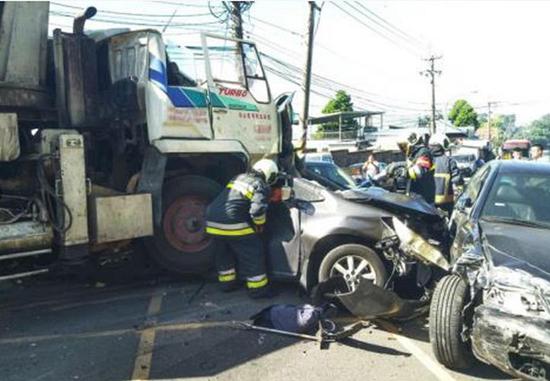
4 dead, 9 injured in Taipei car crash

Four people are killed and nine others injured after a pileup on Yangde Boulevard in suburban Taipei on July 19, 2017. [Photo/cctv.com]

Four people were killed and nine others injured after a pileup on Yangde Boulevard in suburban Taipei on Wednesday, according to local police.

The accident occurred at around 8:16 a.m. when a cement truck failed to stop as it approached an intersection on the boulevard.

A total of nine fire engines and 12 ambulances were dispatched to the scene.

Three men and one woman died. Five houses, 13 cars and nine motorcycles were damaged due to the accident, local authorities said.

The truck’s driver said his vehicle’s brakes failed. Further investigation is underway.