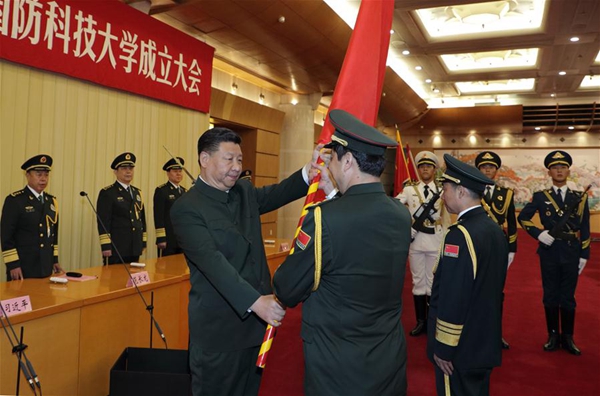
Xi calls for more replicable reform practices

image_pdfimage_print

Chinese President Xi Jinping Tuesday stressed the importance of pilot reform while calling for more reform practices that could be replicated and promoted.

Xi, also general secretary of the Communist Party of China (CPC) Central Committee and chairman of the Central Military Commission, made the remarks at the 35th meeting of the Central Leading Group for Deepening Overall Reform, which he heads.

Li Keqiang, Liu Yunshan and Zhang Gaoli, all members of the Standing Committee of the Political Bureau of the CPC Central Committee and deputy heads of the leading group, also attended the meeting.

A guideline on deepening reform of the educational system was adopted at the meeting, aimed to cultivate students’ abilities in lifetime learning and creative thinking, as well as the ability to adapt to the times.

Educational reform should update the methods of school running as well as management mechanisms to promote comprehensive development, according to a statement issued after the meeting.

In a separate topic, the leading group called for enhanced efforts to allow foreign investors easier access to China’s key sectors via a “negative list” approach.

The statement outlined several sectors that should further open to foreign investment, including services, manufacturing and mining.

The leading group also urged standardization of Chinese firms’ overseas operations, urging the formation of a supervision system featuring clear demarcation of rights and obligations and effective risk control.

According to the meeting, a long-term supervision and early warning system should be established to keep an eye on resources and environmental constraints on economic development. Environmental monitoring should be conducted in a scientific way with collection of reliable data.

The leading group also vowed to push for establishment of the personal information and asset system, and introduce information rating and a traceable security mechanism to ensure that personal information is safe and used properly.

To improve air quality in the Beijing-Tianjin-Hebei region with coordinated efforts, the leading group called for efforts to conduct a pilot program on setting up a cross-region environmental protection agency.

Environmental regulation in the region should apply unified standards, assessment, monitoring and law enforcement.

With the principle of prioritizing environmental protection and proper use of resources, the leading group called for use of market-based and paid-use mechanisms to develop maritime areas and uninhabited islands. Certain such regions that need special protection are prohibited from development.

The statement also said time has been ripe to officially establish the system of public interest litigation by prosecutors after nearly two years of pilot reform.

In July 2015, the Supreme People’s Procuratorate began the pilot program that allowed prosecutors in 13 provincial divisions to institute public interest litigation in civil and administrative cases.

So far, prosecutors have filed public interest lawsuits related to environmental protection, food and drug safety, state assets and state land use.

Abundant case samples and rich experience have been gained and the procedural mechanism well tested, according to the statement, which called for legal guarantees for procuratorates to file such litigation.

Jiaolong plumbs deepest region of the ocean

image_pdfimage_print

Jiaolong, China’s manned submersible, is about to dive into the South China Sea, May 10, 2017. [File Photo/Xinhua] 

The Jiaolong, China’s manned submersible, dived in the Mariana Trench on Tuesday, making the first of a series dives for the third stage of the country’s 38th oceanic expedition.

The craft reached a depth of 4.8 kilometers at 9:49 a.m. and remained submerged for about nine hours in all, said Tang Jialing, the pilot of the Jiaolong.

The Mariana Trench-in the western Pacific Ocean about 200 km southwest of Guam-is the site of Challenger Deep, the deepest valley in the ocean. Tuesday’s dive was made along the northern slope of the 11-km-deep valley.

In the next few days, the Jiaolong will make another dive to 6.3 kilometers and three more to 6.7 kilometers in the Marina Trench.

During these dives, it will collect samples of seawater, sediment, rocks and deep sea creatures to study the trench’s geochemical and biological activity, Tang said. In later missions, the Jiaolong will retrieve a deep-sea sampler planted there at a depth of 6 km last year.

Next, the expedition will sail to the Yap Trench, on the southern tip of the Marina Trench, and make five more dives.

The 38th oceanic expedition, which began on Feb. 6, is the longest and includes the most missions yet for the Jiaolong. The first of its three stages took place in the Indian Ocean for 59 days, and the second in the South China Sea for 34 days, according to China’s National Deep Sea Center.

The third stage began on May 16, when the scientific expedition ship Xiangyanghong 09 set sail for the Mariana and Yap trenches carrying the submersible and 96 scientists. The entire expedition is planned to end on June 9, when the Xiangyanghong 09 returns to port.

The deep sea is often regarded as Earth’s last frontier. Its exploration can yield better understanding of how organisms adapt and live in the world’s most extreme environment, said Wu Changbin, commander of the expedition’s third stage.

The ocean’s floor in the Mariana Trench is dark place with water temperatures from 1 to 4 C and atmospheric pressure 1,000 times greater than at the sea’s surface.

Yet life blossoms, due to hot water vents that emit chemicals such as hydrogen sulfide, which bacteria and other microbes can feed on and in turn support a variety of exotic creatures ranging from giant amoebas to bioluminescent fish.

Chinese scientists discovered 27 such vents in the Indian Ocean during the first stage of the expedition. In the South China Sea, they found rare bio examples such as sea lily and a branch of red coral attached to polymetallic nodules-clusters of minerals containing more than 10 elements, ranging from cobalt to manganese.

The Jiaolong, named after a mythical dragon, reached its maximum depth yet of 7,062 meters in the Mariana Trench in June 2012. China is building a new mother ship to operate and support the Jiaolong, and it is expected to enter service in 2019.

Interview with Tracy Grimshaw, A Current Affair

image_pdfimage_print

TRACY GRIMSHAW:

I spoke with Prime Minister Turnbull a short time ago. Prime Minister thank you very much for your time on a terrible night. We are all bracing ourselves to hear confirmation of the ages of the victims of this awful attack. Judging by your speech today I get the sense that you are feeling the same dread about that.

PRIME MINISTER:

This was a vile, reprehensible attack on innocence.

This was an attack on teenagers. Unimaginably cruel.
 
TRACY GRIMSHAW:

At this stage it is thought that this was one suicide bomber. How can we protect ourselves from one madman in a crowd of 21,000. How can we as a nation, learn security lessons from this?

PRIME MINISTER:

We are constantly working to keep Australians safe, Tracy. Since 2014, our intelligence and security agencies have thwarted 12 terrorist plots.

I asked the Australia-New Zealand Counter-Terrorism Committee, which brings together my federal agencies and all of the states and territories and New Zealand, to work together on a new, upgraded plan to defend places of mass gathering. That is nearly complete.

But I want to say this; above all, our prayers, our sympathy – our heartfelt sympathy –  goes out to the victims, to their families, to the people of Britain facing this attack. And above all, our resolute solidarity.

We stand with the people of Britain. We stand with Britain as we always have, defying terrorism.

TRACY GRIMSHAW:

In terms of protecting ourselves though, on a sort of, on a real basis, are we looking at having metal detectors at the entrances to all big sporting events? To all big concert events for example? I mean this was one man, it would appear, with a nail bomb. Is that what we’re going to have to do to protect ourselves?

PRIME MINISTER:

I was discussing this today with my counter-terrorism coordinator, with the Director-General of ASIO, and just a moment ago with the Commissioner of the Australian Federal Police. These are constantly under review Tracy. They will assess each event, in the light of the risk assessment that is appropriate. It’s a very dynamic environment. We have to constantly monitor the intelligence and constantly adjust the levels of protection in the light of what we’re seeing as patterns developing both here and overseas.

TRACY GRIMSHAW:

We have a military commitment to the war against terror in the Middle East. But if one suicide bomber can cause this carnage at a random event, can we ever win the war against terror?

PRIME MINISTER:

We will win the war against terror. We will crush the terrorists, we will destroy them in the field. We will destroy their co-called caliphate in the field, which they have used as a recruiting method. We will defeat them at home and abroad.

I want to remind you that since September 2014, we have arrested, here in Australia, 63 people on terrorism offences including a person today, as you may be aware, another person today. We have thwarted 12 plots, there have been four terrorist incidents that have occurred during that period. So the protection that our agencies give is substantial but it cannot be 100 per cent, there is no guarantee that a terrorist event cannot occur.

But I have to say to you that we have the best intelligence, security and police agencies in the world. They are constantly working to keep us safe. That’s my job, as Prime Minister, to make sure that we keep Australians safe and we have the best men and women on the front line, the best professionals keeping us secure.

TRACY GRIMSHAW:

Okay, thanks Prime Minister. Thanks for your time.

PRIME MINISTER:

Thank you.

[ENDS]

President of Sri Lanka to visit Australia

image_pdfimage_print

I look forward to welcoming the President of Sri Lanka, His Excellency Maithripala Sirisena, to Australia from 24 – 26 May.

This will be the first time a Sri Lankan Head of State has made a state visit to Australia and builds on Prime Minister Ranil Wickremesinghe’s successful visit in February.

2017 marks the 70th anniversary of diplomatic relations between Australia and Sri Lanka. Our deep and enduring friendship is anchored in shared history as Commonwealth countries and through our shared interests as Indian Ocean nations.

President Sirisena’s visit will be an opportunity to advance key areas of bilateral cooperation, including education, defence, science and technology, economic development, medical research and the fight against people smuggling.

President Sirisena will visit Canberra and Sydney. I look forward to meeting with him on this important visit.

New secure Internet app aids UN peacekeeping maintain and share statistics

image_pdfimage_print

23 May 2017 – The United Nations peacekeeping office today announced a new software application that is enhancing efficiency and situational awareness in the field.

The app, created as a result of collaboration with the Government of Singapore, alerts everyone necessary in the event of an emergency and is expected to be fully operational this year.

“We hope this will serve as a model for similar projects with Member States,” said Jean-Pierre Lacroix, the new Under-Secretary-General for UN Peacekeeping Operations.

Mr. Lacroix accepted the software in a ceremony today in New York, alongside Under-Secretary-General for Field Support, Atul Khare.

“This software will help keep all entities updated in the unfortunate situation when our colleagues in the field are killed, injured or fall ill, enabling Headquarters to respond with speed and efficiency,” Mr. Khare said.

According to information from the peacekeeping department, the software is compatible with other UN systems, stores information in a central location and provides secure access to permitted users only.

It is expected to “significantly improve the information processing time” as compared with the current manual process of casualty notification.

The app is in line with recommendations made to the peacekeeping office to deploy more information management and analysis tools to strengthen our operations. Those suggestions were made in the reports of the Expert Panel on Technology and Innovation in UN Peacekeeping and the High-level Independent Panel on Peace Operations (HIPPO).