China welcomes more job-seeking foreign graduates

image_pdfimage_print

Four months before getting his Master’s degree in computer science, Irish student Gareth Lacey got a job offer from a Chinese tech start-up in Beijing’s equivalent of Silicon Valley.

It might not sound like a big deal to a science postgraduate student in Beijing, but the offer did not come easily.

China only recently dropped the work experience requirement for foreign postgraduates, opening a floodgate of opportunities, especially to foreign students pursuing higher education degrees in China.

It had been almost impossible for foreign students to be employed right after graduation. Two years of work experience were mandatory in most cases, Beijing-based foreign students said.

Lacey, who has been studying at Beijing Institute of Technology, will be among the first to benefit.

He described the policy as a “welcome change” for himself and many foreign graduates in similar positions.

According to a January circular issued by Ministry of Human Resources and Social Security, Ministry of Foreign Affairs, and Ministry of Education, foreign students with a postgraduate degree or higher from Chinese or “well-known” foreign universities can be offered employment within a year after graduation.

Applicants should be healthy, have no criminal record, obtain a B grade average (or 80 out of a 100-point scale), have a job offer related to the major of study and with an income no lower than the local average.

Successful applicants will be given a one-year work permit, which can be extended to no more than five at renewal.

Lacey said the Chinese job market is a big draw for foreign job-seekers due to competitive salaries and relatively low living costs.

With its rapid development, China’s market has more to offer foreign job-seekers. Typical jobs for expatriates used to be language teachers, multinational executives, and foreign mission staffers, but the range is widening quickly.

Figures on the number of foreign employees in China are not always available. It was estimated that in the first decade of this century, the number of foreigners working in China grew three times to 220,000, according to the Ministry of Public Security, which oversees immigration affairs.

Lacey said that with the new policy, he suspects there will be a large increase in recent graduates seeking work in China.

“I found it hard to understand in the past that multiple scholarships were offered to foreign students to study in China, but after graduating, they had to leave,” he said.

Chinese universities began aggressively enrolling foreign students in 2010. The amount of scholarships has been increased over the years.

The country aims to become Asia’s top destination for international students by 2020, targeting 500,000 foreign students enrolled per year by then.

The Beijing-based think tank Center for China and Globalization estimates that about 398,000 foreign students came to study in China in 2015.

Wang Ying, director of the international student office under Beijing Institute of Technology, said Beijing’s Zhongguancun hi-tech zone had actually started piloting the policy last year and it was well received.

Postgraduates jumped at the opportunity, Wang said. Last year, his school organized eleven job affairs for international students. Each was full packed. Tech giants like Huawei were among the hiring firms.

“Many of our students were thrilled. They told me they wanted to learn Mandarin and work in China,” Wang said.

The appeal of a Chinese job is not confined to metropolises like Beijing, Shanghai, and Shenzhen.

There is enthusiasm in mid-level and even smaller cities.

Ayaz Ali, a Pakistani Ph.D. candidate studying at Northwest Institute of Eco-Environment and Resources under the Chinese Academy of Sciences, said it was his dream to work in the northwest city of Lanzhou.

Ali said other than participating in the world’s leading cryospheric research, he finds the local culture accommodating to Muslims like him. The province of Gansu, where Lanzhou is located, has a relatively large Muslim population, and Islamic rituals and practices are observed.

Ali said many Pakistani students come to study in China, but until now few have been able to stay on after graduation, which remains a cause of concern among Pakistani students in China.

“After all, it is also very hard to find a good job back home,” he said.

Ma Xiaolei, director of the international student affairs office at Beijing Language and Culture University, said lowering the employment threshold for foreign students serves the strategy to reinvigorate China through human resources development.

He said foreign employees will help Chinese enterprises gain an advantage as they expand overseas, and it is logical for foreign graduates of Chinese universities to put to use what they learn in school.

To open its market, China has also been easing the residence and entry policies for foreigners.

Last year, 1,576 foreigners obtained permanent residence in China, rising 163 percent over the previous year. Foreigners with permanent residence will enjoy the same rights as Chinese citizens in areas such as investment, housing purchases and schooling, among other rights.

Chinese syndicate stands trial for faking baby formula

image_pdfimage_print

Two staff of food safety watchdog investigate milk powder at a supermarket. [File Photo]

A Chinese syndicate of 11 people stood trial on Tuesday in Shanghai for allegedly producing and selling counterfeit baby formula imitating popular foreign and domestic brands.

The group was accused of manufacturing milk powder cans that copied the designs and logos of Beingmate and Abbott and filling them with cheap and inferior formula. The products were sold to the market through traders in several east and central China cities.

According to the indictment, at least 15,000 cans of counterfeit Abbott baby formula and 9,000 cans of counterfeit Beingmate products were sold between 2014 and 2015, earning illegal gains of millions of yuan.

The Shanghai food safety watchdog, police, and procuratorate were alerted to act in September 2015 after Abbott reported the case.

The authorities said they have been tracing and confiscating all fake products of the two syndicates on the market.

People convicted of manufacturing or selling counterfeit products can be sentenced to life in prison in severe cases.

The two-day trial, heard in the Third Intermediate People’s Court of Shanghai, ended Tuesday without the announcement of a judgment.

Child’s death prompts better supervision of shared bikes

image_pdfimage_print

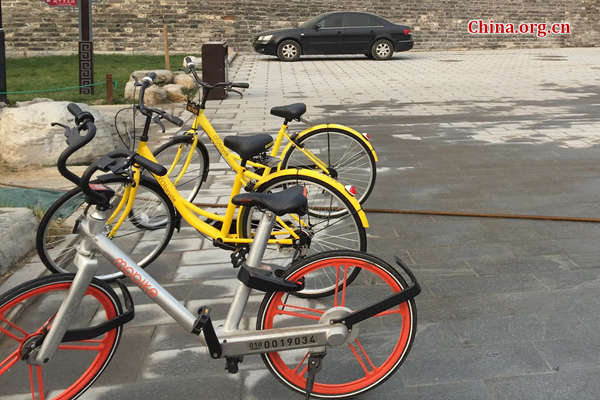
Rental bikes on the street. [Photo by Guo Yiming/China.org.cn] 

Supervisors and law experts have called for better supervision on shared bikes and more parental guidance for children following the death of a child riding a shared bike in Shanghai.

On Sunday, an elementary school boy, riding an Ofo shared bike, died after being hit by a bus in Shanghai.

Ofo issued a statement on Tuesday pledging to assist the police investigation related to the death. The company said it is working on an effective prevention mechanism to prevent children under 12 years old from using shared bikes.

Chinese national road safety law requires a person to be 12 years old or older in order to ride a bicycle or tricycle.

However, with a growing number of shared bikes on the streets, children under 12 years old have become frequent users. If a user forgets or fails to lock an Ofo bike after use, for example, it is free for the next user to use, even if the rider has not registered for an account via smart phone.

Guo Jianrong, general secretary of the Shanghai Bicycle Industry Association, said the association has required Ofo to place smart locks on its bikes. Ofo’s chief rival, Mobike, uses smart locks that can only be unlocked using a phone.

“Rules need to be established to supervise the use of shared bikes,” said Liu Chunyan, a law expert at Tongji University.

“If an accident happens because of the quality of a bicycle, for example, a brake failure, the company should be held liable. In other cases, the company is not at fault,” Liu said.

Cui Minyan, China division chief of Safe Kids Worldwide, said parents should give more guidance to their children regarding shared bikes.

“Parents may underestimate the danger of road traffic and think their children have good bicycle skills. The absence of guidance may easily lead to tragedies,” Cui said.

Chinese leaders attend funeral of former senior political advisor

image_pdfimage_print

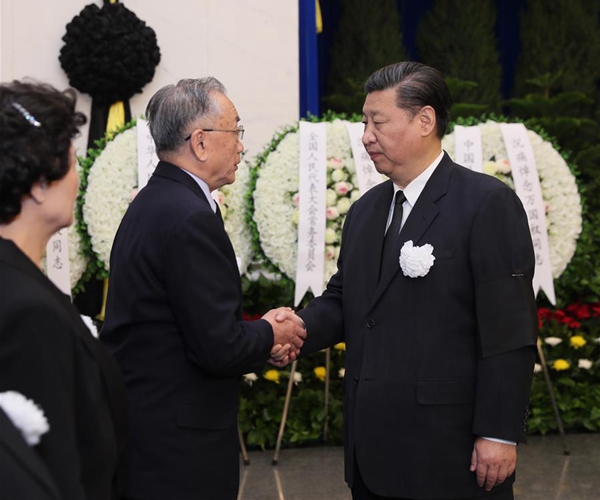
Chinese President Xi Jinping (R) shakes hands with a family member of Wan Guoquan, former vice-chairman of the National Committee of the Chinese People’s Political Consultative Conference, during Wan’s funeral at the Babaoshan Revolutionary Cemetery in Beijing, capital of China, March 28, 2017. [Photo/Xinhua]

The cremation of Wan Guoquan, former vice-chairman of the National Committee of the Chinese People’s Political Consultative Conference, was held Tuesday, with Chinese leaders paying their respects at the funeral in Beijing.

Xi Jinping, Li Keqiang, Zhang Dejiang, Yu Zhengsheng, Liu Yunshan, Wang Qishan, Zhang Gaoli, as well as Jiang Zemin and Hu Jintao either visited Wan when he was in hospital or extended their condolences after his death.

Xi Jinping, Zhang Dejiang, Yu Zhengsheng, Liu Yunshan, Wang Qishan, Zhang Gaoli, as well as Hu Jintao attended the funeral at Babaoshan Revolutionary Cemetery.

They stood in silent tribute and bowed three times in front of Wan’s body. They also offered Wan’s family their condolences.

Wan was also executive vice-chairman and honorary vice-chairman of the Central Committee of the China National Democratic Construction Association, one of China’s eight non-communist parties.

Wan died on March 23 at the age of 99.

BCC comments on the triggering of Article 50 and the start of Brexit negotiations

image_pdfimage_print

On the day Article 50 is triggered, Dr Adam Marshall, comments on the start of the Brexit negotiations.

29 March 2017

Commenting on the triggering of Article 50 by the Prime Minister, Theresa May, Adam Marshall, Director General of the British Chambers of Commerce (BCC), said:

“Now that Brexit negotiations are set to begin, businesses across the UK and their trading partners in Europe want answers to practical questions, not political posturing. A pragmatic and grown-up dialogue on the real-world issues, rather than verbal volleys between London and Brussels, would give firms greater confidence over the next two years.

“In the early weeks of the negotiation process, businesses would like to see an effort to secure simultaneous exit and trade talks. Concluding exit and trade negotiations at the same time would moderate adjustment costs for UK businesses, and enable trade between UK and EU firms to continue with less disruption.”

On business expectations beyond Brexit, Marshall added:

“It is crucial for the Prime Minister and her government to remember Brexit is not the only thing on the minds of UK businesses. Issues here at home, from the training system to sky-high business rates and up-front costs, still need to be addressed.

“Businesses would not look kindly on a government that treats Brexit as its only job. Getting the fundamentals right here in the UK is as important, if not more important, than any eventual Brexit deal.”

Ends

Notes to editors:

The British Chambers of Commerce have published a Business Brexit Priorities report. The key recommendations in the report are:

  • On the Labour Market, the government should provide certainty for businesses on the residence rights of their existing EU workers, provide clarity on hiring from EU countries during the negotiation period, and avoid expensive and bureaucratic processes for post-Brexit hires from the EU
  • On Trade, the government should aim to minimise tariffs, seek to avoid costly non-tariff barriers, grandfather existing EU free trade agreements with third countries, and expand the trade mission programme
  • On Customs, the government should develop future customs procedures at the UK border in partnership with business, seek to maintain the UK’s position as an entry point for global businesses to Europe
  • On Tax, the government should guarantee that HMRC is appropriately resourced to help businesses through the transition process, and provide clarity on whether VAT legislation will continue to mirror current core VAT principles
  • On Regulation, the government should ensure stability by incorporating existing EU regulations into UK law and maintaining these for a minimum period following Brexit, and ensure that product standards are aligned with, and recognised by, the EU to keep UK products competitive
  • On EU funding, the government should maintain UK access to the European Investment Bank, and ensure there is no funding ‘cliff-edge’ for areas in receipt of EU funding
  • On Northern Ireland, the government must avoid any return to a hard border, so that businesses can move people and goods as freely as possible.

The British Chambers of Commerce (BCC) sits at the heart of a powerful network of 52 Accredited Chambers of Commerce across the UK, representing thousands of businesses of all sizes and within all sectors. Our Global Business Network connects exporters with nearly 40 markets around the world. For more information, visit: www.britishchambers.org.uk

Media contacts:

Allan Williams – Senior Press Manager

020 7654 5812 / 07920583381

Orla Hennessy – Press and Communications Officer

020 7654 5813 / 07825746812