Press release: PM meeting with Malaysian Prime Minister Najib Razak: 14 Sept 2017

A Downing Street spokesperson said:

The Prime Minister welcomed Malaysian Prime Minister Najib Razak to Downing Street on 14 September with Defence Secretary Michael Fallon also in attendance.

The leaders spoke of the deep and historical ties between the UK and Malaysia and agreed on the importance of taking steps to enhance our bilateral relationship. They noted that that 2017 marks the 60th anniversary of diplomatic relations between our two countries as well as the 60th anniversary of Malaysian independence.

The Prime Minister and Prime Minister Najib discussed the ongoing crisis in Rakhine in Burma with the Prime Minister reiterating the importance of the Burmese authorities allowing unfettered access for humanitarian assistance in the country. The leaders agreed that the UK and Malaysia should co-ordinate on the provision of humanitarian assistance in Burma and in Bangladesh.

The Prime Minister and Prime Minister Najib also agreed on the continuing importance of Commonwealth values and spoke of the steps being taken to renew the organisation including at the Commonwealth Summit in London next year.

They discussed the importance of the existing defence relationship between the UK and Malaysia with both countries being party to the Five Power Defence arrangements.

The leaders spoke about the opportunities that the UK’s exit from the EU will offer and committed to exploring ways to deepen the trade and investment relationship between the UK and Malaysia.

The Prime Minister also took the opportunity to personally express her condolences to Prime Minister Najib for the loss of life in the Darul Quran Ittifaqiyah Tahfiz school fire.

Press release: PM meeting with Malaysian Prime Minister Najib Razak: 14 Sept 2017

The Prime Minister welcomed Malaysian Prime Minister Najib Razak to Downing Street on 14 September with Defence Secretary Michael Fallon also in attendance.

The leaders spoke of the deep and historical ties between the UK and Malaysia and agreed on the importance of taking steps to enhance our bilateral relationship. They noted that that 2017 marks the 60th anniversary of diplomatic relations between our two countries as well as the 60th anniversary of Malaysian independence.

The Prime Minister and Prime Minister Najib discussed the ongoing crisis in Rakhine in Burma with the Prime Minister reiterating the importance of the Burmese authorities allowing unfettered access for humanitarian assistance in the country. The leaders agreed that the UK and Malaysia should co-ordinate on the provision of humanitarian assistance in Burma and in Bangladesh.

The Prime Minister and Prime Minister Najib also agreed on the continuing importance of Commonwealth values and spoke of the steps being taken to renew the organisation including at the Commonwealth Summit in London next year.

They discussed the importance of the existing defence relationship between the UK and Malaysia with both countries being party to the Five Power Defence arrangements.

The leaders spoke about the opportunities that the UK’s exit from the EU will offer and committed to exploring ways to deepen the trade and investment relationship between the UK and Malaysia.

The Prime Minister also took the opportunity to personally express her condolences to Prime Minister Najib for the loss of life in the Darul Quran Ittifaqiyah Tahfiz school fire.

Press release: HMRC’s Executive Chair to step down

Edward joined HMRC in 2012 after several years in HM Treasury, and is the department’s most senior tax professional. During his time at the department, Edward has fulfilled the roles of Tax Assurance Commissioner as well as leading the former business group Central Tax and Strategy. As the former Head of Profession, Edward has also been responsible for overall policy partnership with HM Treasury. Since April 2016, Edward has chaired HMRC’s Board.

Speaking of his retirement, Edward said:

After nearly 40 years in the world of tax, and the last 13 working in HM Treasury and HMRC, I have decided to retire from my role as Chair of HMRC. We have just delivered our best ever annual performance and I am immensely proud to end my professional career in tax in the department which is at the heart of the UK’s tax system. My colleagues across HMRC continue to deliver the vital work we do with huge talent and professionalism and the department is well on track to fulfil the vision of becoming a world class organisation.

Chief Executive, Jon Thompson, said:

Edward has given his all to this department during his time here, and as our most senior tax professional, we will miss greatly Edward’s expertise and leadership. HMRC is without a doubt a better organisation thanks to Edward’s contribution, and we will certainly build on his achievements here – I wish him all the best for whatever he does next.

Chancellor of the Exchequer, Philip Hammond, said:

My colleagues and I are very grateful to Edward for his service to HMRC and HM Treasury – his deep expertise and experience has rightly gained him the respect of the tax world and he retires with our very best wishes.

Edward will leave the department on 31 December, 2017.

End

Having become involved in tax policy through work with the Institute for Fiscal Studies and other academic and professional groups, in 1995 Edward was asked to join the Treasury as Special Adviser on tax to Kenneth Clarke, the then Chancellor.

Edward worked on the 1995 and 1996 Budgets, before returning to Simmons & Simmons in 1997 as Head of Tax Strategy, where he contributed to a range of tax initiatives and published and lectured extensively on tax policy issues.

Edward joined the Treasury as Director, Business and Indirect Tax in 2004 and was Director-General, Tax and Welfare from 2010 until he joined HMRC in 2012 as Tax Assurance Commissioner and Second Permanent Secretary.

Edward Troup was appointed Executive Chair and First Permanent Secretary at HM Revenue and Customs (HMRC) in February 2016.

Case 411 – Safety pins on swimming pool locker keys

The page you requested does not exist…

…but we think we can help you

You may not be able to find this page because of:

  1. An out-of-date bookmark/favourite
  2. A search engine that has an out-of-date listing for us
  3. A mis-typed address

Please try one of the following pages:

Bluebook on China’s competitiveness of global talent recruitment

A bluebook report identifying China’s relative weak competitiveness in wooing global talents as well as containing proposals for measures for different regions within China to improve was released on Sept. 11 in Beijing, as parts of a joint effort of the Center for China and Globalization (CCG) and the Institute of Development Studies at Southwestern University of Finance and Economics (SWUFE) in Sichuan.

The report, titled The Report on China’s Regional International Talent Competitiveness 2017, is published as China is gearing up to attract more talented people from all over the world in order to boost its economic growth. It is an imperative to objectively evaluate the current status of China’s competitiveness of global talent recruitment in order to identify the gap and find solutions.

CCG and SWUFE’s Institute of Development Studies co-established an index model to assess China’s regional competitiveness in attracting overseas talents by using six dimensions – population size, structure, innovation, policy, development and living conditions, supported by 13 secondary indices and 36 tertiary indices.

Based on the model, the report compiled a ranking of the most-preferred places in China for foreign talents. Futhermore, by comparing the situation in all of China’s 31 province-level regions (Taiwan, Macao, and Hong Kong not included), the report mapped out policy measures to improve China’s regional and national competitiveness to recruit more global talents.

The key highlights of the report are as follows:

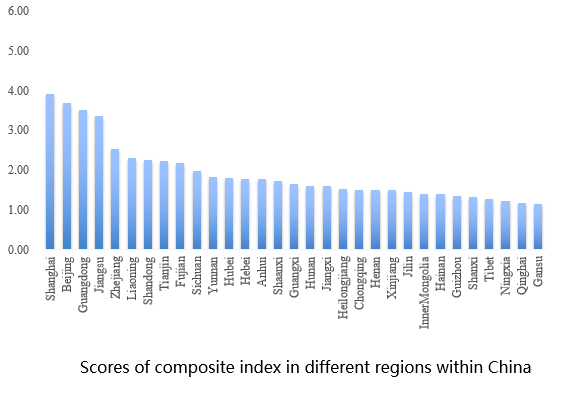
• China’s overall global talent competitiveness still lags behind many developed countries. The proportion of international workers in China is far below the world average. In 2015, only 0.06% of the country’s population were foreigners, while the worldwide average proportion was 3.3%. Shanghai ranks the highest among all of the Chinese cities evaluated according to the 2017 report. Even so, it only attains 65.17 out of 100 in global talent competitiveness, followed by Beijing, Guangdong, and Jiangsu, all of which are the most economically developed regions in China.
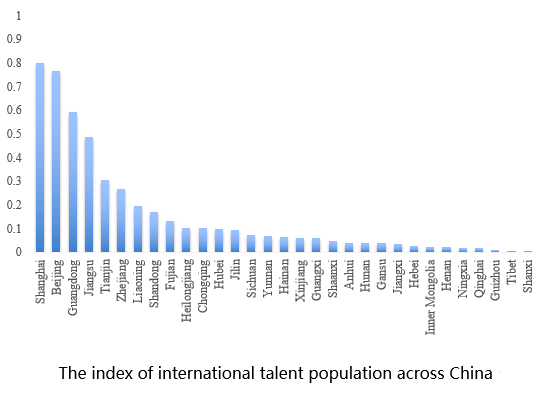
• Geographically, foreign talents are very unevenly spreaded in China with the gap between first placed Shanghai and last placed Shanxi reaching 0.8 out of a total score of 1. Beijing, Shanghai and Tianjin are the top three most favorite cities for foreign students, while Guangdong, Shanghai and Jiangsu are the first-tier cities which accommodate the most foreign experts.
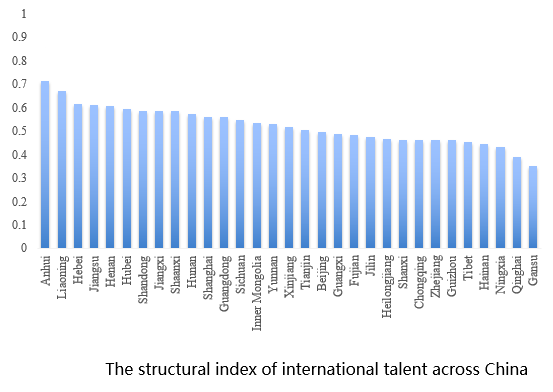
• In terms of the quality of the recruited global population, there is not a large margin between different provinces or regions. Anhui and the western regions score higher in global talent eudcation degree structure for having more foreign experts on science and technology research with strong academic backgrounds. Jiangsu, Guangdong, and Shanghai score the highest in global talent occupation structure for providing foreign workers room to develop their long-term career.
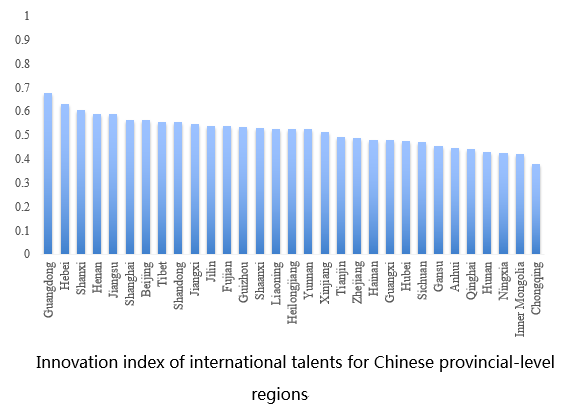
• Guangdong ranks the first in terms of international talent innovation, as the foreign workers there are foscused on innovative industries and activities, while the western region also has great potential in this regard. Shanghai, on the contrary, scores low on this index, because most international talents there are working in the financial industry, instead of innovative industries such as IT or high-end manufacturing.
 

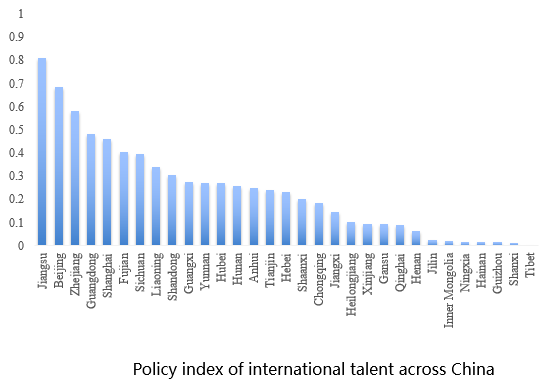
• The eastern coastal regions have more friendly international talent recuitment policies, while China’s mid and western regions lag behind. Jiangsu ranks first on this index, followed by Beijing, Zhejiang, and Guangdong. With respect to international talent recruitment policy innovation, Beijing, Shanghai and Guangdong score higher, as they have all been rolling out policies to reform entry and exit regulatory system to facilitate high-level international talents and their entrepreneurship and innovation activities in China.
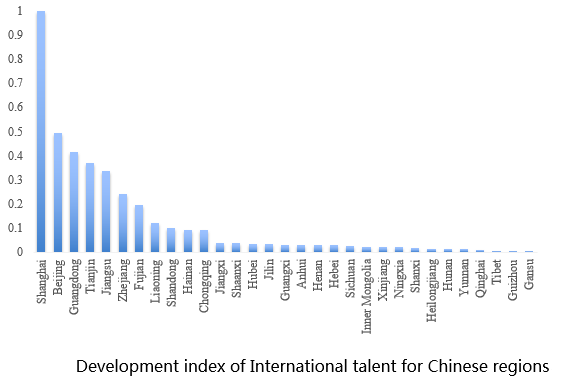
• Sharp margins exist between China’s coastal and inland region over creating a talent cultivation environment for foreign workers. Shanghai obtains a full score on this index. With extensive access to the global economy and strong international background, Shanghai has become a hub for forign trade and MNC headquarters. However, most regions still lack strength in building the appropriate surroundings for foreign talents.
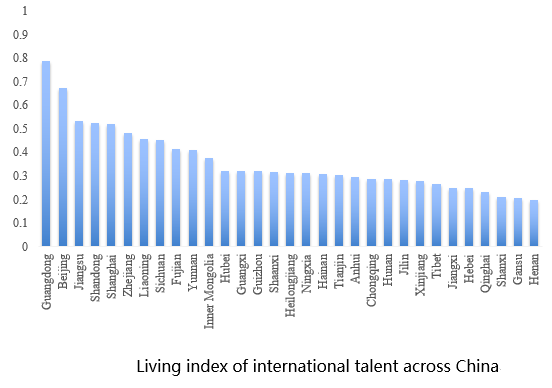
• Guangdong is selected by foreign talents as the most popular place to live, and China’s midwest also has great potential in attracting foreign talents with its better environment and living conditions. Guangdong, Jiangsu, Beijing, Shandong and Shanghai rank as the top 5 provinces/cities respectively for providing the best social security and services to foreign talents, such as healthcare and children’s education.
Based on the findings above, the report proposed to institutionally improve the work of inter-national talent recruitment in order to attract more foreign talents. Measures such as estab-lishing a governing entity specifically for international talent management, expanding inter-national talent recruitment policies which have been proved effective in pilot programs, and enhancing regional competitiveness for international talent through improved natural envi-ronments and living conditions were provided in the bluebook. (Li Xiaohua contributes to this article)