News story: Burial of 19 unknown British WW1 Soldiers in Ypres, Belgium

19 unknown British comrades in arms who lost their lives on the battlefield during World War 1 (WW1) have finally been laid to rest in the New Irish Farm Commonwealth War Graves Commission (CWGC) Cemetery in Ypres, Belgium on Thursday 28 September.

Unusually for a single service the ceremony involved casualties from English, Irish, Scottish and Welsh Regiments. The service itself was organised by the MOD’s Joint Casualty and Compassionate Centre (JCCC), part of Defence Business Services and was conducted by The Reverend Iori Price CF, Chaplain to the 1st Battalion, The Royal Anglian Regiment.

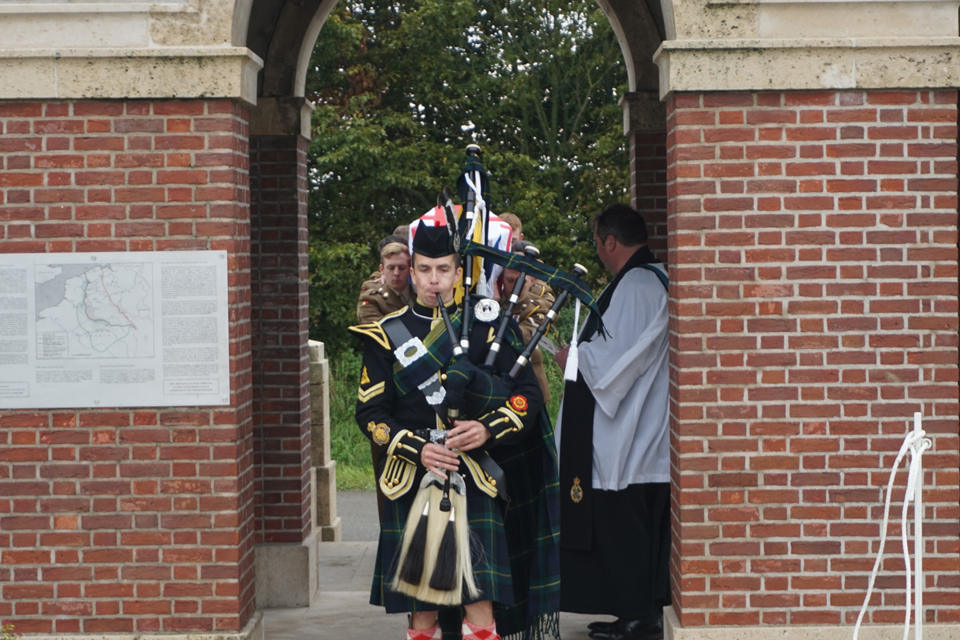
Local piper, Pierre Dervaux, leads the procession into the cemetery – Crown Copyright, All Rights Reserved

Sue Raftree, JCCC said:

It is very unusual for there to be 19 First World War soldiers from English, Irish, Scottish and Welsh Regiments buried in one ceremony. It has been a privilege for the Joint Casualty and Compassionate Centre to organise this service.

The soldiers were found following ground work at an industrial development at Briekestraat, Ypres in Belgium. The location, thought to be the original Irish Farm site, is an original war time cemetery created by the army under war conditions. It was believed that all those buried there had been transferred to the New Irish Farm Cemetery, some 300 meters away, but this discovery has proved that they hadn’t.

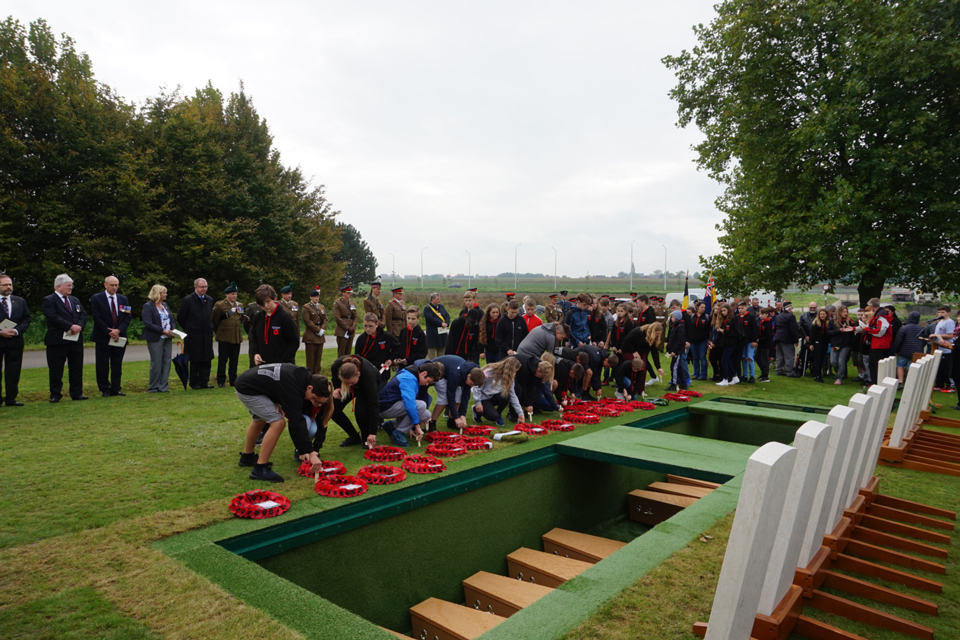
Local children from the Peace Village lay wreaths for the 19 unknown soldiers – Crown Copyright, All Rights Reserved

Investigations undertaken by the JCCC established that of the 19 soldiers:

  • 4 served with the Essex Regiment
  • one with the Monmouthshire Regiment
  • one with the Argyll and Sutherland Highlanders
  • one with the Northumberland Regiment
  • one with the Royal Irish Regiment

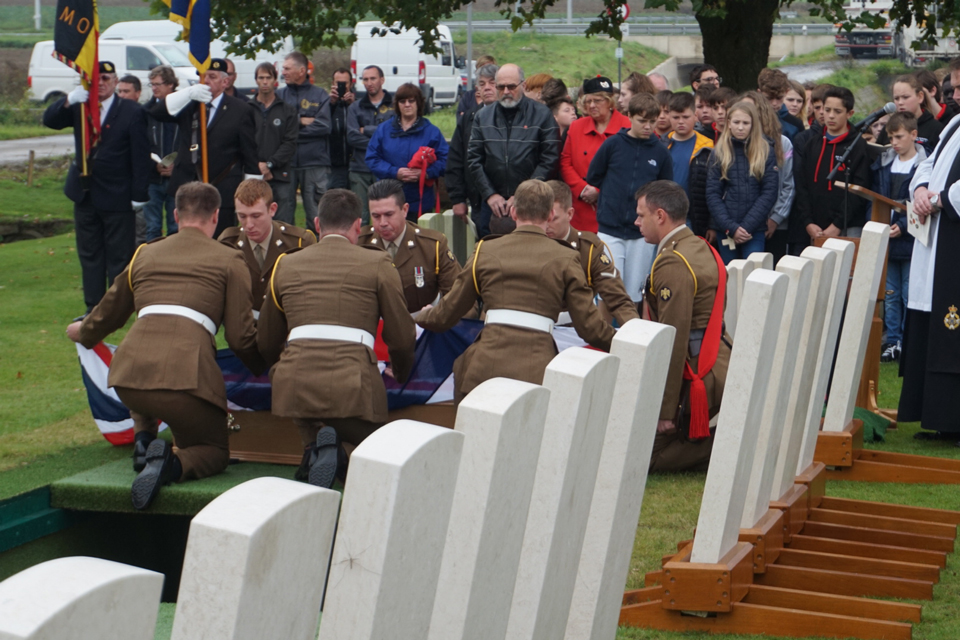
As no regimental artefacts were found, the remaining 11 will be buried as ‘Known Unto God’. During the burial service all the coffins were in the burial plots with the exception of 1, which was carried in as the focus of the ceremony by the Essex Regiment, now the Anglians.

A bearer party prepare coffin to be lowered into the ground – Crown Copyright, All Rights Reserved

Reverend Iori Price CF said:

We are always mindful of the costs of conflict and the need we have to persue peace for all. At such a moment as this, when we have gathered to bury those fallen in conflicts, we reflect on the great price paid by our service personnel then and the motivation that encouraged them.

The headstones were provided by the CWGC and Liz Sweet, CWGC’s Director of External Relations in Western Europe said:

We, at the Commonwealth War Graves Commission, are delighted that the sacrifice of these 19 soldiers has been recognised by today’s event and will now be cared for in perpetuity by the Commission.
News story: Burial of 19 unknown British WW1 Soldiers in Ypres, Belgium

19 unknown British comrades in arms who lost their lives on the battlefield during World War 1 (WW1) have finally been laid to rest in the New Irish Farm Commonwealth War Graves Commission (CWGC) Cemetery in Ypres, Belgium on Thursday 28 September.

Unusually for a single service the ceremony involved casualties from English, Irish, Scottish and Welsh Regiments. The service itself was organised by the MOD’s Joint Casualty and Compassionate Centre (JCCC), part of Defence Business Services and was conducted by The Reverend Iori Price CF, Chaplain to the 1st Battalion, The Royal Anglian Regiment.

Local piper, Pierre Dervaux, leads the procession into the cemetery - Crown Copyright, All Rights Reserved
Local piper, Pierre Dervaux, leads the procession into the cemetery – Crown Copyright, All Rights Reserved

Sue Raftree, JCCC said:

It is very unusual for there to be 19 First World War soldiers from English, Irish, Scottish and Welsh Regiments buried in one ceremony. It has been a privilege for the Joint Casualty and Compassionate Centre to organise this service.

The soldiers were found following ground work at an industrial development at Briekestraat, Ypres in Belgium. The location, thought to be the original Irish Farm site, is an original war time cemetery created by the army under war conditions. It was believed that all those buried there had been transferred to the New Irish Farm Cemetery, some 300 meters away, but this discovery has proved that they hadn’t.

Local children from the Peace Village lay wreaths for the 19 unknown soldiers - Crown Copyright, All Rights Reserved
Local children from the Peace Village lay wreaths for the 19 unknown soldiers – Crown Copyright, All Rights Reserved

Investigations undertaken by the JCCC established that of the 19 soldiers:

  • 4 served with the Essex Regiment
  • one with the Monmouthshire Regiment
  • one with the Argyll and Sutherland Highlanders
  • one with the Northumberland Regiment
  • one with the Royal Irish Regiment

As no regimental artefacts were found, the remaining 11 will be buried as ‘Known Unto God’. During the burial service all the coffins were in the burial plots with the exception of 1, which was carried in as the focus of the ceremony by the Essex Regiment, now the Anglians.

A bearer party prepare coffin to be lowered into the ground - Crown Copyright, All Rights Reserved
A bearer party prepare coffin to be lowered into the ground – Crown Copyright, All Rights Reserved

Reverend Iori Price CF said:

We are always mindful of the costs of conflict and the need we have to persue peace for all. At such a moment as this, when we have gathered to bury those fallen in conflicts, we reflect on the great price paid by our service personnel then and the motivation that encouraged them.

The headstones were provided by the CWGC and Liz Sweet, CWGC’s Director of External Relations in Western Europe said:

We, at the Commonwealth War Graves Commission, are delighted that the sacrifice of these 19 soldiers has been recognised by today’s event and will now be cared for in perpetuity by the Commission.
Helping the environment by recycling

Date published: 28 September 2017

Everyone is being encouraged to help the environment by recycling more material, including food waste. Reduce, reuse and recycle where possible as part of the household daily routine.

Food waste

Food waste makes up a significant amount of the household waste we throw out each week.

Making the effort to recycle this food waste can greatly help to improve the environment.

Even small bits of food, like tea bags and coffee grounds, can be recycled.

It is important that everyone uses the recycling services provided by councils throughout the year.

Locally-produced compost from recycled food waste is being used within our local parks and community gardens, keeping them in good condition for the growth of flowers, fruit and vegetables. 

More useful links

Share this page

Feedback

Would you like to leave feedback about this page? Send us your feedback

News story: Infected blood scheme reform

The government announced reforms to payments supporting people who received infected blood during NHS treatment in the 1970s and 1980s.

The Department of Health published its response to the recent consultation on infected blood support and the special category mechanism on 28 September.

As part of this response, the government announced new payment ‘uplifts’ and a new special category mechanism (SCM) to improve financial support for those affected by the infected blood tragedy of the 1970s and 1980s.

At least 2,400 people died and thousands more were exposed to Hepatitis C and HIV, with life-changing consequences, as a result of receiving infected blood.

The following measures will now be introduced:

  • a new SCM will be introduced so more people with hepatitis C stage 1 can claim financial support with no distinction between severities of illness suffered

  • the SCM will consider any significant and sustained adverse impact of Hepatitis C infection or its treatment on the ability of an individual to carry out routine day-to-day activities

  • administration of the current 5 payments schemes will be given to a single body – the NHS Business Services Authority (NHSBSA). The NHSBSA will start on 1 November 2017

  • ‘uplifts’ to annual payments from 2018 to 2019 and increasing the amount of discretionary funding available

  • adding membranoproliferative glomerulonephritis (MPGN) to the list of stage 2 Hepatitis C conditions.

The discretionary payment scheme has been changed so that all groups can get the support they need quickly, both financial and otherwise

The department has increased annual spend on support payments to record levels since 2015, committing an additional £125 million in funding for support.

The changes concern people who were infected in England.

Spanish-born giant panda arrives in China

A giant panda born in Madrid Zoo in 2013 arrived in Chengdu, capital of southwest China’s Sichuan Province Thursday.

The male panda will been quarantined for one month before meeting the public at his new home, Chengdu Research Base of Giant Panda Breeding, the base said.

Xing Bao, which means star treasure, was born on Aug. 30, 2013. He was the third cub born to panda Huazuiba and her mate Bing Xing.

Under agreements signed with international zoos, all pandas born overseas must come to China once they mature to take part in breeding programs.

Staff at the base prepared billboards introducing Xing Bao and gave out postcards to celebrate his arrival.

China began cooperation with Spain in giant panda breeding research in 2007.