|
|
|
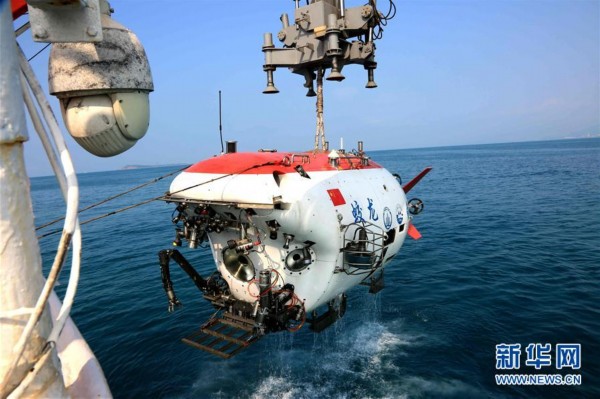
Jiaolong submersible goes through a dive simulation in Sanya, Hainan Province, on April 22. [Photo/Xinhua]
|
Jiaolong, China’s manned submersible, completed a dive Wednesday in the South China Sea.
Departing its mother ship Xiangyanghong 09 at around 7 a.m., Jiaolong stayed underwater for nine hours and twelve minutes for the dive before returning at around 4:19 p.m.
It managed to bring 16 liters of sea water samples collected near the seabed, eight sediment samples and two rock samples back to Xiangyanghong 09, in addition to high-definition photos and video footage shot during the mission.
Wednesday’s dive marks the first dive by Jiaolong in the second stage of China’s 38th ocean scientific expedition, which will last until May 13.
The maximum depth of the Jiaolong mission on Wednesday was 1,741 meters below sea level, and the submersible spent some seven hours on the seabed.
Three staff, including one seasoned crew member, Tang Jialing, and two interns, Liu Xiaohui and Yang Yifan, were on board the submersible.
“This is almost Jiaolong’s longest underwater mission,” said Tang.
In an interview with Xinhua prior to the drive, Yang Yaomin, chief scientist for the second stage expedition, said experts had planned to choose a site for experimenting with the collection of polymetallic nodules during the mission.
“We are working to avoid damaging the marine environment in mining,” said Yang. “The expedition will help develop technology for environmentally friendly deep-sea mining.”
Polymetallic nodules are mineral resources that are generally deposited more than 4,000 meters deep beneath the sea’s surface and contain manganese, iron, copper, nickel, cobalt as well as rare earth elements.
During the expedition, manned deep-sea submergence was also conducted in the seamount chain and continental slope areas in the South China Sea, according to scientist Shi Xuefa.
“We plan to carry out geological and biological surveys in the region,” said Shi. “The submersible will take photos of the distribution of polymetallic nodules, deep-sea life and seafloor terrain.”
The rock samples collected from the seamount will be used in research in chronology, mineralogy and geochemistry on the South China Sea, advancing the study of the region’s structural evolution, according to Shi.
The 38th oceanic scientific expedition started on Feb. 6. Jiaolong completed a dive in the northwestern Indian Ocean earlier this year in the mission’s first stage. It will also conduct surveys in the Yap Trench and the Mariana Trench in the third stage.
Named after a mythical dragon, Jiaolong reached its deepest depth of 7,062 meters in the Mariana Trench in June 2012.
read more


