China to spur market vitality via integration of certificates

China will keep integrating business certifications and licenses into one consolidated business license, which is to further reduce institutional costs for market entities and stimulate market vitality as part of the country’s business registration reform.

The decision was made at a State Council executive meeting, which was presided over by Premier Li Keqiang on Wednesday and approved a guideline on its implementation.

With this policy in action, different certificates related to business registration will be sorted out and merged into one business license, making enterprises ready for operations once they obtain the license with no further delay.

“We should focus on creating a globally competitive business environment and continuing the business registration reform. It’s to reduce institutional costs for enterprises and cultivate an inclusive and fair backdrop for mass entrepreneurship and innovation as more enterprises can be easily registered and flourish,” Li said.

As a significant measure to boost the supply-side structural reform and administrative reforms, the integration of certificates will further transform governmental functions and unleash benefits enabled by reforms, the guideline said.

The document required integration, simplification and abolition of certificates as much as possible with a handful of exceptions involving safety and security concerns. Any of enterprise-related certificates and licenses with no statuary foundations or set without due legal procedures will be canceled.

The guideline aimed to boost inter-departmental sharing of basic and credit information of enterprises. Repetition in submitting identical registration information will be avoided. Integration of the Internet with governmental services will be further boosted to improve efficiency for approvals.

Supervision will be strengthened to oversee registration and post-registration procedures with clearly-defined departmental responsibilities, while a new supervisory mechanism will be established centering on corporate credits.

The document also encouraged local governments to explore new ways in the integration process and boost assessment and rankings for local business facilitation in accordance with international benchmarks for business environment.

On Oct. 1, 2015, China merged the business license, the organizational code certificate and the tax registration certificate into one.

One year later, the country further encompassed the social insurance registration certificate and the statistical registration certificate into the business license, a move that has significantly reduced institutional costs.

A State Council executive meeting on Oct. 14, 2016 decided that more enterprises-related certificates will be integrated with the business license to facilitate business startups, boost social creativity and boost employment.

Further actions have been undertaken since to accelerate the process.

It was suggested in the Government Work Report Li delivered in March with an aim to promote mass entrepreneurship and innovation.

Li said that the integration of certificates is an effective way to improve productivity. While numerous certificates still exist, relevant departments need to “give up petty benefits for greater achievements by adding more water to nourish fish in the pond,” a metaphor to symbolize making enterprises thrive with streamlined procedures. He also called for enhanced information-sharing and disclosure as much as possible.

More than 3.59 million new market entities were registered in the first quarter of this year, an increase of 19.5 percent compared to the same period last year, according to the State Administration for Industry and Commerce. Among them were 1.26 million new enterprises, up by 18 percent.

Li said implementation is the key. “To ease burdens for enterprises and for the sake of the people, governments at all levels should focus on improving services and strengthening compliance oversight with special focus on the last mile of service delivery.”

Wednesday’s meeting also decided to change five business registrations from pre-setup approvals into post-setup approvals.



Green Party pledges to scrap tuition fees and bring back maintenance grants

26 April 2017

*Green Party launches three student policies

*Pledges to scrap tuition fees, bring back maintenance grants and protect students and universities after Brexit

*Co-leader Jonathan Bartley: “Students need a liferaft in the Brexit storm”

The Green Party will announce three policies aimed at students at an event in Sheffield today.

Co-leader Jonathan Bartley and deputy leader Amelia Womack will make a series of commitments to students during a visit to the University of Sheffield [1]. They will be joined by students, members of the Young Greens and Natalie Bennett, candidate for Sheffield Central.

The Green Party will pledge to:

*Scrap tuition fees

*Reinstate maintenance grants

*Continue the Erasmus programme and match EU funding for universities with a UK equivalent after Brexit

Ahead of the announcement, Bartley said:

“The Green Party is the only party standing up for students and putting young people at the heart of its campaign. Education is a right not a commodity to be bought and sold, and we need a level playing field so everyone has the chance to go to university or college. 

“Students need a liferaft in the Brexit storm. They are being ignored in the Brexit negotiations, despite having the most to lose. Funding for our universities is under unprecedented threat. The Green Party will not let young people miss out on opportunities to study, travel and work across Europe because of a decision that they so emphatically voted against.   

“Building a better future for young people is an absolute priority and today we are committing to policies that will help us work towards an open, fairer society where everyone has the chance to succeed.”

Notes:

1.  The policy launch is at 12 noon, April 26 outside the Information Commons, University of Sheffield, 44 Leavygreave Road, Sheffield S3 7RD.

2. Green Party tax plans will be unveiled in the manifesto in May. The scrapping of tuition fees will be paid for through progressive taxation including a rise in corporation tax for large companies. Corporation tax has been cut sharply since 2010, with the main rate dropping from 28% to a proposed 17%, which will cost £12bn by 2020-21. 

Back to main news page

Let’s block ads! (Why?)


Chinese media unite against news copyright infringement

Ten of China’s major news agencies and websites formed a union in Beijing on Wednesday in order to provide better copyright protection for the media.

The union was set up at a conference on internet copyright protection, where a declaration of the union was read by Zhou Xisheng, CEO of ChinaSo, a search engine set up by the country’s major news organizations, and a founding member of the union.

According to the declaration, the union will play a significant part in issues including the unified management of news copyright, and will support its members to uphold their own copyrights.

The declaration also criticized misconduct in the news business, such as piracy, incorrect or fake quotes and unauthorized reprints, which severely hurt the enthusiasm of journalists and negatively affect the sustainable development of the business.

The union has called for the society to respect and protect news copyrights, and has asked for more news organizations to join the union to improve the situation.

A total of 115 media outlets released a joint statement at the conference, also calling for better copyright protection in the news business.

China has been emphasizing the importance of copyright protection recently, as a national copyright monitoring website was set up on April 20, which was seen as a step forward in the nation’s crackdown on piracy.

The website, www.12426.cn, is managed by the Copyright Monitoring Center under the Copyright Society of China, providing identification, security monitoring, early warning and rights infringement solution services for registered copyright owners.


Chinese submersible Jiaolong completes S. China Sea dive

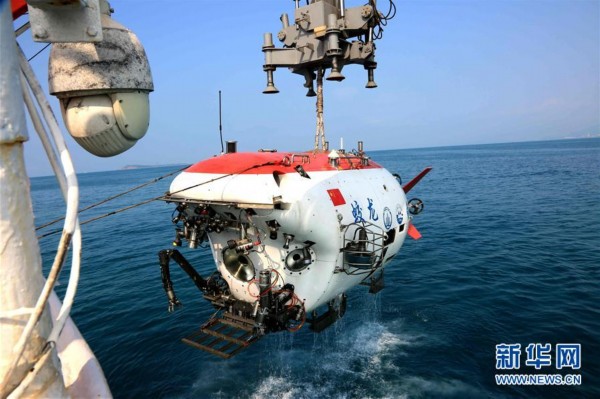
Jiaolong submersible goes through a dive simulation in Sanya, Hainan Province, on April 22. [Photo/Xinhua]

Jiaolong, China’s manned submersible, completed a dive Wednesday in the South China Sea.

Departing its mother ship Xiangyanghong 09 at around 7 a.m., Jiaolong stayed underwater for nine hours and twelve minutes for the dive before returning at around 4:19 p.m.

It managed to bring 16 liters of sea water samples collected near the seabed, eight sediment samples and two rock samples back to Xiangyanghong 09, in addition to high-definition photos and video footage shot during the mission.

Wednesday’s dive marks the first dive by Jiaolong in the second stage of China’s 38th ocean scientific expedition, which will last until May 13.

The maximum depth of the Jiaolong mission on Wednesday was 1,741 meters below sea level, and the submersible spent some seven hours on the seabed.

Three staff, including one seasoned crew member, Tang Jialing, and two interns, Liu Xiaohui and Yang Yifan, were on board the submersible.

“This is almost Jiaolong’s longest underwater mission,” said Tang.

In an interview with Xinhua prior to the drive, Yang Yaomin, chief scientist for the second stage expedition, said experts had planned to choose a site for experimenting with the collection of polymetallic nodules during the mission.

“We are working to avoid damaging the marine environment in mining,” said Yang. “The expedition will help develop technology for environmentally friendly deep-sea mining.”

Polymetallic nodules are mineral resources that are generally deposited more than 4,000 meters deep beneath the sea’s surface and contain manganese, iron, copper, nickel, cobalt as well as rare earth elements.

During the expedition, manned deep-sea submergence was also conducted in the seamount chain and continental slope areas in the South China Sea, according to scientist Shi Xuefa.

“We plan to carry out geological and biological surveys in the region,” said Shi. “The submersible will take photos of the distribution of polymetallic nodules, deep-sea life and seafloor terrain.”

The rock samples collected from the seamount will be used in research in chronology, mineralogy and geochemistry on the South China Sea, advancing the study of the region’s structural evolution, according to Shi.

The 38th oceanic scientific expedition started on Feb. 6. Jiaolong completed a dive in the northwestern Indian Ocean earlier this year in the mission’s first stage. It will also conduct surveys in the Yap Trench and the Mariana Trench in the third stage.

Named after a mythical dragon, Jiaolong reached its deepest depth of 7,062 meters in the Mariana Trench in June 2012.


5,000-yr-old ruins found at SW China construction site

Archaeologists announced Wednesday neolithic ruins dating back 4,500 to 5,000 years had been found in southwest China’s Sichuan Province.

The ruins was found on Ling Mountain in the ancient city of Langzhong last July, when villagers were building a reservoir, said Sun Zhibin, from the Sichuan Provincial Cultural Relics and Archaeology Research Institute.

A team led by Sun excavated the ruins from September 2016 to January 2017.

A total of 108 items were found at the ruins, including porcelain pots and plates, and stone tools, such as axes and spears.

“The discovery has provided new material for the research on cultural blending in the Sichuan Basin and its surrounding culture,” he said.

The discovery, the first ruins dating back to the late neolithic period near the middle reaches of Jialing River, has put back human activity at Langzhong from 3,000 years ago to 4,500 to 5,000 years ago, said Sun.