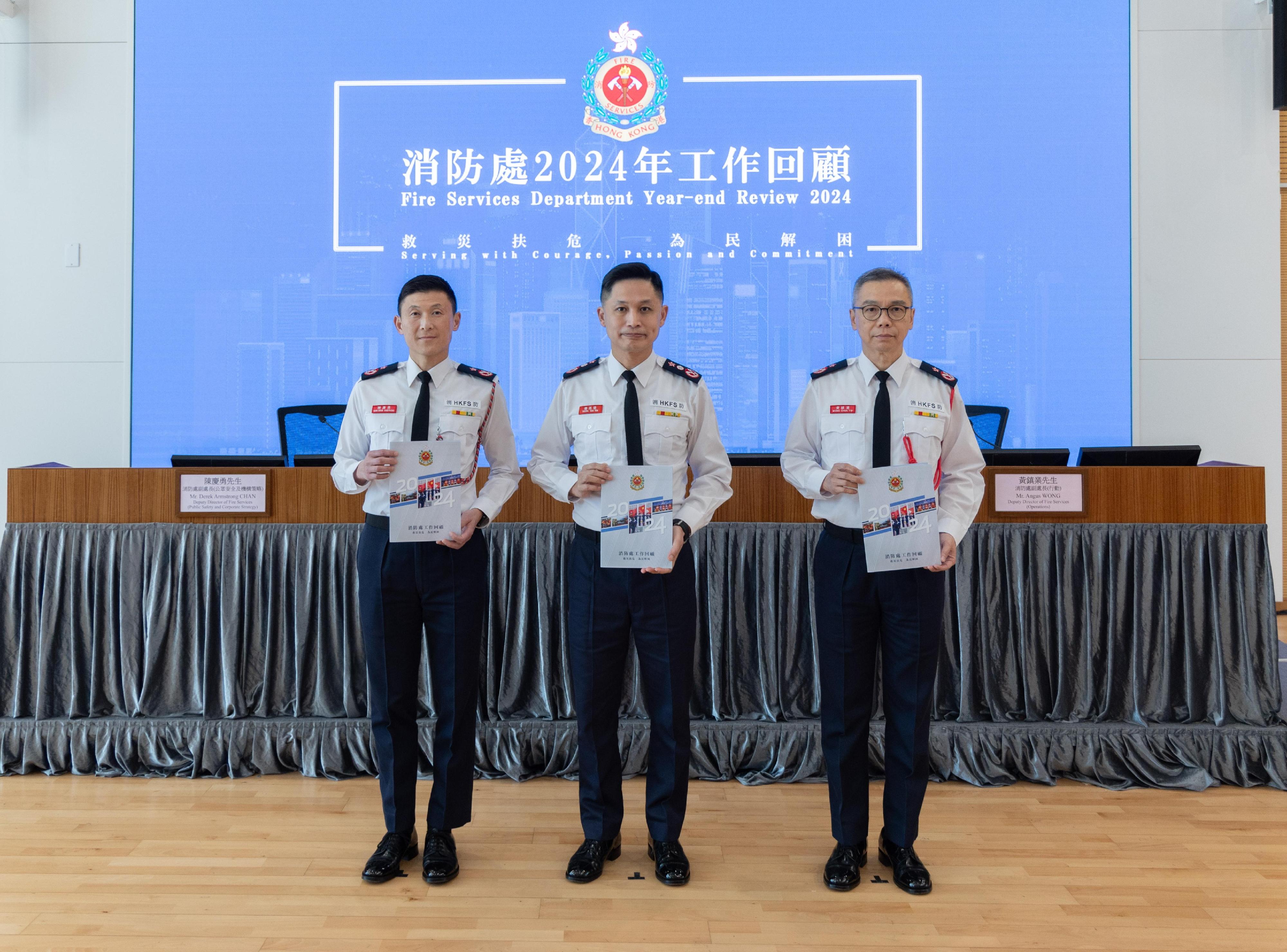
The following is the 2024 Year-end Review delivered by the Director of Fire Services, Mr Andy Yeung, today (January 22):
Preamble
Throughout last year, the Fire Services Department (FSD) has, as in the past, remained steadfast in its duties, and stood united to promote the safety and development of Hong Kong and the country, making Hong Kong a safe place to live and work. On top of proactively fulfilling its responsibilities in areas such as firefighting and rescue, ambulance services and fire protection regulatory work, the FSD committed itself in integrating into the overall development of the country and deepening the ties with Hong Kong’s Mainland counterparts.
The year 2024 marked the 75th anniversary of the founding of the People’s Republic of China. It is also a historic year because it witnessed the formal implementation of the Safeguarding National Security Ordinance. Upholding the policy of “patriotism with affection for our country and city”, the department established the National Affairs and National Security Education Steering Committee to press ahead with education on national affairs and national security. Moreover, the governments of Guangdong, Hong Kong and Macao signed the Guangdong-Hong Kong-Macao Emergency Management Co-operation and Greater Bay Area Emergency Response Operation Co-operation Framework Agreement last year, thereby establishing a government-led co-operation mechanism for emergency response, with professional emergency rescue forces as the mainstay and actions as the core, resulting in enhanced capabilities in emergency management for the three places.
As for the work plan, the FSD has been vigorously implementing its work as mentioned in the Policy Address. The department drew up the Strategic Plan 2024-2026 to clearly set out the development direction for the FSD in the coming three years. A steering committee was also formed to regularly monitor and implement the Strategic Plan to ensure that strategic targets will be taken forward in order of priority.
1) Firefighting and rescue services
The FSD received a total of 37 828 fire calls last year, representing an increase of 4.8 per cent over 2023 (36 103 cases). This was mainly due to an increase in the number of unwanted alarms (29 357 cases), representing an increase of 5.7 per cent over 2023 (27 787 cases). The increase was mainly attributed to environmental factors, such as humidity and rainfall. In addition, there were 5 222 damaging fires, which was a rise of 154 cases when compared with 2023 (5 068 cases). The increase was mainly attributed to cooking stove fires, motor vehicle fires and fires caused by welding sparks. In all, 95.6 per cent of the building fire calls were responded to within the graded response time, about 3.1 per cent higher than the FSD’s target set out in the performance pledge (i.e. 92.5 per cent).
A notable incident was a No. 3 alarm fire that broke out in an old composite building in Jordan on April 10, which led to multiple casualties. The department subsequently formed a dedicated team to investigate the causes of the incident and factors which led to the multiple casualties. Separately, a No. 4 alarm fire broke out at a construction site on Hung Nga Road in Hung Shui Kiu on April 9 and was largely put out by April 11, which lasted nearly 42 hours. The department utilised the indoor locating equipment for the first time during this operation. The equipment can monitor the real-time locations and safety conditions of frontline personnel and show the locations of those awaiting rescue, so that the search time can be significantly reduced and the safety of the frontline personnel can be enhanced.
Regarding special services calls, there were a total of 39 320 such calls within the year, representing a decrease of 3.5 per cent over 2023 (40 763 calls). A notable incident was an accident involving the collapse of a bamboo scaffold at a construction site in Kai Tak in February, which resulted in two deaths and three injuries.
2) Fire protection regulatory work
The FSD has continued to reform and enhance its fire protection regulatory procedures to boost work efficiency. Dedicated efforts have also been made to raise fire protection awareness in the community.
Regarding the certification and acceptance inspection of fire service installation and equipment (FSI), the FSD plans to flexibly deploy internal resources and establish the One-stop Coordination Office for New Fire Protection Facilities Acceptance (One-stop Coordination Office) in March 2025 to further enhance the overall efficiency of FSI acceptance inspections of new buildings and projects that facilitate business operations and benefit people, as well as to strengthen co-operation between the engineering sectors and relevant government departments.
At present, the entire acceptance inspection process, from submission of application to completion of acceptance inspection, as well as vetting of all the plans and documents, and the issuance of Fire Services Certificates in the end, can be completed within 52 working days in most cases. The FSD hopes that, upon establishment of the One-stop Coordination Office, the overall time required for acceptance inspections can be shortened by one-third and be further reduced to within 35 working days in respect of average-scale regular projects through a series of measures, such as enhancing communication with various stakeholders, advance scheduling of acceptance inspections, arranging pre-inspection meetings, and expediting the process with the use of technology. As for public housing projects, the target is for the entire process to be completed within 22 working days.
To enhance the fire safety of old buildings, apart from proactively conducting fire safety inspections, the FSD has been actively monitoring follow-up actions and ensuring the effective implementation of relevant policies. It has also completed the amendment to the Fire Safety (Buildings) Ordinance (Ordinance) which came into force on December 13, 2024. The main purpose of the amendment is to introduce the defaulted works mechanism, increase penalties, as well as to assist and drive target buildings regulated by the Ordinance to comply with the requirements so that the fire safety standards of the buildings are enhanced to meet modern fire protection requirements.
In terms of support for target building owners and occupiers, the FSD has divided the fire safety improvement works into four stages and introduced a series of appropriate support measures. With these measures in place, the overall enforcement of the Ordinance has improved notably. In 2024, the FSI drawings for a total of 1 176 buildings were approved, representing an increase of 74 per cent over 677 buildings in 2023, with most of these drawings being successfully approved on first submission. Also, the number of buildings with the entire building’s Fire Safety Directions all being complied with significantly rose from 58 in 2023 to 108 in 2024, representing an increase of 86 per cent, while that for domestic portions of buildings rose from 48 to 85, representing an increase of 77 per cent.
Furthermore, the FSD established in December 2023 the FSD Building Improvement Support Centre in Yau Tsim Mong District, Kowloon, which has processed a total of 10 322 cases to date. The FSD plans to establish one new Support Centre on Hong Kong Island and in the New Territories respectively by the third quarter of 2025 to increase coverage and provide one-stop support services for owners and occupiers of old buildings. The department also plans to establish the Building Improvement Special Duty Team by the first quarter of 2025 to proactively carry out inspections of 1 800 old buildings every year, strengthen law enforcement and enhance fire safety education.
Regarding fire safety inspections, the department conducted 460 400 inspections last year. Overall, a total of 17 775 Fire Hazard Abatement Notices were issued and 4 967 cases were brought to prosecution. In response to the tragic fire at New Lucky House, the FSD proactively conducted, under a risk-based principle, about 8 200 inspections of some 1 000 old composite buildings with relatively higher fire risk. These buildings were primarily located in Yau Tsim Mong, Sham Shui Po, Eastern District, and Central and Western District, accounting for over half of the total. A total of 8 661 notices were issued during the inspections and over half of the cases (i.e. 4 695 cases) were related to smoke stop door irregularities. Also, among the 5 991 expired notices, over 90 per cent (i.e. 5 632 notices) had been complied with, while there were only four cases of recurrence of fire hazard, accounting for less than 0.1 per cent of the total.
With respect to raising fire protection awareness in the community, the FSD has implemented various educational and promotional programmes to enhance home fire protection. This includes visiting old buildings and “three-nil buildings” with District Offices and District Fire Safety Committees, distributing the “Three Treasures for Fire Protection”, namely fire extinguishers, fire blankets and stand-alone fire detectors, and promoting the use of mini portable fire extinguishers. The FSD has also stepped up inspections of critical infrastructures, licensed food premises, temporary places of entertainment and petrol filling stations with a view to enhancing fire safety standards in the community. Moreover, during the Winter Disaster and Emergency Preparedness Promotional Month, the FSD organised more than 100 promotional activities and conducted a series of fire safety inspections. During the inspections, the department analysed the causes of fire and common fire hazards over the year to formulate the four key messages, namely “keep smoke stop doors closed”, “prepare the ‘three essentials’ for fire escape”, “annual inspection on fire service installations” and “safe use of lithium batteries and charging devices” for promotion to the public.
Moreover, the FSD conducted a trade consultation on the code of practice of registered fire engineers in the first quarter of 2024 and received general support. The department will come up with the details regarding the implementation, regulation and other aspects of the Registered Fire Engineer Scheme. It is expected that the draft subsidiary legislation can be introduced in the current term of the Legislative Council.
On dangerous goods control, the 24-month transitional period of the newly amended Dangerous Goods Ordinance expired on March 30, 2024, signifying that the regulation of dangerous goods in Hong Kong has officially aligned with international standards. The FSD has converted a total of 3 966 Manufacture Licences/Store and Use Licences and 1 613 Dangerous Goods Conveyance Licences for the trades, while putting in place an array of measures to help the trades and the public comply with the new requirements. Given that the International Maritime Dangerous Goods Code is updated regularly, the FSD updated the list of dangerous goods and relevant codes of practice late last year so as to facilitate the operation of the trades.
As for combatting illicit fuelling activities, the FSD conducted nearly 2 000 inspections and 29 interdepartmental enforcement operations last year, seizing about 630 000 litres of fuel and instituted prosecutions on 268 charges.
3) Ambulance service
There were 784 243 emergency calls received in 2024, representing an increase of 1.1 per cent over 2023 (775 625 cases). Among them, 96.1 per cent of the calls were responded to within the target response time of 12 minutes, which was about 3.6 per cent higher than the FSD’s performance pledge of 92.5 per cent. In view of the increasing demand for ambulance services in Kwun Tong, the FSD has converted some buildings at the current site of Kwun Tong Fire Station to set up a new ambulance depot.
The FSD continued to strengthen the promotion of cardiopulmonary resuscitation (CPR) and automated external defibrillators (AEDs). It collaborated with a number of organisations, including the Education University of Hong Kong, the Law Society of Hong Kong, the Scout Association of Hong Kong, the Civil Service Bureau and Ocean Park, as well as District Offices, to organise various CPR and AED training activities.
The FSD also received support from the Education Bureau to launch the Secondary School Student Digital AED and CPR Experiential Programme, under which students without any previous training can learn through educational videos and experiential tools how to handle cardiac arrest patients. The programme has been implemented since May 2024, with 23 secondary schools having participated and over 2 500 secondary school students having received training. This year, the programme will be expanded to another 50 secondary schools to provide training for about 5 000 secondary school students.
Moreover, it has been over a year since the inception of the Resuscitation Alliance (RA) in June 2023. With the Sudden Arrhythmia Death Syndromes HK Foundation and the Hong Kong College of Cardiology joining the RA during the year, the number of RA member organisations has increased to nine, and more than 160 000 citizens have been recruited as RA members.
As an effort to expand the coverage of AEDs, the FSD will continue to encourage and assist various sectors of the community to install AEDs. Currently, information of over 3 300 AEDs of about 370 institutions is available on the FSD’s online information platform Centralized AED Registry for Emergency. These AEDs are mainly scattered in high-risk and crowded areas, such as sports premises, shopping centres and MTR stations. Also, with funding from the Hong Kong Jockey Club Charities Trust, the FSD has launched the AED Everywhere Programme to progressively install AEDs at bus stops, transitional housing and light public housing in Hong Kong.
Moving forward, the FSD will continue to expand coverage of AEDs and promote first aid training with a view to building a better community-based safety net.
4) Safeguarding national security
Last year, the FSD remained determined to safeguard national security and organised a number of activities to enhance the sense of national security among its staff.
As a matter of fact, the FSD took part in 12 interdepartmental counter-terrorism (CT) exercises last year, in which nearly 1 000 frontline staff members received CT training.
In view of the public’s increased willingness to extend a helping hand in emergencies, the department launched the FSD Community Emergency Responder (FSDCER) Scheme to holistically enhance the emergency preparedness of the public and instil into them a sense of commitment to the community. The new scheme replaces the existing Fire Safety Ambassador and Building Fire Safety Envoy schemes, which had been implemented for years, and particularly adds a parent-child programme to encourage parents to nurture fire safety awareness and emergency response capability in children at an early age. The FSD will continue to proactively implement the community-based public safety strategy and establish a closer relationship and a more effective communication mechanism with the 18 District Fire Safety Committees through the FSD Community Collaboration Network with a view to optimising emergency response measures for local communities.
5) Links with the Mainland and overseas
In 2024, the FSD renewed its efforts in deepening collaboration with the Mainland and overseas, proactively fostering technical exchanges and professional development.
On the Mainland front, with the implementation of the Guangdong-Hong Kong-Macao Emergency Management Co-operation and Greater Bay Area Emergency Operation Co-operation Framework Agreement, the governments of Guangdong, Hong Kong and Macao pledged to further strengthen co-operation on emergency management and rescue through the technical and knowledge exchange mechanism, resource sharing mechanism, and emergency mobilisation and co-ordination mechanism to enhance the effectiveness of cross-boundary rescues. In the year, Guangdong, Hong Kong and Macao co-organised four cross-boundary joint exercises. During a large-scale exercise held in Jiangmen in May, the FSD personnel and equipment for the first time entered the Mainland through the cross-boundary Green Channel to participate in the exercise.
The FSD participated in professional conferences and technical exchanges in the Mainland. Last year, the department made 98 duty visits on the Mainland, such as attending the annual review meeting of the Committee of Fire Investigation Technology of China to explore technology for investigating new energy fires; and visited various provinces and municipalities on the Mainland for training and study tours. Among such visits, the Airport Fire Contingent visited Wuhan, Ezhou and other cities to foster co-operation between Hubei and Hong Kong in aviation fire safety. Regarding paramedical training, the department had seven co-operative exchanges with Mainland hospitals and the National Health Commission.
On the overseas front, Fire Asia 2024, organised by the FSD in collaboration with several professional institutions in Hong Kong, proved to be a fruitful success. The conference not only gathered local, Mainland and international counterparts, but also attracted experts from 19 Belt and Road countries and Association of Southeast Asian Nations (ASEAN) member states for in-depth discussions on regional emergency management, rescue technology and co-operation opportunities. The FSD has also been actively deepening its ties with ASEAN member states and Asia-Pacific countries. Apart from inviting representatives from six countries and regions to Hong Kong for the specialised technical exchange session of the Compartment Fire Behaviour Specialist Team, the department also had in-depth exchanges with Singapore in the field of ambulance services, and dispatched swiftwater and flood rescue specialists to Malaysia to provide technical guidance and expert advice to the local counterparts. Moving forward, the FSD will continue to showcase Hong Kong’s advantages as an international city and further consolidate its influence in the area of regional emergency response.
6) Youth development
The FSD has always been committed to promoting youth development. Last year, the Fire and Ambulance Services Teen Connect (FAST Connect) was expanded to cover all the 18 districts over the territory, with an increased membership of more than 1 000, which will be further expanded to cover primary schools to attract more youngsters.
The FSD organised the FAST Connect Rally at the Fire and Ambulance Services Academy to celebrate the 75th anniversary of the founding of the People’s Republic of China. The newly formed Guards of Honour of the FAST Connect made their debut in the Rally, demonstrating their senses of national identity, belonging and national pride. Moreover, the department launched the Ethnic Minority Community Emergency Preparedness Participation Scheme in Sham Shui Po and organised an FSD Work-experience Day for local and ethnic minority students to enhance their knowledge of fire safety and emergency rescue, and also to help ethnic minority teenagers integrate into the community.
7) Bringing convenience to the public through innovative technology
The FSD has long moved with the times and made good use of innovative technologies in multiple areas to enhance operational efficiency and bring convenience and benefits to the public.
With regard to firefighting and rescue technology, the FSD has further enhanced its mountain search and rescue system through the combined use of a mobile phone locator, drones and artificial intelligence-assisted image analysis software and new applications. Furthermore, the department has been training its fire personnel to engage in decision-making in the light of different scenarios to enhance their capabilities in emergency management through the newly developed Virtual Fire Scene Incident Command Training System, which garnered a number of awards at the International Exhibition of Inventions of Geneva and the Asia Exhibition of Innovations and Inventions Hong Kong held in 2024.
To better cope with epidemics and infectious diseases, the Infection Control and Critical Care Transfer Ambulance was put into service in December 2024. Fitted with a negative pressure system with a high air change level and specialised equipment for critical care transport, the new vehicle strengthens the FSD’s capabilities in handling the threats of novel infectious diseases and conveying critically ill patients. In addition, the FSD is also utilising big data to extend AED coverage and is developing a data dashboard for enhancing the efficiency of emergency rescue resources allocation and quality of decision-making.
As for initiatives that bring convenience to the public, the FSD has launched an electronic licence/certificate service, with increased transparency, to facilitate members of the public by allowing them to verify documents through the Government’s “e-Proof” one-stop platform anytime. The department will also launch a new online platform to enable submissions of information and enquiries of fire hazard complaint cases.
8) Plans for the year ahead
In the new year, the FSD will continue to implement various initiatives as set out in the Policy Address and the Strategic Plan 2024-2026.
To shape the fire services of Hong Kong into a quality brand, the FSD has been obtaining accreditation for its advanced technical training courses. Currently, seven courses have been accredited at Level 4 of the Qualifications Framework, including the newly accredited diving rescue and swiftwater rescue courses, and the accreditation work for the Professional Certificate in HazMat technician is also under way. Meanwhile, the department is striving to seek accreditation for the Hong Kong Special Administrative Region search and rescue team as a medium International Search and Rescue Team, and plans to provide training and accredited courses for other countries and regions in the future, with a view to promoting the professionalisation and internationalisation of fire services.
As for the FSD’s integration into national development, the department will strengthen ties with Hong Kong’s Mainland counterparts and deepen co-operation with the Greater Bay Area in training and technical exchanges. In late March this year, the rescue teams of Guangdong, Hong Kong and Macao will carry out a large-scale cross-boundary joint exercise in Hong Kong with a view to further enhancing the capability of co-ordinated disaster management within the Greater Bay Area. At the same time, the department will draw reference from national fire service technologies and standards to enhance the safety level of the local industry and help the industry keep pace with the rapid development of the fire safety sector in the Mainland.
The FSD will also collaborate with telecommunication service providers to promote smart firefighting and expedite the department’s digital transformation. This partnership will explore innovative application of technologies, such as 5G, big data, the Internet of Things and artificial intelligence in rescue, fire protection and emergency management, including the Internet of Things fire detection system, low-altitude economy technology and emergency communications technology, for the purpose of holistically enhancing the level of intelligentisation and informatisation in firefighting.
As regards community work, the FSD will deepen its co-operation with District Fire Safety Committees and District Services and Community Care Teams to comprehensively enhance public awareness of fire safety and emergency preparedness. The department will also fully implement the FSDCER Scheme, aiming for an intake of 5 000 new members each year.
Conclusion
Summing up 2024, with sustained momentum for advancement and self-reforms, the FSD successfully tackled various challenges and fully capitalised on opportunities for development. The FSD is truly grateful for the staunch support rendered by different sectors of society. Looking ahead, the department will keep pace with the times, leveraging technology to further enhance service efficiency and quality. The department will strive to safeguard national security and integrate into national development, while ensuring the safety, stability, advancement and prosperity of Hong Kong.