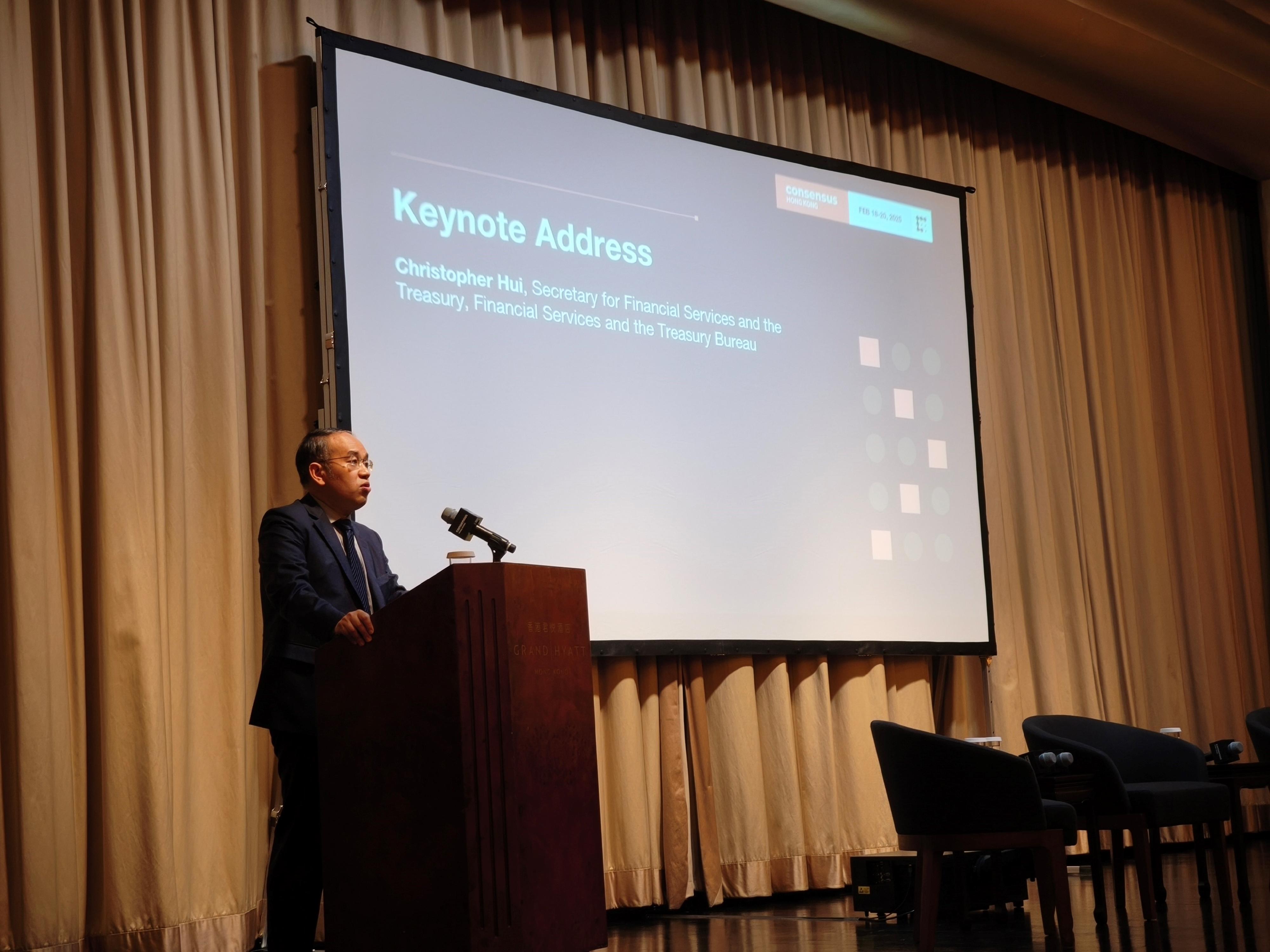
Following is the keynote address by the Secretary for Financial Services and the Treasury, Mr Christopher Hui, at the Institutional Summit at Consensus Hong Kong 2025 this morning (February 18):
Tira (Managing Director of CoinDesk Events, Ms Tira Grey), Michael (Chairman of Consensus Hong Kong, Mr Michael Lau), distinguished guests, ladies and gentlemen,
It is my profound honour to join you today at Consensus Hong Kong 2025 – a landmark event that celebrates innovation, brings together global pioneers in blockchain, Web3, virtual assets, and artificial intelligence, and galvanises the forces driving the future of our financial ecosystem. I welcome you all to a market where vision meets policy, and where transformative ideas are nurtured under a forward-looking policy and regulatory framework.
Today, Hong Kong stands poised on the threshold of a new chapter – one in which traditional finance and digital innovation integrate to create efficiency, transparency, and inclusive growth.
It is no coincidence that Consensus Hong Kong 2025 is taking place in our vibrant city. The Government remains steadfast in our mission to foster an environment where innovation is underpinned by robust regulation, ensuring that our financial markets not only thrive on competitiveness but also maintain the highest standards of investor protection and market integrity.
Today, I wish to share with you my vision for the future, one built upon three defining trends. The first is financial market innovation through tokenisation. Tokenisation is not merely a buzzword – it is a profoundly transformative development that holds the promise of reshaping traditional financial markets. By converting conventional financial instruments and physical assets into digital tokens, we are building bridges between traditional finance and the emerging digital economy. Our regulatory framework has laid a solid foundation for this evolution. Our securities regulator has proactively issued circulars to guide intermediaries engaging in tokenised securities-related activities and expectations for the tokenisation of SFC (Securities and Futures Commission)-authorised investment products.
These measures have provided critical clarity to market participants and investors alike, fostering an environment of trust and informed innovation. We have witnessed encouraging developments that testify to our approach. Consider, for instance, the tokenisation of gold – where physical gold is integrated with blockchain technology to offer investors greater flexibility, fractional ownership, and enhanced security. Similarly, the emergence of tokenised money market funds shows how traditional liquidity management can benefit from digital innovations, enabling more efficient market making alongside expanded secondary market liquidity for institutional investors.
An important initiative to foster tokenisation development is Project Ensemble, a sandbox launched by the Hong Kong Monetary Authority. This initiative is designed to experiment with the tokenisation of money enabling seamless interbank settlements. By exploring tokenisation across fixed income and investment funds, liquidity management, green and sustainable finance, and trade and supply chain finance, Project Ensemble exemplifies Hong Kong’s commitment to harnessing emerging technology to enhance financial market infrastructure. This experimental Sandbox not only embraces innovation but also ensures that the innovations are implemented with a clear focus on stability and investor protection.
The second trend that will shape our future financial landscape is the integration of Web3 innovations into the real economy. In our ongoing efforts to narrow the gap between digital finance and everyday business operations, the Government has taken decisive steps to develop a regulatory regime for stablecoin issuers. We are actively engaging with the real economy – where businesses that support cross-border payments, international trade, and digital commerce are eager to solve longstanding issues such as high costs, delayed transfers, and the challenges posed by the sometimes unpredictable FX (foreign exchange) markets.
In recognition of these challenges, the regulator has established a Sandbox to obtain feedback and provide clarity to entities interested in issuing fiat-referenced stablecoins. This Sandbox serves not only as an incubator for innovations but also as a platform that bridges industry needs with prudent regulation. We see promising potentials for stablecoins to streamline payment systems, fostering a more efficient and integrated financial landscape that benefits businesses and consumers alike.
Furthermore, the application of tokenisation extends far beyond traditional financial instruments. Already, we observe its impact across various sectors. From financing EV (electric vehicle)-charging infrastructure through tokenised management fee, to facilitating more agile supply chain finance, our digital infrastructure is now robust enough to support longstanding economic practices, albeit with a modern twist. These developments illustrate how the convergence of digital technologies with real-world assets can unlock significant economic value and propel us into a new era of cross-sector collaboration.
The third and perhaps most transformative trend is the integration of AI with blockchain and Web3 technologies. In today’s rapidly evolving technological landscape, AI represents not just an opportunity but a necessity to enhance our digital infrastructures. Decentralised AI platforms, built on blockchain principles, provide a promising avenue for ensuring data privacy, security, and collaborative innovation.
Decentralised AI has the potential to revolutionise how we manage, train, and deploy machine learning models. By enabling secure data sharing across multiple stakeholders, we create a system in which AI models can be trained collaboratively using diversified databases. This collaborative approach ensures that the resulting models are not only more widely applicable but also benefit from the collective insights of multiple organisations. Moreover, an open-source philosophy in model development promotes transparency, accountability, and a shared economic vision in which the fruits of innovation are accessible to all.
Recognising these immense opportunities, the Government has set forth a policy statement to foster responsible AI innovation in our financial markets. Last October, we issued a detailed statement outlining our vision for the responsible usage of AI, balancing innovation with the imperative for control, transparency, and fairness. In line with our policy, the Hong Kong University of Science and Technology (HKUST) has embarked on a collaborative initiative, making its InvestLM model available to the financial services industry. This programme offers both advisory and training services – providing options for on-premises deployment as well as application programming interfaces (APIs) and web interfaces that utilise the HKUST’s computing resources.
The transformative trends of tokenisation, real economy adoption, and AI integration can only reach their full potential within a reliable and adaptable regulatory system. Our guiding principle – “same activities, same risks, same regulations” – underscores our commitment to fairness, consistency, and the highest standards of market protection.
We are continuously reviewing and refining our regulatory regime to foster a complete ecosystem for virtual assets. By developing comprehensive frameworks that include virtual asset exchanges, stablecoin issuers, custodians, and over-the-counter trading activities, we pave the way for an interconnected value chain that will underpin Hong Kong’s financial markets.
In closing, I invite all stakeholders here today – from seasoned financial experts to the visionary entrepreneurs shaping tomorrow’s digital economy – to embrace the challenges and opportunities that lie ahead. Consensus Hong Kong 2025 is more than just an event; it is a call to action. It is a recognition that our collective ingenuity, when harnessed under a principled regulatory framework, has the power to drive sustainable progress.
I extend my heartfelt gratitude to the Consensus event organisers, our trusted partners at Invest Hong Kong, the Hong Kong Tourism Board, and every individual contributing to the success of this event. I wish you a productive and transformative gathering at Consensus Hong Kong 2025, and I look forward to witnessing the many innovations that will shape our shared future.
Thank you.