image_pdfimage_print

Author Archives: hksar gov

Exchange Fund Bills Tender Results

The following is issued on behalf of the Hong Kong Monetary Authority:

     Exchange Fund Bills tender results:
 

Tender date : February 18, 2025
Paper on offer : EF Bills
Issue number : Q2508
Issue date : February 19, 2025
Maturity date : May 21, 2025
Amount applied : HK$148,500 MN
Amount allotted : HK$64,966 MN
Average yield accepted : 3.40 PCT
Highest yield accepted : 3.48 PCT
Pro rata ratio* : About 41 PCT
Average tender yield : 3.54 PCT
****************************
Tender date : February 18, 2025
Paper on offer : EF Bills
Issue number : H2537
Issue date : February 19, 2025
Maturity date : August 20, 2025
Amount applied : HK$43,900 MN
Amount allotted : HK$13,000 MN
Average yield accepted : 3.40 PCT
Highest yield accepted : 3.48 PCT
Pro rata ratio* : About 8 PCT
Average tender yield : 3.58 PCT
 
*”Pro rata ratio” refers to the average percentage of allotment with respect to each tender participant’s tendered amount at the “highest yield accepted” level.
 
———————————————————

     Hong Kong Monetary Authority Tenders to be held in the week beginning February 24, 2025:
 
Tender date : February 25, 2025
Paper on offer : EF Bills
Issue number : Q2509
Issue date : February 26, 2025
Maturity date : May 28, 2025
Tenor : 91 Days
Amount on offer : HK$65,577 MN
****************************
Tender date : February 25, 2025
Paper on offer : EF Bills
Issue number : H2538
Issue date : February 26, 2025
Maturity date : August 27, 2025
Tenor : 182 Days
Amount on offer : HK$14,000 MN
read more

Remarks by CE at media session before ExCo (with video)

     Following are the remarks by the Chief Executive, Mr John Lee, at a media session before the Executive Council meeting today (February 18):
 
Reporter: Good morning, Mr Lee. Firstly, with regards to the taxi strike, the Hong Kong Tele-Call Taxi Association has earlier threatened that it would organise a five-day strike if the Government does not respond positively to their demands to crack down on ride-hailing. About the strike, you know, how seriously does the Government view this threat by the taxi sector, and would this threat sway the Government’s stance on ride-hailing regulation? Secondly, the Secretary for Labour and Welfare has previously said that the Government administration would exchange data between departments to create a database for identifying hidden cases of at-risk carers. Do you think that the Government perhaps is a bit too slow in identifying hidden elderly or hidden carers? And also, can the Community Care Teams perhaps do more before the Government can set up this database in the meantime? Thank you.
 
Chief Executive: The Government position in respect of the improvement of taxi service and also to have a lawful system to govern online hailing platforms is clear. Taxi service needs to be improved. Car-hailing platforms need to be regulated, and enforcement action needs to be taken against unlawful hire car service. Any drastic action is not going to solve problems. Drastic actions may also hurt the interests of normal citizens in the course of their daily going-about of their lives. It is not going to receive public support. Also, there is a potential that the issue may change its nature, and the issue may be hijacked by some people with ulterior motives – that will be not in the interest of society and the citizens, and will not get public support. A large number of representatives from the taxi business have indicated that they will not support drastic actions. They will not take part. I think these issues need to be addressed with a good will, consciously, rationally, so as to find a solution to take the matter forward. The Transport and Logistics Bureau has already made a proposal to address the problem, and the proposal includes introducing taxi fleets so that the management control of taxi service can be enhanced. The proposal also includes having a legal framework to regulate online hailing platforms to ensure that citizens will have a lawful regime that ensures there will be proper and lawful service and allows them to use online hailing platforms.
 
     Improving taxi service and regulating online hailing platforms is a problem that has been accumulating over a long period of time. The Government, since our assumption of office, has made a determination to address the problem and make a workable solution. We have made that proposal. Tomorrow, a working group of the Transport Advisory Committee will hold a meeting, and has invited representatives from the taxi trade and also representatives from online hailing platforms. Government representatives will also join the meeting, and it is a good opportunity for everybody to talk through the whole thing rationally with a common will to move forward to find out a solution to solve this problem that has been accumulating over a long period of time. And I hope and believe that it would be in everybody’s interest that all parties will rationally talk through the problem, give out their opinions, and then work together to push forward the implementation of the government proposal. I think that will be in the interest of all parties, in the interest of society and citizens.
 
     Regarding a very unfortunate and sad incident of carers who, because of a lack of support, were left alone in their own home and not receiving assistance, we feel very sad about it, and of course, we must find a solution to address it. The Secretary for Labour and Welfare has already indicated that he is pushing forward a database so that we can collect data of individuals who are in need, who may not readily be known to service providers otherwise, and already a lot of action has been taken to approach different departments for such information. The Labour and Welfare Bureau has already approached the Office of the Privacy Commissioner for Personal Data to see how we can push forward this database as soon as possible. My position is clear: the earlier this database can be created, the better. It does not have to be 100 per cent at the first moment, because where there are areas we can more easily get information, within the confines of the law, we should do it first. And slowly and slowly, we address the difficult cases. I’ve already seen strong commitment and goodwill amongst all departments and bodies concerned to find a way to address this problem as soon as possible. The Labour and Welfare Bureau will work hard on this and have this database created as soon as possible so that we can build it up. We can build it up, and add to the database as we collect more information because I think society has a very common understanding that for those hidden cases, we should do our best to help them. And of course, all the 18 districts will do their best, including district councillors, Care Teams as well as departments and bodies responsible for offering assistance in this area.
 
(Please also refer to the Chinese portion of the remarks.) read more

Advisory Committee on Sports Dispute Resolution of DoJ discusses development direction of sports dispute resolution with SF&OC (with photos)

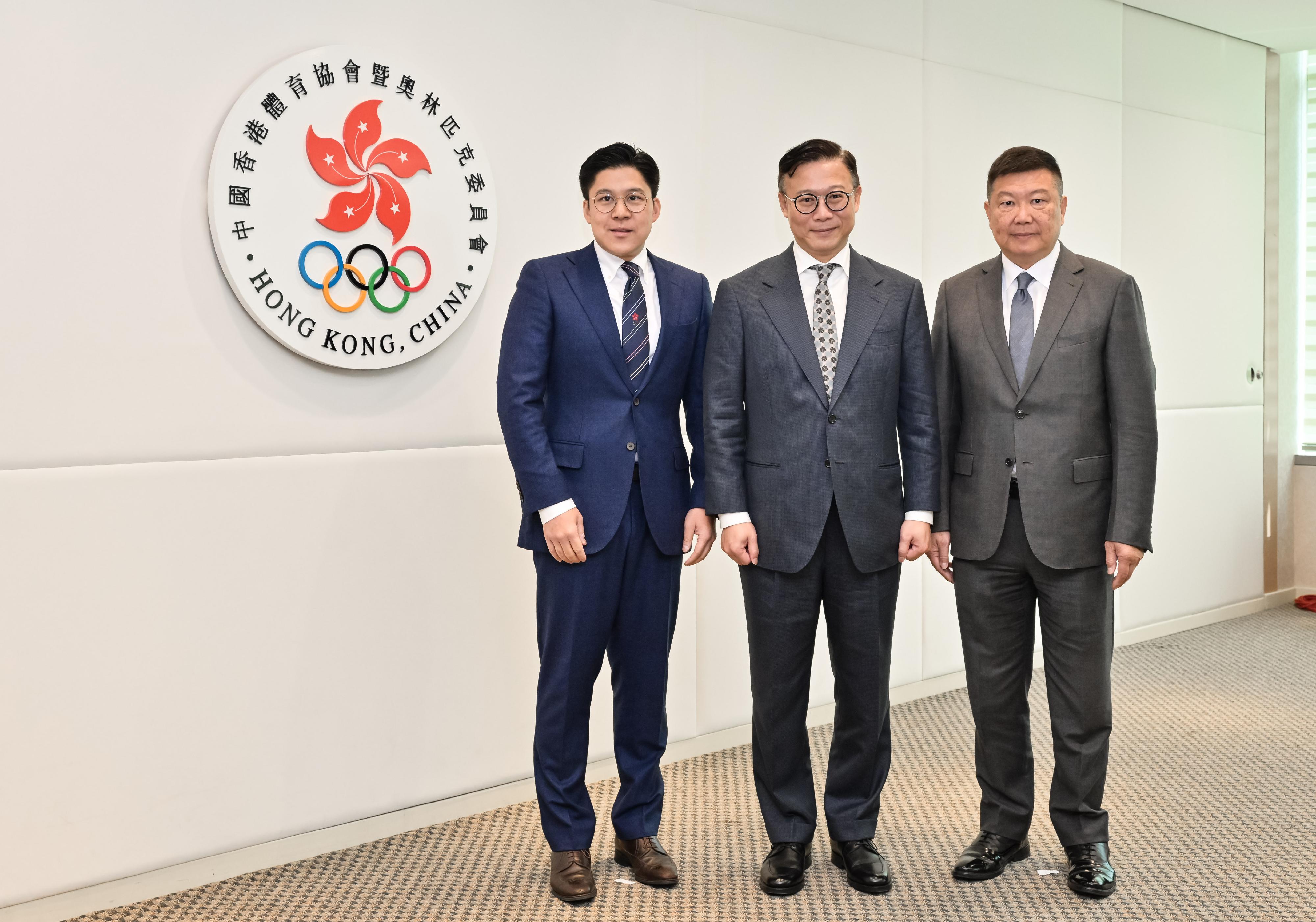
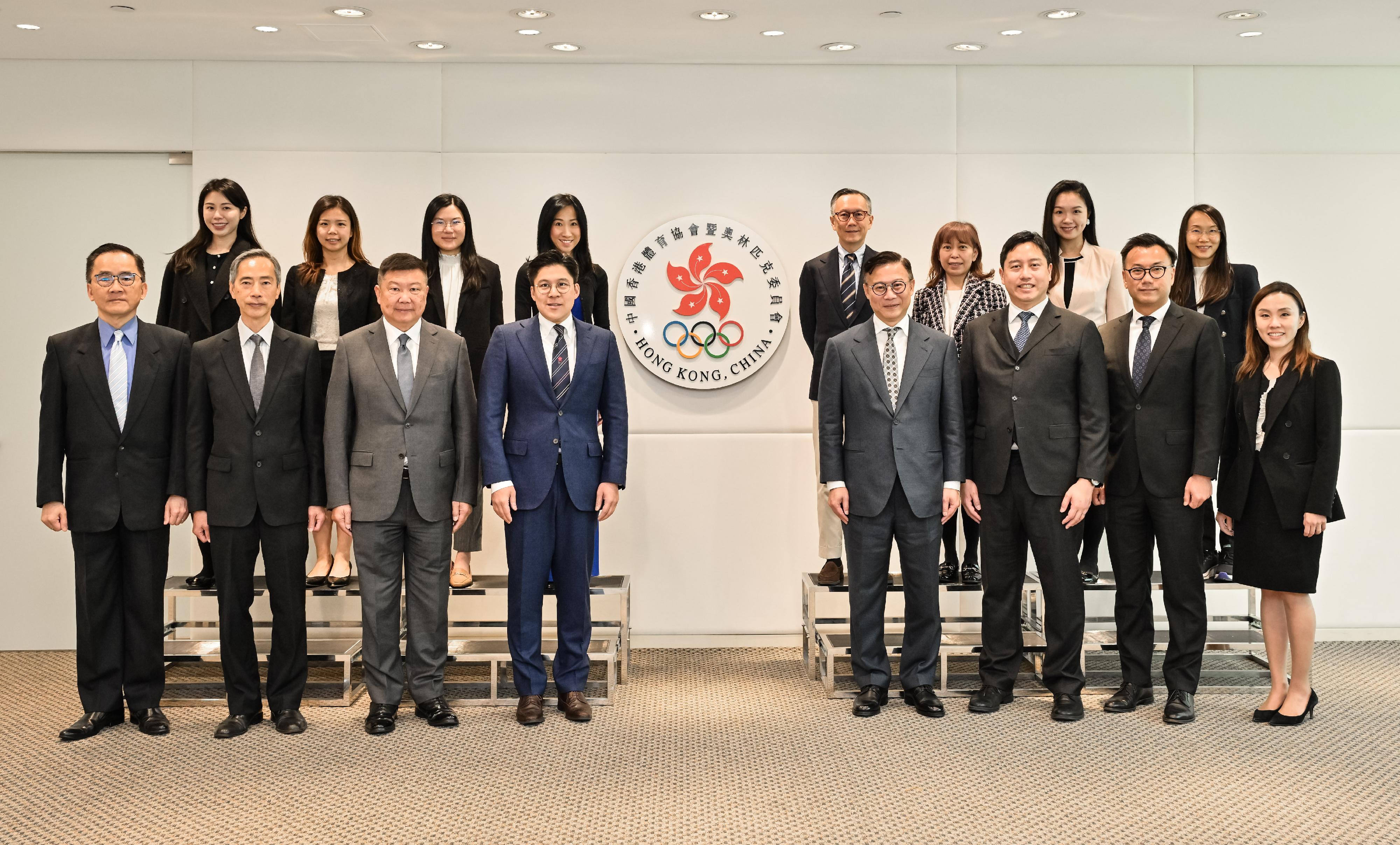
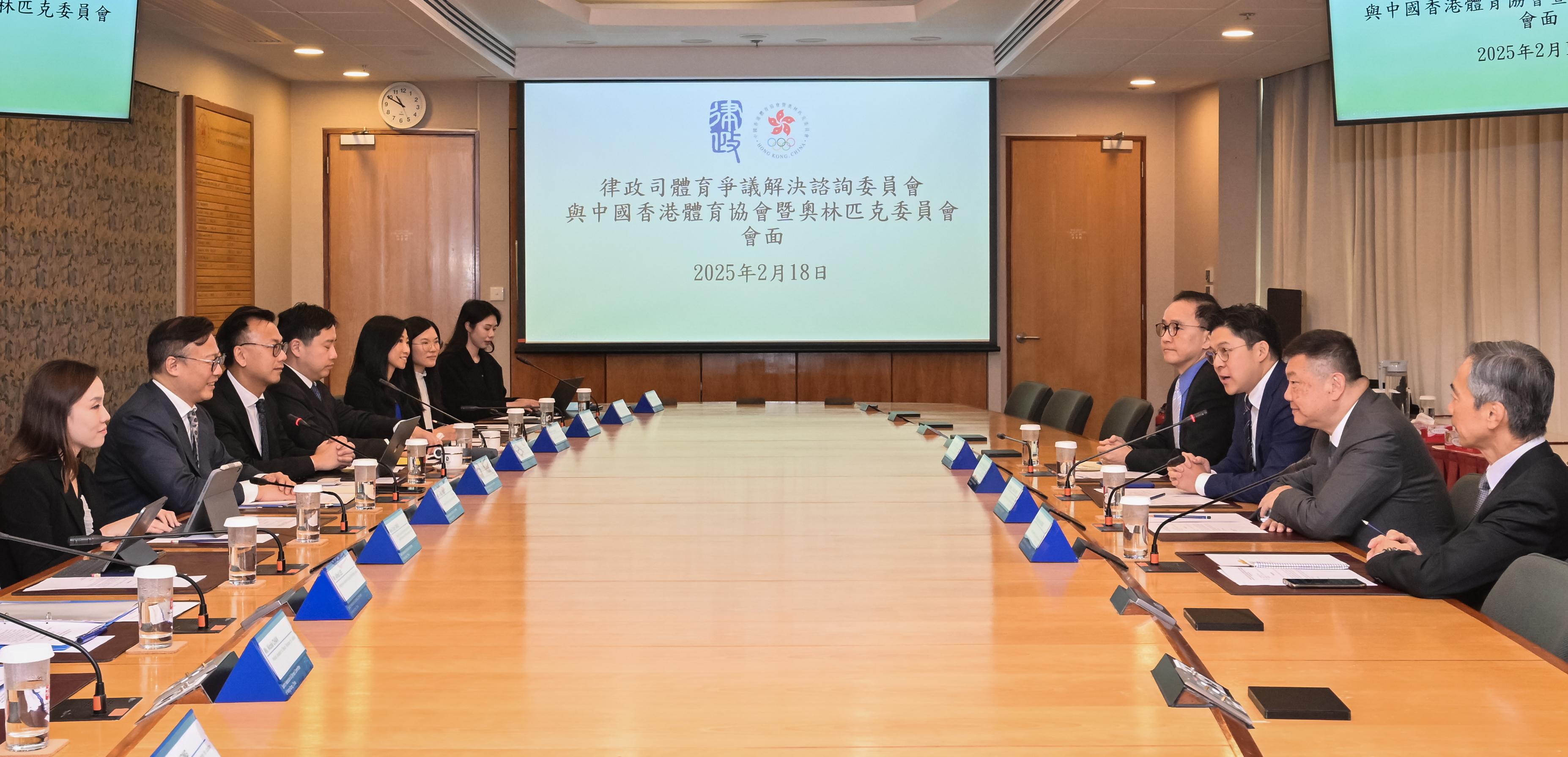
     â€‹The Advisory Committee on Sports Dispute Resolution of the Department of Justice (DoJ), chaired by the Deputy Secretary for Justice, Dr Cheung Kwok-kwan, met with Vice-President of the Sports Federation & Olympic Committee of Hong Kong, China (SF&OC) Mr Kenneth Fok and the Honorary Secretary General of the SF&OC, Mr Edgar Yang, today (February 18) to discuss the direction of development of promoting sports dispute resolution in Hong Kong.
      
     At the meeting, both sides had in-depth exchanges on the latest developments in sports dispute resolution. They also discussed ways to encourage the sports industry to widely adopt alternative dispute resolution mechanisms for handling sports disputes in the spirit of embracing change and boldly pursuing reforms.
      
     Dr Cheung said that, with a view to enhancing the local sports dispute resolution landscape, the Hong Kong Special Administrative Region Government has been actively engaging with key stakeholders and understands that the industry is keen to have a neutral, fair and efficient mechanism to handle and resolve sports disputes. As announced in “The Chief Executive’s 2024 Policy Address”, the Government will explore establishing a sports dispute resolution system to promote the sustainable development of sports in Hong Kong.
      
     Dr Cheung was pleased to learn that the SF&OC fully supports Hong Kong to leverage its institutional advantages in dispute resolution to develop sports dispute resolution, thereby further consolidating Hong Kong’s status as a centre for international legal and dispute resolution services in the Asia-Pacific region.
      
     He said that the Government and the Advisory Committee are carrying out the preparatory work for a pilot scheme on sports dispute resolution at full steam. He sincerely thanked the SF&OC for its valuable advice on the implementation of the pilot scheme, especially regarding the specific requirements for selecting dispute resolution institutions, the fields of disputes suitable for resolution through mediation or arbitration, and the fee structure. The two sides also exchanged views on the potential for future collaboration, including promoting awareness and providing education to national sports associations and local athletes on the use of alternative dispute resolution in handling sports disputes, as well as encouraging retired athletes to participate in sports dispute mediator and arbitrator training.
      
     Dr Cheung said that the Advisory Committee will continue to actively engage with major stakeholders, gathering and listening to feedback from all sectors of the community, with a view to formulating a specific mechanism and arrangement for the pilot scheme. He expressed hope that the pilot scheme will be launched within this year to promote the wider use of sports dispute resolution in Hong Kong.

Photo  Photo  Photo  
read more

Speech by SJ at opening ceremony of National Training Course for Talents Handling Foreign-related Arbitration (Hong Kong) (English only)

     Following is the speech by the Secretary for Justice, Mr Paul Lam, SC, at the opening ceremony of the National Training Course for Talents Handling Foreign-related Arbitration (Hong Kong) today (February 18):
      
Director Yang (Director of Bureau of Public Legal Services Administration of Ministry of Justice, Mr Yang Xiangbin), Secretary Jiang (Council Chair of the China University of Political Science and Law, Mr Jiang Zeting), Director Liu (Director of China Legal Service (H.K.) Limited, Ms Liu Changchun), distinguished guests, ladies and gentlemen,
      
     Good afternoon, and a warm welcome to you all to the National Training Course for Talents Handling Foreign-related Arbitration (Hong Kong). It is my pleasure to address such an accomplished gathering of professionals in foreign-related arbitration. 
      
The Course
      
     This Course is the first specialised training programme on arbitration under the Hong Kong International Legal Talents Training Academy. I would like to take this opportunity to express my heartfelt gratitude to the Ministry of Justice and the China University of Political Science and Law and also the China Legal Service (H.K.) Limited for their unwavering support in making this Course a reality. This Course in fact marks an important milestone to implement the record of meeting between the Ministry of Justice and our Department signed in July 2023 when Ms He Rong visited Hong Kong, to further deepen exchanges and co-operation on talent nurturing and legal and dispute resolution services between the Mainland and Hong Kong.
      
     To contribute to the national strategy of developing foreign-related rule of law, it is our collective goal to cultivate a team of foreign-related arbitration professionals with a global vision, good understanding of international rules, and capability in providing specialised services in the cross-border legal service market.
      
     This Course will provide a comprehensive overview of arbitration in Hong Kong, including comparative analyses with the Mainland and international frameworks. In addition to the informative lectures, there will be exchange sessions with arbitration institutions, professional legal bodies, and visits to barristers’ chambers, international law firms and also court visits, during which participants will have the chance to interact directly with experienced legal professionals, and gain first-hand experience of the legal and arbitration practice in Hong Kong. I hope that by the end of this Course, you will have developed a deeper understanding of international arbitration and its intricacies, and the various topics that we will explore together.
      
     We are truly privileged to have a distinguished line-up of speakers who are prominent practitioners in the field of arbitration. I am confident that their expertise, insights, and practical experiences can be effectively applied and incorporated into practices. As talent handling foreign-related arbitration with different backgrounds, each of you brings a unique perspective to this Course. The diversity of experiences in this room is a tremendous asset that enriches our discussions and learning experience. In this regard, I invite you to actively engage in discussions, raise questions that come to mind, and share your thoughts. This Course offers more than just an opportunity to learn from our esteemed speakers; it is also about fostering an interactive learning atmosphere where we can all benefit from each other’s experiences and perspectives.
      
     Furthermore, the lectures in this Course are primarily conducted in English. English is one of the official languages in Hong Kong, and is frequently the language of choice due to its global prevalence in business and legal matters. Many arbitration proceedings are conducted in English, particularly those involving international parties. As a bridge between East and West, Hong Kong’s bilingual proficiency facilitates cross-border transactions and dispute resolution, making it an attractive venue for international arbitration. By engaging with the lectures and course materials in English, you will have the opportunity to practise English in legal and business contexts, unlocking unparalleled opportunities for advancement for yourselves in the field of global arbitration.
      
Arbitration in Hong Kong
      
     In fact, a significant number of our legal and dispute resolution professionals are bilingual, or even multilingual, and many are qualified in multiple jurisdictions. This ensures that that parties involved in arbitration can readily find suitable representation or arbitrators for their proceedings.
      
     Hong Kong is a leading global hub for international arbitration, and one of the most preferred seats of international arbitrations worldwide. With the strong support from the Central People’s Government, the National 14th Five-Year Plan, the Belt and Road Initiative and the Outline Development Plan for the Guangdong-Hong Kong-Macao Greater Bay Area (GBA) all explicitly endorse Hong Kong’s development into a centre for international legal and dispute resolution services in the Asia-Pacific region.
      
     While Hong Kong legal practitioners are trained in the common law, many have developed significant expertise and experience in handling issues involving Mainland elements. In particular, since 2020, the Central Authority has launched a pilot scheme permitting eligible Hong Kong and Macao legal practitioners to practise civil and commercial matters in nine Mainland cities in the GBA after passing the GBA Legal Professional Examination, and completed some practical training.
      
     While we are confident in the depth and breadth of Hong Kong’s existing legal talent pool, participation of overseas professionals in international arbitrations conducted in Hong Kong is essential. The nationalities or qualifications of arbitrators or legal representatives are not restricted in any way under our Arbitration Ordinance. In other words, clients are completely free to choose their preferred arbitrators or legal representatives. We have put in place a scheme to further facilitate the participation of non-Hong Kong residents in arbitral proceedings on a short-term basis by offering immigration convenience, enabling all visitors to come and participate in arbitral proceedings in Hong Kong without any employment visa as arbitrators, counsel, and factual or expert witnesses.
      
     Furthermore, two measures are introduced to the CEPA Agreement on Trade in Services to facilitate Hong Kong investors. First of all, Hong Kong-invested enterprises registered in the pilot cities of the GBA may adopt Hong Kong law or Macao law as the applicable law in their contracts. Secondly, Hong Kong-invested enterprises registered in the nine Mainland cities in the GBA may choose Hong Kong or Macao as the seat of arbitration. The expansion of these measures will not only facilitate the internationalisation of the GBA’s business environment and benefit the collaborative development of its legal and dispute resolution sectors, but also, more importantly, encourage Mainland enterprises to leverage Hong Kong as a springboard for overseas expansion and empower foreign investors to utilise Hong Kong as a gateway to the Mainland.
      
     In recent years, the Hong Kong Special Administrative Region Government has actively pursued a range of initiatives to enhance its arbitration-related legal framework, for example the funding options for arbitration, attract leading international arbitration institutions to establish regional offices in Hong Kong, and host major international legal and dispute resolution events, with an aim of promoting Hong Kong as a premier centre for international legal and arbitration services.
      
     Looking ahead, we anticipate sustained growth in demand for HK’s legal and dispute resolution services, especially in the GBA and in the Belt and Road region, and hence there is a growing need for nurturing talent for a sustainable supply of legal and dispute resolution professionals. 
      
The Hong Kong International Legal Talents Training Academy
      
     In this connection, the Chief Executive announced in his 2023 and 2024 Policy Address to establish the Hong Kong International Legal Talents Training Academy. Through the Academy, Hong Kong can build on the unique advantages and position in connecting our country to the rest of the world at the interface of the rule of law, contributing to the country’s efforts in training foreign-related legal talent and actively participating in the next decade of the Belt and Road Initiative as a capacity building hub.
      
     The Academy will make good use of Hong Kong’s bilingual common law system and international status, and organise practical training courses, seminars, international exchange programmes to promote exchanges among talent in the regions along the Belt and Road. Training programmes will cover topics including international law, common law, civil law and national legal systems of other Belt and Road countries.
      
     As this Course is the Academy’s first training programme in collaboration with the Ministry of Justice, we value your insights and encourage you to share your honest feedback on what worked well and what could be improved in this Course. Your input will directly shape the future of our training programs, ensuring they meet the evolving needs of the arbitration community.
      
Conclusion
      
     Ladies and gentlemen, this Course is not just about acquiring knowledge about international arbitration; it is also about connecting with fellow professionals in Hong Kong and finding out why Hong Kong is a prime venue for dispute resolution in the world. I also encourage you to discover all that Hong Kong has to offer, from its bustling streets to its stunning views, before and after all the lectures and visits on each day.
      
     In closing, I wish to reiterate my appreciation to the Ministry of Justice of the People’s Republic of China, the China University of Political Science and Law, the China Legal Service (H.K.) Limited, and to each and everyone of you for taking part in this Course. I look forward to the inspiring and productive training in the coming week. Thank you. read more

Minimum Wage Commission delighted by acceptance of recommended new Statutory Minimum Wage rate

The following is issued on behalf of the Minimum Wage Commission:
 
     After thorough consideration, the Minimum Wage Commission (MWC) has recommended raising the Statutory Minimum Wage (SMW) rate from the current $40 per hour to $42.1.
      
     The Chairperson of the MWC, Ms Priscilla Wong, said today (February 18), “We are delighted to learn that the Chief Executive (CE) in Council has accepted our recommendation about the SMW rate after considering the report of the MWC.”
      
     Ms Wong added, “The MWC agreed to adopt the formula approved by the CE in Council on April 30, 2024, to derive the recommended SMW rate (please refer to the Annex). During the review process, the MWC discussed in detail the implementation arrangements for adopting the formula, examining the latest data of indicators in the formula and assessing the relevant impacts. The MWC believes that the new SMW rate can maintain an appropriate balance between forestalling excessively low wages and minimising the loss of low-paid jobs, while giving due regard to sustaining Hong Kong’s economic growth and competitiveness, which is in line with the policy objectives of the SMW. We earnestly hope that the new SMW rate will be accepted by the Legislative Council.”

     The 2024 Report on Reviewing the Statutory Minimum Wage Rate has been uploaded to the MWC’s website (www.mwc.org.hk). read more