Author Archives: hksar gov

LCQ10: Facilitation measures for cross-boundary goods vehicles

     Following is a question by the Hon Yim Kong and a written reply by the Secretary for Transport and Logistics, Ms Mable Chan, in the Legislative Council today (June 11):

Question:

     It has been reported that the Government will announce the details of Southbound Travel for Guangdong Vehicles within this year, and only non-commercial small passenger vehicles will be allowed to apply under the first phase of implementation. Some members of the logistics and transport industries expect the Government to make good use of the Hong Kong-Zhuhai-Macao Bridge and take the opportunity of implementing Southbound Travel for Guangdong Vehicles to enhance the relevant policy on Guangdong/Hong Kong cross-boundary Mainland goods vehicles, so as to further consolidate Hong Kong’s role as the prominent hub for the Guangdong-Hong Kong-Macao Greater Bay Area, and to drive the development of the Hong Kong International Airport (the airport), container terminals, and the entire logistics industry. In this connection, will the Government inform this Council:

(1) whether the Government will, in the course of formulating the policy on Southbound Travel for Guangdong Vehicles, discuss with the Mainland authorities the enhancement of the relevant policy on cross-boundary Mainland goods vehicles (including the quota system coordinated by the governments of Guangdong and Hong Kong), so as to facilitate cross-boundary goods vehicles in travelling between the Mainland and Hong Kong; if so, of the details, including the expected time of announcing the relevant policy;

(2) whether the Government will enhance the application process for southbound cross-boundary Mainland goods vehicles or introduce new measures, e.g. making reference to the existing system of “closed road permits” while streamlining the application process therein, such that a certain number of Mainland goods vehicles will be allowed to reach designated major cargo hubs in Hong Kong (including the cargo terminals of the airport and container terminals) directly via designated routes; and

(3) whether the Government will make reference to the experience of other places (e.g. the “Green Card system” (a kind of cross-border motor insurance card system) in Europe) and promote a mutual recognition mechanism for motor insurance among Guangdong, Hong Kong and Macao, so as to achieve “one insurance policy for all”?

Reply:

President,

     The Transport and Logistics Bureau (TLB) attaches great importance to the development of modern logistics, and is committed to developing Hong Kong into an international smart logistics hub. To this end, the Government promulgated the Action Plan on Modern Logistics Development in 2023, which proposed to enhance Hong Kong’s role as the gateway and key transshipment hub for cargoes to and from the Greater Bay Area (GBA) by improving multimodal transport. In particular, cross-boundary land freight transport is a major mode of freight transport between Hong Kong and other cities in the GBA, as well as an important component of the “rail-sea-land-river” intermodal transport system between Hong Kong and the Mainland. On the other hand, cross-boundary goods vehicles are also a major means for transporting daily supplies and are of crucial importance to the livelihood of Hong Kong people. Hence, the TLB has always placed strong emphasis on improving cross-boundary land freight transport arrangements. In handling matters related to cross-boundary goods vehicles, the TLB always adheres to the policy principle of “maintaining capacity and stability” and takes into account the views of different stakeholders, so as to ensure smooth operation and adequate capacity of cross-boundary land freight transport, thereby providing staunch support for strengthening and enhancing Hong Kong’s status as an international maritime centre, international aviation hub and international logistics hub.

     Having consulted the Financial Services and the Treasury Bureau, and the Transport Department (TD), our reply to various parts of the Hon Yim’s question is as follows:

(1) and (2) Cross-boundary goods vehicles are subject to the regulation of the quota system which is agreed and jointly administered by the governments of Guangdong and Hong Kong. If the Mainland goods vehicles need to apply for Hong Kong permit/licence, holders of the Mainland goods vehicle quotas must first apply to the relevant Mainland authority for the Mainland Approval Notice (commonly known as MAN) for their goods vehicles. The quota holders should also apply to the TD for vehicle approval and vehicle examination for their goods vehicles; upon passing the vehicle examination, they could proceed with vehicle registration and licensing as well as apply for Closed Road Permit (CRP). The TD would issue CRPs according to the approved boundary crossing(s) recorded on the MAN so that cross-boundary goods vehicles concerned could ply between Guangdong and Hong Kong via the designated boundary crossing(s). Besides, drivers from the Mainland driving the goods vehicles concerned should hold a full Hong Kong driving licence for the corresponding vehicle class(es) (such as light, medium or heavy goods vehicles). From 2022 to April 2025, the number of cross-boundary goods vehicles with valid CRPs maintained at about 10 000, among which goods vehicles from the Mainland have increased.

     Guangdong and Hong Kong have been maintaining close liaison, and will review and enhance relevant facilitation measures for cross-boundary goods vehicles as appropriate subject to the development of freight logistics, local traffic capacity and trade’s responses in both places. Guangdong and Hong Kong also keep reviewing the number of quotas for cross-boundary goods vehicles from time to time. If the Mainland authorities seek to increase the quotas, Hong Kong will expedite the vetting with enhanced efficiency. Besides, the TD has enhanced the arrangement of vehicle approval for cross-boundary goods vehicles with a view to completing the relevant process with enhanced speed. In general, if all the documents required are in order and accurate, the time needed for completion of vehicle approval, examination, registration and licensing, as well as CRP application has been greatly shortened to as fast as three to four weeks.

(3) The Insurance Authority has been in discussion with relevant authorities and the insurance industry on the insurance arrangement for cross-boundary vehicles, with a view to providing facilitation and appropriate insurance products. Take Northbound Travel for Hong Kong Vehicles as an example, the Government has at the same time implemented the “unilateral recognition” arrangement for cross-boundary motor insurance, which allows Hong Kong private cars driving into Guangdong via the Hong Kong-Zhuhai-Macao Bridge to extend the coverage of their third-party liability insurance purchased from Hong Kong insurers to the Mainland, thereby eliminating the need for separate policies in both places and facilitating travel between Guangdong and Hong Kong. The Government will continue to monitor the development of the cross-boundary freight and logistics industry, and review the relevant measures in a timely manner. read more
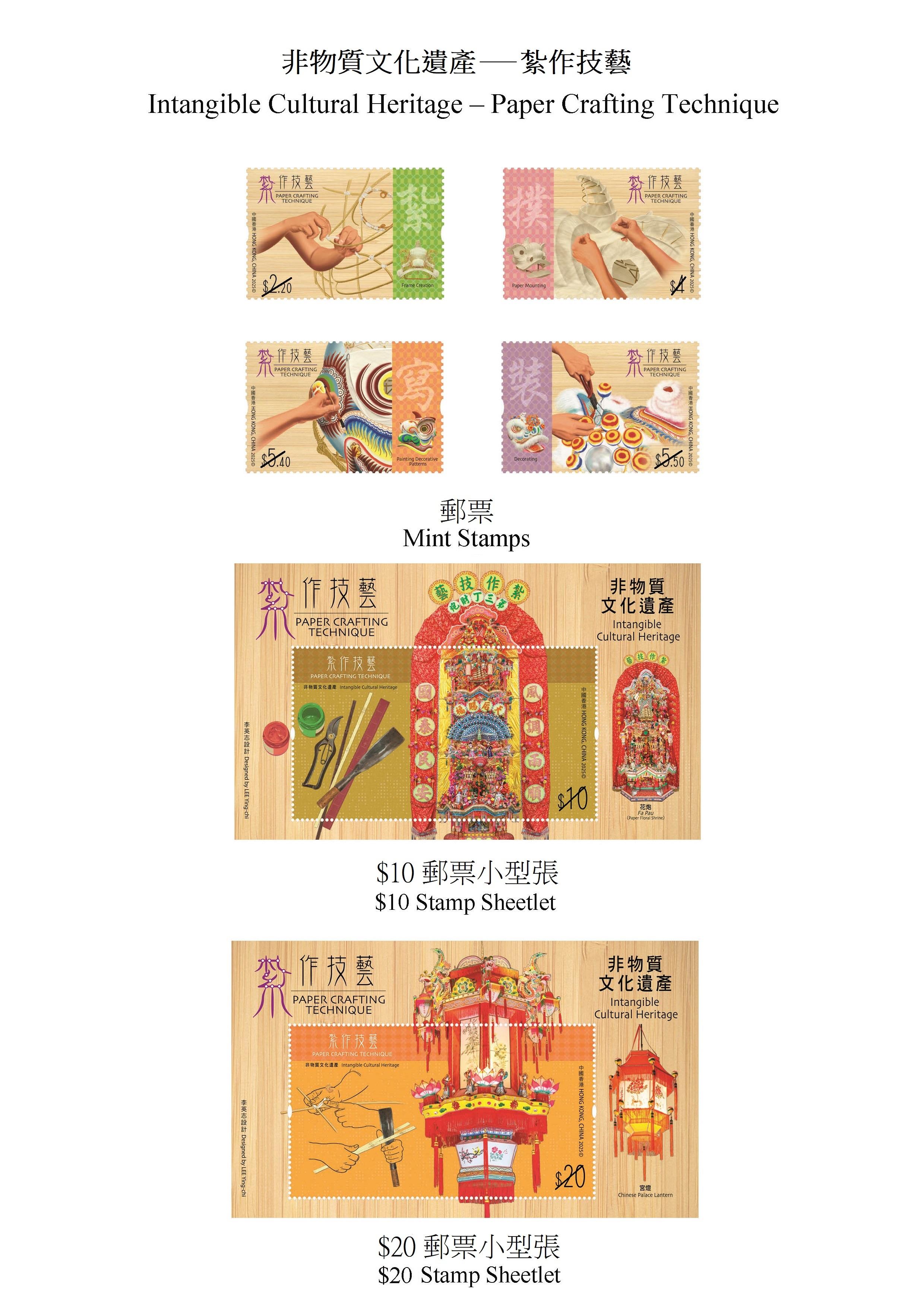
Hongkong Post to issue “Intangible Cultural Heritage – Paper Crafting Technique” special stamps (with photos)

     â€‹Hongkong Post announced today (June 11) that a set of special stamps and associated philatelic products on the theme of “Intangible Cultural Heritage – Paper Crafting Technique” will be released for sale on June 26 (Thursday).
      
     Inscribed onto the first Representative List of the Intangible Cultural Heritage of Hong Kong in 2017, the paper crafting technique is a folk art with a long history. Utilising materials such as bamboo, bamboo splints, iron wires, rice paper strips and fabric, paper craft masters create a variety of products through four major steps, namely frame creation, paper mounting, painting decorative patterns and decorating. These paper craft products are used for folk festivals, as decorations, or as offerings in religious ceremonies.
      
     To promote this intangible cultural heritage of Hong Kong, Hongkong Post will issue a set of four stamps, two stamp sheetlets and associated philatelic products on the theme of “Intangible Cultural Heritage – Paper Crafting Technique” to enhance public knowledge of this traditional craftsmanship.
      
     Official first day covers for “Intangible Cultural Heritage – Paper Crafting Technique” will be on sale at all post offices and Hongkong Post’s online shopping mall ShopThruPost (shopthrupost.hongkongpost.hk) from tomorrow (June 12). This set of special stamps and associated philatelic products will be on sale at all post offices and ShopThruPost from June 26, while serviced first day covers affixed with the special stamps will be available at philatelic offices only.
      
     A hand-back date-stamping service will be provided on June 26 at all post offices for official first day covers/souvenir covers/privately made covers bearing the first day of issue indication and a local address.
      
     Information about this set of special stamps and associated philatelic products is available on the Hongkong Post Stamps website (stamps.hongkongpost.hk).

Photo  Photo  Photo  
read more

LCQ16: Hong Kong Authorized Economic Operator Programme

     Following is a question by the Hon Frankie Yick and a written reply by the the Secretary for Commerce and Economic Development, Mr Algernon Yau, in the Legislative Council today (June 11):

Question:
 
     According to the information of the Customs and Excise Department, since the launch of the Hong Kong Authorized Economic Operator Programme, about 90 enterprises have become Authorized Economic Operators (AEOs), and their goods transported to the 16 economies with which Hong Kong has entered into AEO mutual recognition arrangements (MRAs) can enjoy customs facilitation arrangements, which is instrumental in facilitating seamless cross-boundary movement of goods. However, there are views that the current rate of enterprise participation in the Programme and the coverage of the Programme are not extensive enough. In this connection, will the Government inform this Council:
 
(1) of the volume and value of imported and exported goods involving Hong Kong AEOs in the past three years, as well as their respective percentages in the total volume and value of such goods;
 
(2) as there are views that in order to enhance the efficiency of the import and export of local and Mainland goods, Hong Kong must further extend the coverage of the MRA network, of the progress of the authorities’ entering into MRA agreements with more economies; and
 
(3) as there are views that apart from enabling enterprises to enjoy speedy customs arrangements, being accredited as the AEOs also helps enhance the management standards of enterprises, and the Mainland has even set up training bases to encourage more enterprises to become the AEOs, of the measures put in place by the Government to encourage more local enterprises to become the AEOs?
 
Reply:
 
President,
 
     Having consulted the Customs and Excise Department (C&ED), the reply to the question raised by the Hon Frankie Yick is as follows:
 
     The volume and value of imported and exported goods involving Hong Kong Authorized Economic Operators (AEOs) in the past three years, along with their respective percentages in the total volume and value of imported and exported goods, are shown below:
 

Year Volume of imported and exported goods involving Hong Kong AEOs (consignment) Percentage in Hong Kong’s total volume of imported and exported goods
2022 1.78 million 1.79%
2023 3.14 million 3.11%
2024 3.52 million 4.04%
 
Year Value of imported and exported goods involving Hong Kong AEOs ($) Percentage in Hong Kong’s total value of imported and exported goods
2022 842 billion 8.89%
2023 1,073 billion 12.15%
2024 1,318 billion 13.90%
 
     At present, Hong Kong has ratified AEO mutual recognition arrangements (MRAs) with 16 economies, ranking fourth globally in terms of the number of MRAs after Mainland China, Korea and the United States. The C&ED has been proactively expanding the global network of AEO MRAs with good progress made in recent years. It has signed action plans for AEO MRAs with eight economies including Türkiye, Saudi Arabia, Cambodia, the Philippines, the United Arab Emirates, Laos, Peru and Chile, marking a significant step towards the conclusion of the MRAs by both sides. The C&ED is now actively engaged in discussions and follow-up work with the customs administrations of these economies regarding the MRAs.
 
     Looking ahead, the C&ED will continue its efforts to expand the MRA network by actively liaising with Hong Kong’s major trading partners and dovetailing with the national development strategy on the Belt and Road Initiative. Priority will be given to discussing the MRAs with Belt and Road economies, including member states of the Association of Southeast Asian Nations, the Cooperation Council for the Arab States of the Gulf, and economies in the South American and African regions, with a view to benefitting more enterprises.
 
     To encourage local enterprises to become Hong Kong AEOs, the C&ED has continuously collaborated with the industry, major chambers of commerce and relevant partners to organise different types of publicity and promotional events, including briefing sessions and exhibition booths, to enhance enterprises’ understanding of the Hong Kong AEO Programme. Last year, the C&ED set up exhibition booths and hosted thematic seminars at major events, such as the Belt and Road Summit jointly organised by the Belt and Road Office and the Hong Kong Trade Development Council (HKTDC), as well as the Asian Logistics, Maritime and Aviation Conference organised by the Hong Kong Special Administrative Region Government and the HKTDC, with a view to fostering exchanges with different fields and industries. In addition, the C&ED has been disseminating the latest information on the developments of local and global AEO programmes through its website and social media channels, so as to extend the reach of its publicity and promotional efforts as well as strengthen communication and engagement with stakeholders.
 
     To further enhance the appeal of the Hong Kong AEO Programme, the C&ED has been actively seeking co-operation with various organisations to offer more benefits to the AEOs. For instance, the C&ED collaborates with the Hong Kong Export Credit Insurance Corporation to provide Hong Kong AEOs with free buyers’ credit checks to help them cope with market risks. In addition, the C&ED signed the Memorandum of Understanding (MoU) on Enhancing AEO Co-operation in the Greater Bay Area among Mainland, Hong Kong and Macao Customs under the AEO MRAs with the General Administration of Customs of the People’s Republic of China and the Macao Customs Service in 2023. Through such initiatives as the mutual referral mechanism on AEO applications, enhanced joint publicity and staff training, the MoU deepens the co-operation among the three customs administrations and supports enterprises of the three places to seize development opportunities in the Guangdong-Hong Kong-Macao Greater Bay Area. read more