Tag Archives: China

image_pdfimage_print

EDB clarification on Summer Reading Programme – Gift Book Pilot Scheme

     In response to a Legislative Council member’s allegations made yesterday (June 19) against the Summer Reading Programme – Gift Book Pilot Scheme launched by the Education Bureau (EDB), a spokesman for the EDB issued the following clarification:

     The EDB has all along been recommending books based on professional considerations of the quality of the books and whether the books are suitable for students at different key stages of primary and secondary schools, and not making recommendation based on the publishers of the books. Therefore, there is no question of giving preferential treatment to a particular bookstore or books from a certain publisher.

     In fact, the EDB has long been providing recommended book lists to schools with a view to promoting reading. The well established practice of recommending quality books to the school sector by EDB’s professional staff is effective. Since the 2018/19 school year, to align with the disbursement of the Promotion of Reading Grant to all public sector schools, the EDB has been providing schools with recommended book lists on four themes, namely Chinese History and Culture, Healthy Living, Moral Education, and Science, Technology, Engineering and Mathematics (STEM) Education. For details, please refer to www.edb.gov.hk/en/curriculum-development/4-key-tasks/reading-to-learn/contribution-of-book-titles/index.html.

     The Gift Book Pilot Scheme aims to offer free printed books to about 600,000 primary and secondary students before the summer vacation through schools’ procurement initiatives. In this connection, it is of prime importance to ensure that the supply of books to schools could be secured within a short period of time. The EDB understands that the book procurement procedures take time, and the reprinting of books and the relevant logistics are difficult to be arranged. To enable students to receive printed books before the summer vacation and enjoy leisure reading during the holiday, a pragmatic approach is adopted to include only local Chinese books in the Pilot Scheme.

     Based on the aforementioned recommended book lists on the four themes, professional staff of the EDB have consolidated within a very short period of time the book lists of a certain amount of quality books from different publishers to provide schools with sufficient choices. Schools can exercise discretion on book selection according to their own contexts and operational needs. Schools can select appropriate books from the designated book lists with reference to students’ abilities and interests. They can also repeatedly select certain books to tie in with their work in promoting reading, such as class-based/level-based book exchange activities, so as to help students develop a sense of gratitude and learn to cherish the things they have, thereby nurturing students’ positive values. Since printed book publishers have different market share and the themes of their publications vary, it is not difficult to understand that their proportions of books on the designated book lists are different.

     It is with good intention that the EDB initiated the Summer Reading Programme – Gift Book Pilot Scheme to provide students with a gift before the summer vacation to enhance their interest in reading. The EDB announced the pilot scheme to primary and secondary schools in mid-June so as to allow schools to aptly undertake the book procurement procedures after class resumption. To ensure that students can receive their books before the summer holiday, the EDB has allowed schools to shorten the period for written quotations from two or three weeks to one week to meet the operational needs of schools and the pilot scheme so that schools can complete their book procurement procedures as early as possible. If schools’ administrative procedures are not compatible due to time constraints, they can proceed with procurement in accordance with their established procedures. However, the delivery of books to schools before the end of the school term in end July for students’ reading during the summer holiday cannot be guaranteed.

     The acceptance of gift cannot be forced. As EDB explained to the representatives of School Councils, schools can choose not to join the pilot scheme. They may only join the free use of Hong Kong Education City’s eRead Scheme, which comprises both Chinese and English books.

     The EDB has to point out clearly that apart from the summer pilot reading scheme, schools can use the recurrent Promotion of Reading Grant (about $20,000 – $40,000 and $50,000 – $70,000 per year for primary and secondary schools respectively), according to their school-based needs, to procure different kinds of books including Chinese and English printed books and e-books which are not included in the designated book lists to enrich the collection of their school libraries. 

     Regarding the attempt of politician to politicise and demonise the promotion of reading with a standpoint of “China/Taiwan” and distort the facts to smear the EDB with totally unfounded accusation of transfer of benefits, the EDB expresses utmost regret and condemns the move. read more

HAB’s statement on use of District Council members’ ward offices as polling stations for a so-called “referendum” of class boycotts and general strikes

     The Home Affairs Bureau today (June 19) made the following statement on the use of District Council (DC) members’ ward offices as the polling stations for a so-called “referendum” of class boycotts and general strikes.

     The Home Affairs Bureau noted that the so-called “referendum” about carrying out class boycotts and general strikes against the legislation of national security law will be held on June 20 and there are reports stating that some ward offices of the DC members will be used as polling stations on that day.

     The Government reiterated that national security is a matter under the purview of the Central Authorities. Safeguarding national sovereignty, security and development interests is the constitutional requirement of the Hong Kong Special Administrative Region (HKSAR), the duty of the HKSAR Government, and is also in the interest of all Hong Kong residents. The legislation of national security law in Hong Kong will not weaken but instead strengthen “one country, two systems” and help maintain the safety and stability of our community so as to make Hong Kong a safer and more stable city.

     The Government clearly stated that the Basic Law and the Hong Kong’s legal system do not provide for any “referendum” mechanism. Conducting any form of a so-called “referendum” will have no constitutional basis or legal effect.

     According to sections 1 to 3 of General Standards of the Code of Conduct for Members of a District Council or Its Committees: a DC member shall not do anything which may compromise or impair his or her integrity, impartiality, objectivity or his or her ability to perform his or her duties; a DC member shall conduct himself or herself in such a way as not to place himself or herself in a position which may be contrary to the generally assumed standard of conduct expected of a DC member; and a DC member shall ensure that his or her conduct must not be such as to bring the DC into disrepute.

     Furthermore, paragraph 23 of the Guidelines on the Remuneration Package for Members of the District Councils of the HKSAR stipulates that a DC member must ensure that the ward office operated with the support of the Operating Expenses Reimbursement and other accountable allowances/expenses reimbursements for DC members is used for the discharge of DC duties. Should the ward office be used for discharging duties not related to the DC, e.g. using the ward office as the polling station of the abovementioned event, the related expenses will not be reimbursed. read more

S for S visits Macao (with photo)

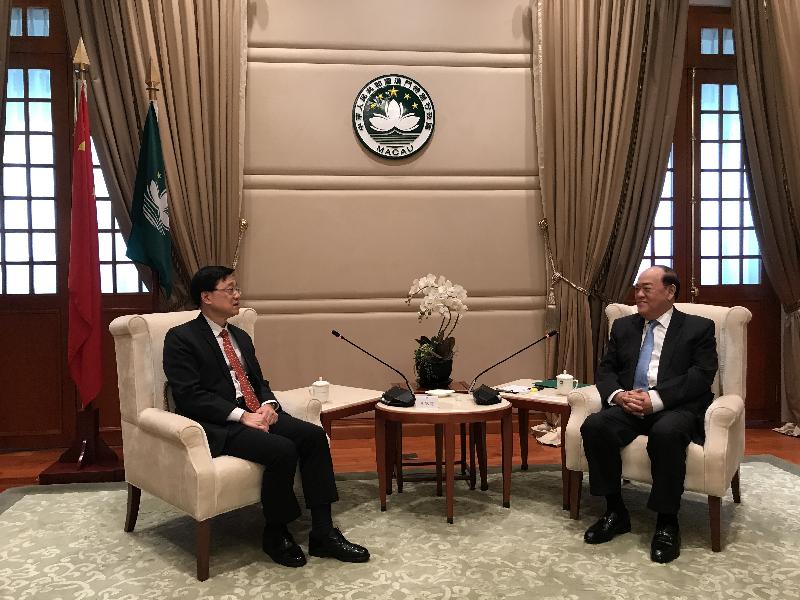
     The Secretary for Security, Mr John Lee, visited Macao this afternoon (June 19) to learn more about the work on safeguarding national security there and its latest developments. He concluded the visit and returned to Hong Kong tonight.

     Mr Lee called on the Chief Executive of the Macao Special Administrative Region (SAR), Mr Ho Iat-seng, today. Mr Ho briefed him on the legislative process, considerations and experiences in relation to Macao’s enactment of the national security law. Mr Lee then met with the Secretary for Security of Macao, Mr Wong Sio-chak, to exchange views on Macao’s experiences regarding its implementation of the national security law since 2009.

     During the meeting and related exchanges, Mr Lee learned that Macao has put in place effective measures at the policymaking and implementation levels to safeguard national security. These include the establishment of the National Security Committee headed by the Chief Executive in 2018 to formulate policies and co-ordinate initiatives with an office headed by the Secretary for Security of Macao to oversee the co-ordination and implementation work. The Macao authorities are planning to set up new government departments and divisions to strengthen enforcement of national security.
      
     According to the decision of the National People’s Congress, introduction of the national security law applicable to Hong Kong aims to prevent, stop and punish the acts and activities seriously endangering national security. During the exchanges, Mr Lee learned about Macao authorities’ experiences in such areas, including the importance of preventive work in reducing threats to national security.  
      
     Information indicates that since Macao’s enactment of the national security law in 2009, its society has become more stable and the economy has developed in a desirable manner. In 2019, its gross domestic product was 2.5 times as much as before the law became effective, while that year the unemployment rate marked a record low and the number of inbound travellers has since risen by 80 per cent. This has shown that the law has had a positive impact on Macao’s society and has enabled a more robust economic development. The example of Macao shows that national security is an important prerequisite and foundation for maintaining the prosperity and stability of society.
      
     Mr Lee held that introducing the national security law applicable to Hong Kong ensures its long-term security and helps continue the development of its economy and people’s livelihoods. Macao and Hong Kong are both special administrative regions and Macao’s experience is worthy of reference for Hong Kong. The exchanges today help Hong Kong better prepare for its implementation of the national security law.
      
     Mr Lee expressed his heartfelt gratitude to the Chief Executive of the Macao SAR and the Secretary for Security of Macao, adding that he was grateful to the Macao authorities for arranging the visit today.

Photo  
read more

Hong Kong Customs and universities join hands to enhance induction programmes and encourage in-service education (with photos)

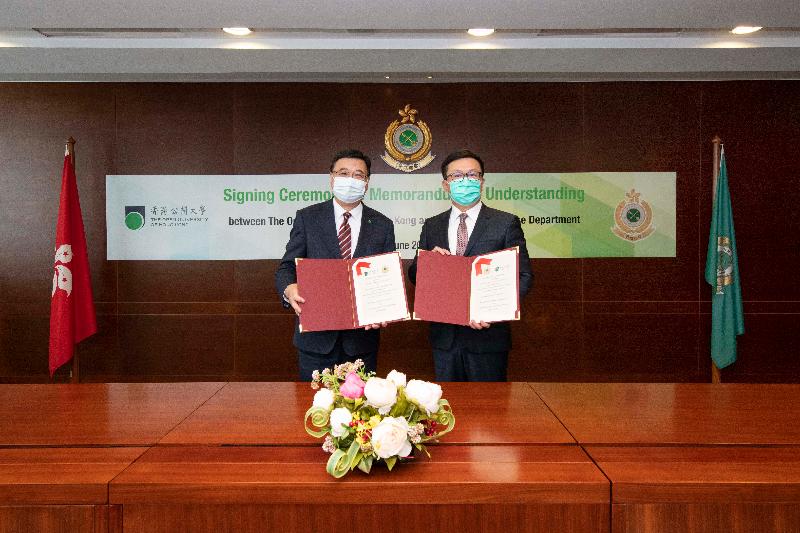
     â€‹Hong Kong Customs has all along attached great importance to staff training with a view to enhancing enforcement effectiveness. To enrich induction training and encourage in-service education, the department has entered into two memoranda of understanding (MoU) with two local universities this month. This is a significant step to map out the department’s staff development strategy.

     The Commissioner of Customs and Excise, Mr Hermes Tang, signed an MoU with the President of the Open University of Hong Kong (OUHK), Professor Wong Yuk-shan, on June 11. All new trainee Inspectors and Customs Officers enrolled since May this year would take two new modules offered by the OUHK, namely “Social Studies in Law Enforcement” and “Psychological Studies in Law Enforcement”, as one of the components of the induction programmes. The contents of the two modules combine both theories and practices. Apart from various concepts of criminology, sociology and psychology, the modules also cover practical knowledge in conflict management, psychological skills, media relations, etc, so as to fully enhance Customs officers’ practical foundation training. 

     Upon completion of relevant programmes, graduate Inspectors and Customs Officers will be awarded the “Certificate in Law Enforcement and Customs Management” by the OUHK. They will be entitled to an exemption of 30 credits when pursuing the “Bachelor of Social Sciences in Law Enforcement and Security Management” (or with Honours). Together with the credit exemption offered by the OUHK since 2004, qualified Customs Officers will be granted at most an exemption of 50 credits, therefore, saving about one-third of curriculum time and course fee. Officers holding local accredited Higher Diplomas or Associate Degrees may even gain further credit exemptions.

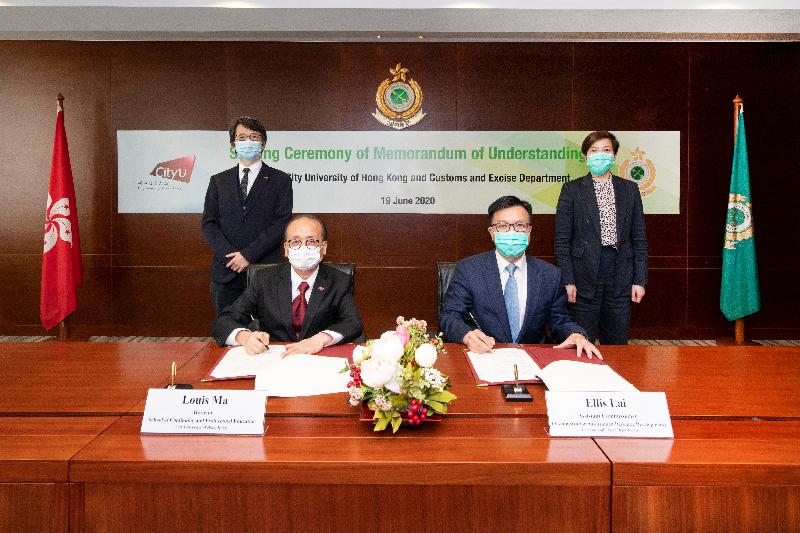
     Apart from the co-operation with the OUHK, Hong Kong Customs also established co-operation ties with City University of Hong Kong (CityU). The Deputy Commissioner of Customs and Excise, Ms Louise Ho, and the Vice-President (Development and External Relations) of CityU, Professor Matthew Lee, today (June 19) witnessed the signing of the MoU by the Assistant Commissioner (Administration and Human Resource Development), Mr Ellis Lai, and the Director of the School of Continuing and Professional Education (SCOPE) of CityU, Dr Louis Ma. Under the co-operation, the SCOPE of CityU will integrate the element of public service management into the induction programmes of which the graduates can gain an exemption of 36 credits when enrolling in the “Advanced Diploma in Management Studies” offered by the SCOPE of CityU. The Advanced Diploma course is also articulated with the “Bachelor of Arts (Honours) in Public Administration and Management” jointly organised by the SCOPE of CityU and De Montfort University of the United Kingdom to facilitate Customs officers to study the degree course.

     Mr Tang expressed his gratitude to the two universities for joining hands with Hong Kong Customs in enhancing the department’s staff training and encouraging continuous education. He said that the MoUs would not only raise the professional standard and academic status of Customs induction programmes, but also facilitate in-service education and encourage lifelong learning, which are extremely meaningful to the career prospects of Customs officers. 

     Mr Tang added that following the Hong Kong Customs College obtaining the accreditation approval from the Hong Kong Council for Accreditation of Academic and Vocational Qualifications in December 2018 to include the Customs induction programmes for Inspectors and Customs Officers in the Qualifications Register, the new MoUs reached between the department and the universities marked another milestone in the departmental staff training development.

     He said that Customs’ work is becoming more extensive and diversified in recent years. The department will continue to enhance staff training and promote in-service education in order to secure sustainable development of human resources.

Photo  Photo  
read more