CJ’s speech at Farewell Sitting (with photos/video)
The following is issued on behalf of the Judiciary:
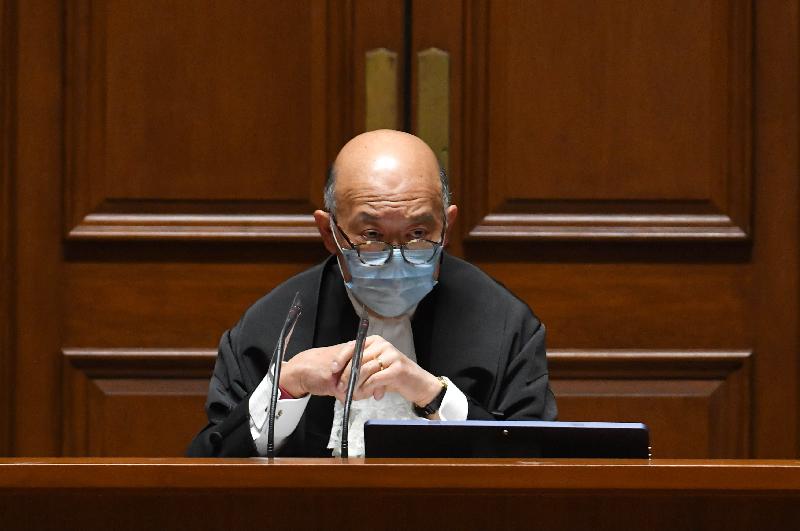
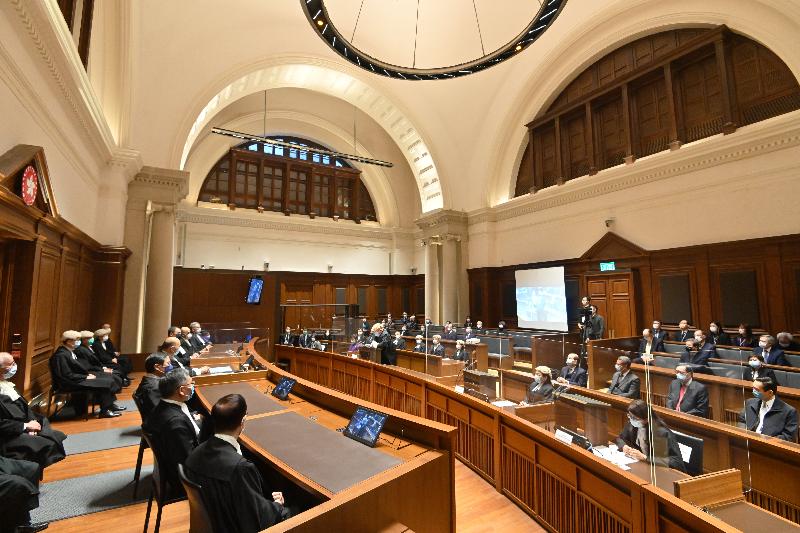
Following is the speech delivered by the Chief Justice of the Court of Final Appeal, Mr Geoffrey Ma Tao-li, at his Farewell Sitting today (January 6):
I am extremely grateful for the far too generous words spoken just now by the Secretary for Justice, the Chairman of the Bar, the President of the Law Society and Lord Neuberger of Abbotsbury, NPJ. I thank everyone for your presence, both here and remotely, at this my farewell sitting. I am particularly honoured by the presence of the Chief Executive and representatives of the Liaison Office and of the Office of the Commissioner of the Ministry for Foreign Affairs. I am also honoured by the presence of the Chief Secretary, the Financial Secretary, the Convenor of the non‑official members of the Executive Council, the President of the Legislative Council and representatives from the Law Society and the Bar. These are all persons to whom I owe much gratitude for their past and continuing support of the Judiciary and its work. Apart from it being a significant personal occasion for me, your presence today reflects the importance in our community of the rule of law itself and, within it, the role of the Judiciary. You have heard me speak much about this over the years and I am grateful to be given a final opportunity as Chief Justice to express my thoughts to you.
The rule of law represents in any community the necessary foundation to enable all who live and work in it to do so with dignity, and to do so acknowledging the interests of others. That is why it is said to be a cornerstone of the Hong Kong community. It is not just about being conducive to business and investment. Nor is it only about law and order. It also includes the recognition and enforcement of those rights we call human rights and fundamental freedoms (such as the freedom of assembly, of procession, of association and the freedom of the press), always of course recognising as well the importance of the respect for the rights and entitlements of others in the community. The importance we place on rights and freedoms is a fundamental feature of the Basic Law. That constitutional document, which was enacted by the National People’s Congress in accordance with the Constitution of the People’s Republic of China, remains the starting point in any discussion about Hong Kong’s system of government.
The Basic Law devotes a whole chapter in Chapter III to the fundamental rights and duties of residents. Chapter I sets out the general principles that govern Hong Kong beginning with Article 1 stating that the HKSAR is an inalienable part of the PRC, followed by Article 2 which prescribes that Hong Kong is to enjoy, among other matters, independent judicial power. The concept of independent judicial power is repeated in Article 19 (in the chapter dealing with the relationship between the central authorities and the HKSAR) and in Article 85 (under Chapter IV “Political Structure”) requiring the courts in Hong Kong to “exercise judicial power independently, free from any interference”.
So whenever there are discussions about the rule of law, the independence of the judiciary, and the role and responsibilities of judges in relation to these fundamental features, the foundation for such discussions must be to refer to the Basic Law. They are not in any way strange concepts that have been transplanted randomly to apply in Hong Kong: they are concepts required by, protected by and to be enforced under the very constitutional document that governs Hong Kong.
And let there be no misunderstanding as to what the independence of the judiciary means. It is important to stress at the outset that this concept is not related to politics. That is why I have always spoken out against the politicisation of the judiciary and of the work of the courts. The independence of the judiciary, which is at the heart of the rule of law, is the guiding concept that underlines the way judges discharge their constitutional responsibilities. The role and responsibilities of the judiciary are clearly and unambiguously set out in the Basic Law. The independence of the judiciary means in essence the responsibility and duty imposed on the courts to adjudicate on the law and on legal disputes fairly, evenly and strictly in accordance with legal principle and the spirit of the law. Underlying this is the recognition, again required under the Basic Law, that all are equal before the law and this of course includes the executive authorities. To repeat a phrase that bears reminding at all times: no one is above the law, all are subject to it and everyone is equal in the eyes of the law. Not only that, no one is able to influence the court in the adjudication of a legal dispute, whether civil or criminal. All this guarantees fairness and justice.
When I became a judge in 2001, like all judges, I took an oath of office (this oath is required under the Basic Law) to uphold the Basic Law, to discharge my judicial duties “conscientiously, dutifully, in full accordance with the law, honestly and with integrity” and to “safeguard the law and administer justice without fear or favour, self‑interest or deceit”. The judicial oath is a solemn promise to ensure that justice is done, is seen to be done, and that nothing and no one will be allowed to influence a judge to act or compromise in any way the demands of this oath.
The constitutional model mandated under the Basic Law is that of “one country, two systems”. I have always placed great emphasis on the need to have meaningful exchanges with the Mainland courts to enhance mutual understanding of the two legal systems. I have had many important exchanges over the years with successive Presidents of the Supreme People’s Court, and I wish to acknowledge my gratitude to them and to the other judges of the Supreme People’s Court and also to the many other Mainland judges whom I have met, for their insight and exchange of views. These mutual exchanges and co-operation must, I firmly believe, continue to strengthen.
The Hong Kong Judiciary does not comprise a large number of judges (I include in this term judicial officers such as magistrates). Hong Kong’s judges are dedicated day in, day out to the practical implementation of the rule of law as I have described and represent the embodiment of the independence of the judiciary. Throughout my tenure as a judge and particularly in the last ten years as Chief Justice, I can say that I remain proud of all the judges in the way they have fearlessly and without compromise upheld the law and been true to their oath. For this I am greatly indebted to them. Whether the political, social or economic atmosphere of Hong Kong has been good or not, the judges have always discharged their responsibilities consistently and conscientiously, without regard to the type or level of criticism that may be directed against them. As we know, such criticisms can be trenchant, even to the point of being abusive on occasion, but in spite of this our judges have remained true to their calling. Sometimes, I think that courage is needed. It is comforting to know, as I believe, that the vast majority of our community has confidence in them and find reassurance in the principled way they carry out their daily work. All this ensures stability at all times, whether good or not so good.
For my part, I wish to express my deep gratitude to our judges. They have almost invariably given me their wholehearted support and have played their proper role in the administration of justice. Without this foundation, I could not have begun to discharge my own responsibilities. For the future I wish to say it is essential that the highest standards, not only of ability but also of integrity, are observed and maintained. It is also critical that judges remain apolitical in the discharge of their duties.
I hope I will be forgiven if I now single out the two levels of court I have called my professional home during my time in the Judiciary: the Court of Final Appeal and the High Court.
I spent nine years in the High Court, seven of them as Chief Judge. Of the various levels in our court system, the busiest (although not in terms necessarily of the number of cases handled) is the High Court, certainly the most pressurised on a day to day basis. Efficiency, teamwork, co-operation and above all dedication are pre-requisites, and these remain the characteristics of the High Court. My years in the Court of First Instance and the Court of Appeal were among the happiest in my legal career. I thank my colleagues for their support and friendship. There was more than a tinge of sadness when I left the High Court.
I joined the Court of Final Appeal in September 2010 and sat in my first case a month later. I have just two days ago presided in my last case. These past ten years have represented for me the pinnacle of my career as a lawyer. My colleagues, the Permanent Judges, have enabled me to improve as a lawyer, to think as a lawyer should and to try at all times to have the instincts of a judge to be fair and just. I do not have the time now to say too much about each of them, but I must acknowledge and thank them both as my professional colleagues and also as my dear friends – (the current Permanent Judges) Mr Justice Ribeiro, Mr Justice Fok, Mr Justice Cheung, (and the former Permanent Judges) Mr Justice Tang, Mr Justice Bokhary and Mr Justice Chan. It has been a great honour for me to have served alongside all of you.
The Court of Final Appeal of course comprises not only Permanent Judges but also Non‑Permanent Judges. I am of course also greatly indebted to the Hong Kong Non‑Permanent Judges but I wish to say something more about the Non‑Permanent Judges from other common law jurisdictions. Lord Neuberger of Abbotsbury, who is on the bench today (remotely), sat on his first case in this Court the same day as I did. It was a particularly proud moment for me that I sat with him in my last appeal. I have through the years learned much from Lord Neuberger and I remain forever grateful to him for his wisdom. It is perhaps invidious to name specific individuals among the Non‑Permanent Judges, all of whom I deeply admire and respect, but I would like to single out another legal titan for special mention because, like Lord Neuberger, I have learned much from him. Sir Anthony Mason remains for me one of the wisest, ablest and best lawyers I have ever had the fortune to meet and work with. I have been much blessed in my professional life in knowing judges like Sir Anthony. Like Lord Neuberger, he is also a great supporter of Hong Kong.
It has of course been a privilege to have worked alongside the overseas Non‑Permanent Judges, but I must in addition recognise their great contribution to and support of Hong Kong generally, and the rule of law specifically. It is important when discussing the role of the overseas Non‑Permanent Judges not to allow politics to cloud the analysis. The role of the overseas Non‑Permanent Judges includes the significant dimension they add to the work of the Court of Final Appeal: they are each in their own right the very best of lawyers in the common law jurisdictions in the World, and their appointments to the Court of Final Appeal (like all other judges being based on their judicial and professional qualities as required under the Basic Law) reflect this excellence. Their presence on Hong Kong’s highest court reflects the fact, as stipulated by the Basic Law, that Hong Kong is a common law jurisdiction and, more important, a jurisdiction that is founded on the rule of law and the independence of the judiciary. The contribution of the Non‑Permanent Judges to Hong Kong has been continuously applauded by all those involved in the law, and supported by the actions and words of the executive and the legislature. Quite simply, their continued presence in Hong Kong is beneficial to the community.
I was at my happiest working in the Judiciary when I was judging, dealing with interesting cases and learning the law along the way. Administrative duties, however, had to be performed and of course taken seriously when I became Chief Judge of the High Court and then Chief Justice. The many functions and work of the Chief Justice are not readily known, even among judges: they range from person management and discipline, through at times the making of delicate policy decisions, to dealing with the Government. There is no handbook or guide for chief justices. This means that the support given to the Chief Justice assumes considerable importance and while it is right that I take sole responsibility for all mistakes that may have been made, I must equally acknowledge the considerable support I have received in the discharge of my administrative duties. Time does not permit me to acknowledge every person individually, but I am grateful to all of you. I must, however, expressly thank the court leaders at each level of court – the Chief Judge of the High Court, the Chief District Judge and the Chief Magistrate, both current (they are all present today) and past. I also appreciate the work of all those judges who have chaired and been responsible for the various court committees. I am fully aware of the extra time they have had to spend on these committees, especially given their busy court schedules.
I must also specifically mention the Judiciary Administrator. Like the role of the Chief Justice, the function and duties of the Judiciary Administrator are not always understood or appreciated. I wish to express my considerable gratitude to the Judiciary Administrators I have closely worked with – Miss Emma Lau (with whom I worked for nine years after I became Chief Justice) and Ms Esther Leung. I particularly appreciated their advice and their insistence on apprising me of all possible options to enable the best decision to be made. Of course, it goes without saying that I am deeply grateful for the consistently excellent support I have been given by all Judiciary Administration staff.
I must also mention and thank my Administrative Assistants who have likewise provided invaluable advice to me as well as considerably easing my burdens: Ms Annie Tang, Mr Esmond Lee and my present Administrative Assistant, Miss Patricia So. Equally indispensable have been my two Senior Personal Assistants, first Mrs Irene Li and now Miss Jaime Siu. Ms Heidi Mak was my Personal Assistant when I was Chief Judge of the High Court. I thank you all sincerely.
In relation to the work of the CFA, I am greatly indebted as well to the Registrars of the Court with whom I have worked – Registrar Simon Kwang and Registrar K W Wong. I must also thank all the Judicial Clerks with whom I have worked both in the High Court and during my time in the CFA. In particular, I am grateful to Ms Wendy Chui and Ms Phoebe Tse. Meticulous and fastidious, they have always provided me with sterling and always cheerful support.
I mentioned earlier the fact that there is no handbook to guide a Chief Justice. What I had was better in preparing me for the responsibilities of being Chief Justice. I was able to learn much from my predecessor, Andrew Li. He gave me a typically down-to-earth piece of advice before I succeeded him: he told me I had to raise my game. I have tried to. I thank Andrew for his guidance, leadership and advice over the years.
Lastly, if you will permit me to speak on a personal level, I want to thank my family. Without the love and support of my wife and daughter, I could not have so willingly and happily been Chief Justice. They have made the happy times happier and even the not so happy times fine. Thank you both from my heart. I am also immensely grateful to my brother who is present today for his great support over the years – indeed he was instrumental in suggesting that I read law in the first place at university. I also thank the clan for all their support and love. I must finally remember my late parents, who have always loved and supported me. I wish they could be present with us today.
I have now talked for far too long and thank you for your patience. It is a sobering thought, in some ways both a relief and sad, that this is my last occasion in court. I have every confidence in my successor Mr Justice Cheung and wish him much success in this important office. I hope that everyone in the community will support the Chief Justice. My only advice to him is always to be guided by your principles, for it is these principles that will see you and the community through all seasons. To all judges in the Judiciary, I also bid you farewell and wish you good fortune in your service to Hong Kong. Be true to your oath and be true to the rule of law. It has been the greatest honour and privilege of my life in the law to have been your Chief Justice and to have served Hong Kong.
For me, it is for others to judge my work. But I wish to say this: I have tried my best at all times to adhere to my oath and to be guided by my principles. Nothing less would have done. I borrow something that was said by Lord Denning on his retirement from the bench (being a reference to St Paul’s final testimony to St Timothy): “I wish I could say I fought the good fight, I finished the course, I kept the faith”.
I was born in Hong Kong and it will remain my home. Hong Kong will continue to flourish, underpinned by the rule of law. I wish you all and everyone in Hong Kong good health and happiness this year, every year.