Tag Archives: China

Speech by SJ at opening ceremony of National Training Course for Talents Handling Foreign-related Arbitration (Hong Kong) (English only)

     Following is the speech by the Secretary for Justice, Mr Paul Lam, SC, at the opening ceremony of the National Training Course for Talents Handling Foreign-related Arbitration (Hong Kong) today (February 18):
      
Director Yang (Director of Bureau of Public Legal Services Administration of Ministry of Justice, Mr Yang Xiangbin), Secretary Jiang (Council Chair of the China University of Political Science and Law, Mr Jiang Zeting), Director Liu (Director of China Legal Service (H.K.) Limited, Ms Liu Changchun), distinguished guests, ladies and gentlemen,
      
     Good afternoon, and a warm welcome to you all to the National Training Course for Talents Handling Foreign-related Arbitration (Hong Kong). It is my pleasure to address such an accomplished gathering of professionals in foreign-related arbitration. 
      
The Course
      
     This Course is the first specialised training programme on arbitration under the Hong Kong International Legal Talents Training Academy. I would like to take this opportunity to express my heartfelt gratitude to the Ministry of Justice and the China University of Political Science and Law and also the China Legal Service (H.K.) Limited for their unwavering support in making this Course a reality. This Course in fact marks an important milestone to implement the record of meeting between the Ministry of Justice and our Department signed in July 2023 when Ms He Rong visited Hong Kong, to further deepen exchanges and co-operation on talent nurturing and legal and dispute resolution services between the Mainland and Hong Kong.
      
     To contribute to the national strategy of developing foreign-related rule of law, it is our collective goal to cultivate a team of foreign-related arbitration professionals with a global vision, good understanding of international rules, and capability in providing specialised services in the cross-border legal service market.
      
     This Course will provide a comprehensive overview of arbitration in Hong Kong, including comparative analyses with the Mainland and international frameworks. In addition to the informative lectures, there will be exchange sessions with arbitration institutions, professional legal bodies, and visits to barristers’ chambers, international law firms and also court visits, during which participants will have the chance to interact directly with experienced legal professionals, and gain first-hand experience of the legal and arbitration practice in Hong Kong. I hope that by the end of this Course, you will have developed a deeper understanding of international arbitration and its intricacies, and the various topics that we will explore together.
      
     We are truly privileged to have a distinguished line-up of speakers who are prominent practitioners in the field of arbitration. I am confident that their expertise, insights, and practical experiences can be effectively applied and incorporated into practices. As talent handling foreign-related arbitration with different backgrounds, each of you brings a unique perspective to this Course. The diversity of experiences in this room is a tremendous asset that enriches our discussions and learning experience. In this regard, I invite you to actively engage in discussions, raise questions that come to mind, and share your thoughts. This Course offers more than just an opportunity to learn from our esteemed speakers; it is also about fostering an interactive learning atmosphere where we can all benefit from each other’s experiences and perspectives.
      
     Furthermore, the lectures in this Course are primarily conducted in English. English is one of the official languages in Hong Kong, and is frequently the language of choice due to its global prevalence in business and legal matters. Many arbitration proceedings are conducted in English, particularly those involving international parties. As a bridge between East and West, Hong Kong’s bilingual proficiency facilitates cross-border transactions and dispute resolution, making it an attractive venue for international arbitration. By engaging with the lectures and course materials in English, you will have the opportunity to practise English in legal and business contexts, unlocking unparalleled opportunities for advancement for yourselves in the field of global arbitration.
      
Arbitration in Hong Kong
      
     In fact, a significant number of our legal and dispute resolution professionals are bilingual, or even multilingual, and many are qualified in multiple jurisdictions. This ensures that that parties involved in arbitration can readily find suitable representation or arbitrators for their proceedings.
      
     Hong Kong is a leading global hub for international arbitration, and one of the most preferred seats of international arbitrations worldwide. With the strong support from the Central People’s Government, the National 14th Five-Year Plan, the Belt and Road Initiative and the Outline Development Plan for the Guangdong-Hong Kong-Macao Greater Bay Area (GBA) all explicitly endorse Hong Kong’s development into a centre for international legal and dispute resolution services in the Asia-Pacific region.
      
     While Hong Kong legal practitioners are trained in the common law, many have developed significant expertise and experience in handling issues involving Mainland elements. In particular, since 2020, the Central Authority has launched a pilot scheme permitting eligible Hong Kong and Macao legal practitioners to practise civil and commercial matters in nine Mainland cities in the GBA after passing the GBA Legal Professional Examination, and completed some practical training.
      
     While we are confident in the depth and breadth of Hong Kong’s existing legal talent pool, participation of overseas professionals in international arbitrations conducted in Hong Kong is essential. The nationalities or qualifications of arbitrators or legal representatives are not restricted in any way under our Arbitration Ordinance. In other words, clients are completely free to choose their preferred arbitrators or legal representatives. We have put in place a scheme to further facilitate the participation of non-Hong Kong residents in arbitral proceedings on a short-term basis by offering immigration convenience, enabling all visitors to come and participate in arbitral proceedings in Hong Kong without any employment visa as arbitrators, counsel, and factual or expert witnesses.
      
     Furthermore, two measures are introduced to the CEPA Agreement on Trade in Services to facilitate Hong Kong investors. First of all, Hong Kong-invested enterprises registered in the pilot cities of the GBA may adopt Hong Kong law or Macao law as the applicable law in their contracts. Secondly, Hong Kong-invested enterprises registered in the nine Mainland cities in the GBA may choose Hong Kong or Macao as the seat of arbitration. The expansion of these measures will not only facilitate the internationalisation of the GBA’s business environment and benefit the collaborative development of its legal and dispute resolution sectors, but also, more importantly, encourage Mainland enterprises to leverage Hong Kong as a springboard for overseas expansion and empower foreign investors to utilise Hong Kong as a gateway to the Mainland.
      
     In recent years, the Hong Kong Special Administrative Region Government has actively pursued a range of initiatives to enhance its arbitration-related legal framework, for example the funding options for arbitration, attract leading international arbitration institutions to establish regional offices in Hong Kong, and host major international legal and dispute resolution events, with an aim of promoting Hong Kong as a premier centre for international legal and arbitration services.
      
     Looking ahead, we anticipate sustained growth in demand for HK’s legal and dispute resolution services, especially in the GBA and in the Belt and Road region, and hence there is a growing need for nurturing talent for a sustainable supply of legal and dispute resolution professionals. 
      
The Hong Kong International Legal Talents Training Academy
      
     In this connection, the Chief Executive announced in his 2023 and 2024 Policy Address to establish the Hong Kong International Legal Talents Training Academy. Through the Academy, Hong Kong can build on the unique advantages and position in connecting our country to the rest of the world at the interface of the rule of law, contributing to the country’s efforts in training foreign-related legal talent and actively participating in the next decade of the Belt and Road Initiative as a capacity building hub.
      
     The Academy will make good use of Hong Kong’s bilingual common law system and international status, and organise practical training courses, seminars, international exchange programmes to promote exchanges among talent in the regions along the Belt and Road. Training programmes will cover topics including international law, common law, civil law and national legal systems of other Belt and Road countries.
      
     As this Course is the Academy’s first training programme in collaboration with the Ministry of Justice, we value your insights and encourage you to share your honest feedback on what worked well and what could be improved in this Course. Your input will directly shape the future of our training programs, ensuring they meet the evolving needs of the arbitration community.
      
Conclusion
      
     Ladies and gentlemen, this Course is not just about acquiring knowledge about international arbitration; it is also about connecting with fellow professionals in Hong Kong and finding out why Hong Kong is a prime venue for dispute resolution in the world. I also encourage you to discover all that Hong Kong has to offer, from its bustling streets to its stunning views, before and after all the lectures and visits on each day.
      
     In closing, I wish to reiterate my appreciation to the Ministry of Justice of the People’s Republic of China, the China University of Political Science and Law, the China Legal Service (H.K.) Limited, and to each and everyone of you for taking part in this Course. I look forward to the inspiring and productive training in the coming week. Thank you. read more
Minimum Wage Commission delighted by acceptance of recommended new Statutory Minimum Wage rate

The following is issued on behalf of the Minimum Wage Commission:
 
     After thorough consideration, the Minimum Wage Commission (MWC) has recommended raising the Statutory Minimum Wage (SMW) rate from the current $40 per hour to $42.1.
      
     The Chairperson of the MWC, Ms Priscilla Wong, said today (February 18), “We are delighted to learn that the Chief Executive (CE) in Council has accepted our recommendation about the SMW rate after considering the report of the MWC.”
      
     Ms Wong added, “The MWC agreed to adopt the formula approved by the CE in Council on April 30, 2024, to derive the recommended SMW rate (please refer to the Annex). During the review process, the MWC discussed in detail the implementation arrangements for adopting the formula, examining the latest data of indicators in the formula and assessing the relevant impacts. The MWC believes that the new SMW rate can maintain an appropriate balance between forestalling excessively low wages and minimising the loss of low-paid jobs, while giving due regard to sustaining Hong Kong’s economic growth and competitiveness, which is in line with the policy objectives of the SMW. We earnestly hope that the new SMW rate will be accepted by the Legislative Council.”

     The 2024 Report on Reviewing the Statutory Minimum Wage Rate has been uploaded to the MWC’s website (www.mwc.org.hk). read more

Chief Executive in Council adopts recommendation on Statutory Minimum Wage rate

     The Chief Executive (CE) in Council has adopted the recommendation of the Minimum Wage Commission (MWC) on raising the Statutory Minimum Wage (SMW) rate from its prevailing level of $40 per hour to $42.1, an increase of $2.1 or 5.25 per cent.
 
     The Government will publish the Minimum Wage Ordinance (Amendment of Schedule 3) Notice 2025 in the Gazette this Friday (February 21) and table it in the Legislative Council (LegCo) on February 26. Subject to the approval of the LegCo, the revised SMW rate will come into force on May 1 this year.
 
     In conducting this review of the SMW rate, the MWC adopted the formula approved by the CE in Council on April 30, 2024, to derive the recommended SMW rate (please refer to the Annex).
 
     The Secretary for Labour and Welfare, Mr Chris Sun, said he is pleased with the MWC’s smooth completion of its mission to review the SMW rate through elaborate discussions to draw up the implementation arrangements for adopting the formula, examining the latest data on the indicators in the formula, and assessing the relevant impacts. He paid warm tribute to the Chairperson of the MWC, Ms Priscilla Wong, for her exemplary leadership and to all MWC members for their sterling contributions.
 
     Mr Sun said, “After careful consideration, the Government is of the view that the MWC has ably discharged its statutory function of reviewing the SMW rate. The recommendation of the MWC is in line with the policy objectives of the SMW to maintain an appropriate balance between forestalling excessively low wages and minimising the loss of low-paid jobs, while giving due regard to sustaining Hong Kong’s economic growth and competitiveness.”
 
     The 2024 Report on Reviewing the Statutory Minimum Wage Rate has been uploaded to the MWC’s website (www.mwc.org.hk).
 
     The Government will publish the Employment Ordinance (Amendment of Ninth Schedule) Notice 2025 in the Gazette on February 21 and table it in the LegCo on February 26. The Notice amends the monthly monetary cap on the requirement for employers to record the total number of hours worked by employees in a wage period. An employer will be exempted from the requirement to record the total number of hours worked by an employee in a wage period if the wages payable to the employee for that wage period are not less than $17,200 (currently $16,300) per month. In tandem with the commencement of the revised SMW rate, the revised monthly monetary cap will come into force on the same day as the revised rate takes effect, which is May 1 this year.
 
     As announced in the CE’s 2024 Policy Address, the Government will implement a new annual review mechanism of the SMW. The first SMW rate derived under the new mechanism is expected to take effect on May 1, 2026. read more

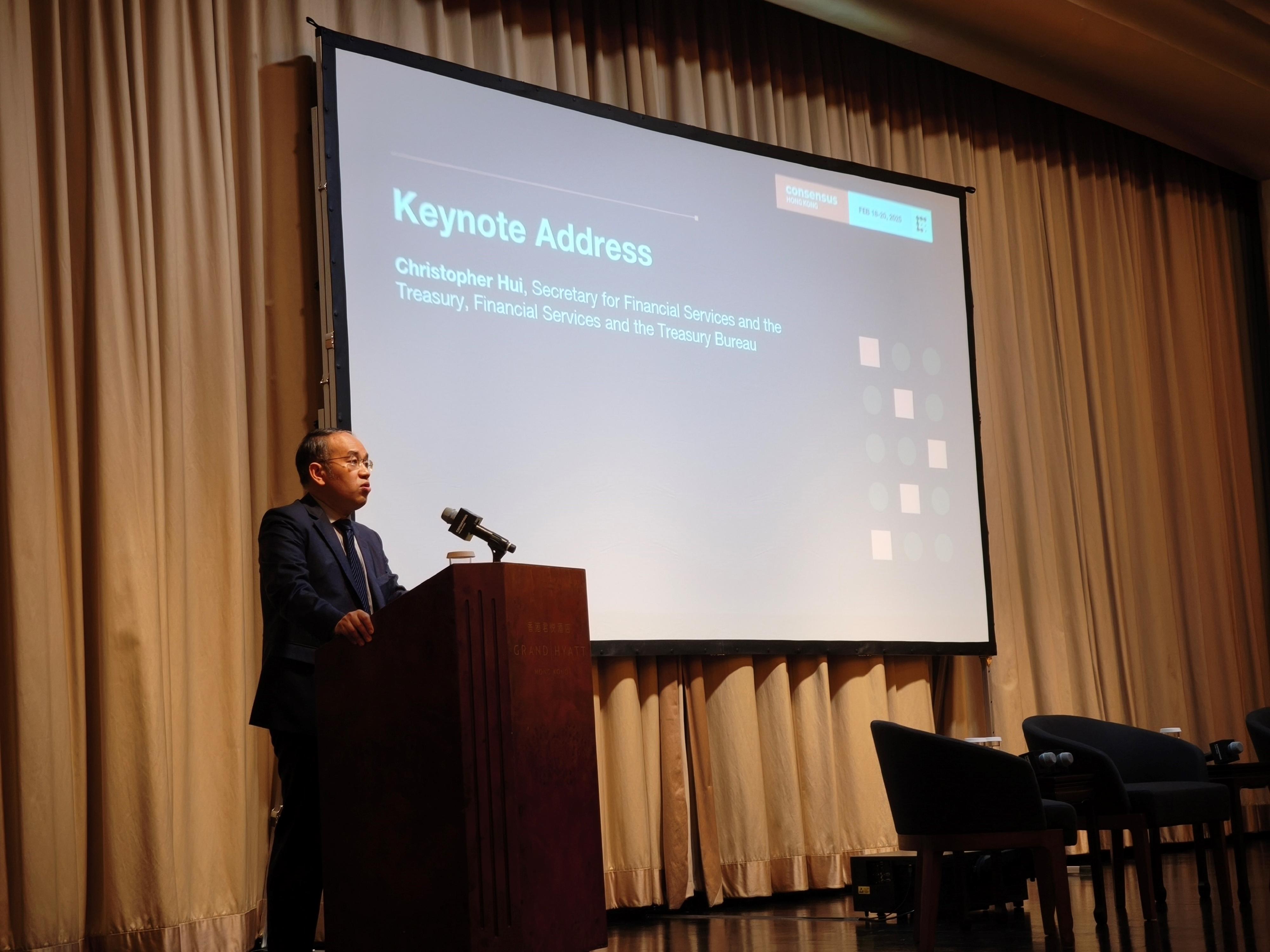
SFST’s keynote address at Institutional Summit at Consensus Hong Kong 2025 (English only) (with photo)

     Following is the keynote address by the Secretary for Financial Services and the Treasury, Mr Christopher Hui, at the Institutional Summit at Consensus Hong Kong 2025 this morning (February 18):
 
Tira (Managing Director of CoinDesk Events, Ms Tira Grey), Michael (Chairman of Consensus Hong Kong, Mr Michael Lau), distinguished guests, ladies and gentlemen,
 
     It is my profound honour to join you today at Consensus Hong Kong 2025 – a landmark event that celebrates innovation, brings together global pioneers in blockchain, Web3, virtual assets, and artificial intelligence, and galvanises the forces driving the future of our financial ecosystem. I welcome you all to a market where vision meets policy, and where transformative ideas are nurtured under a forward-looking policy and regulatory framework.
 
     Today, Hong Kong stands poised on the threshold of a new chapter – one in which traditional finance and digital innovation integrate to create efficiency, transparency, and inclusive growth.
 
     It is no coincidence that Consensus Hong Kong 2025 is taking place in our vibrant city. The Government remains steadfast in our mission to foster an environment where innovation is underpinned by robust regulation, ensuring that our financial markets not only thrive on competitiveness but also maintain the highest standards of investor protection and market integrity.
 
     Today, I wish to share with you my vision for the future, one built upon three defining trends. The first is financial market innovation through tokenisation. Tokenisation is not merely a buzzword – it is a profoundly transformative development that holds the promise of reshaping traditional financial markets. By converting conventional financial instruments and physical assets into digital tokens, we are building bridges between traditional finance and the emerging digital economy. Our regulatory framework has laid a solid foundation for this evolution. Our securities regulator has proactively issued circulars to guide intermediaries engaging in tokenised securities-related activities and expectations for the tokenisation of SFC (Securities and Futures Commission)-authorised investment products.
 
     These measures have provided critical clarity to market participants and investors alike, fostering an environment of trust and informed innovation. We have witnessed encouraging developments that testify to our approach. Consider, for instance, the tokenisation of gold – where physical gold is integrated with blockchain technology to offer investors greater flexibility, fractional ownership, and enhanced security. Similarly, the emergence of tokenised money market funds shows how traditional liquidity management can benefit from digital innovations, enabling more efficient market making alongside expanded secondary market liquidity for institutional investors.
 
     An important initiative to foster tokenisation development is Project Ensemble, a sandbox launched by the Hong Kong Monetary Authority. This initiative is designed to experiment with the tokenisation of money enabling seamless interbank settlements. By exploring tokenisation across fixed income and investment funds, liquidity management, green and sustainable finance, and trade and supply chain finance, Project Ensemble exemplifies Hong Kong’s commitment to harnessing emerging technology to enhance financial market infrastructure. This experimental Sandbox not only embraces innovation but also ensures that the innovations are implemented with a clear focus on stability and investor protection.
 
     The second trend that will shape our future financial landscape is the integration of Web3 innovations into the real economy. In our ongoing efforts to narrow the gap between digital finance and everyday business operations, the Government has taken decisive steps to develop a regulatory regime for stablecoin issuers. We are actively engaging with the real economy – where businesses that support cross-border payments, international trade, and digital commerce are eager to solve longstanding issues such as high costs, delayed transfers, and the challenges posed by the sometimes unpredictable FX (foreign exchange) markets.
 
     In recognition of these challenges, the regulator has established a Sandbox to obtain feedback and provide clarity to entities interested in issuing fiat-referenced stablecoins. This Sandbox serves not only as an incubator for innovations but also as a platform that bridges industry needs with prudent regulation. We see promising potentials for stablecoins to streamline payment systems, fostering a more efficient and integrated financial landscape that benefits businesses and consumers alike.
 
     Furthermore, the application of tokenisation extends far beyond traditional financial instruments. Already, we observe its impact across various sectors. From financing EV (electric vehicle)-charging infrastructure through tokenised management fee, to facilitating more agile supply chain finance, our digital infrastructure is now robust enough to support longstanding economic practices, albeit with a modern twist. These developments illustrate how the convergence of digital technologies with real-world assets can unlock significant economic value and propel us into a new era of cross-sector collaboration.
 
     The third and perhaps most transformative trend is the integration of AI with blockchain and Web3 technologies. In today’s rapidly evolving technological landscape, AI represents not just an opportunity but a necessity to enhance our digital infrastructures. Decentralised AI platforms, built on blockchain principles, provide a promising avenue for ensuring data privacy, security, and collaborative innovation.
 
     Decentralised AI has the potential to revolutionise how we manage, train, and deploy machine learning models. By enabling secure data sharing across multiple stakeholders, we create a system in which AI models can be trained collaboratively using diversified databases. This collaborative approach ensures that the resulting models are not only more widely applicable but also benefit from the collective insights of multiple organisations. Moreover, an open-source philosophy in model development promotes transparency, accountability, and a shared economic vision in which the fruits of innovation are accessible to all.
 
     Recognising these immense opportunities, the Government has set forth a policy statement to foster responsible AI innovation in our financial markets. Last October, we issued a detailed statement outlining our vision for the responsible usage of AI, balancing innovation with the imperative for control, transparency, and fairness. In line with our policy, the Hong Kong University of Science and Technology (HKUST) has embarked on a collaborative initiative, making its InvestLM model available to the financial services industry. This programme offers both advisory and training services – providing options for on-premises deployment as well as application programming interfaces (APIs) and web interfaces that utilise the HKUST’s computing resources.
 
     The transformative trends of tokenisation, real economy adoption, and AI integration can only reach their full potential within a reliable and adaptable regulatory system. Our guiding principle – “same activities, same risks, same regulations” – underscores our commitment to fairness, consistency, and the highest standards of market protection.
 
     We are continuously reviewing and refining our regulatory regime to foster a complete ecosystem for virtual assets. By developing comprehensive frameworks that include virtual asset exchanges, stablecoin issuers, custodians, and over-the-counter trading activities, we pave the way for an interconnected value chain that will underpin Hong Kong’s financial markets.
 
     In closing, I invite all stakeholders here today – from seasoned financial experts to the visionary entrepreneurs shaping tomorrow’s digital economy – to embrace the challenges and opportunities that lie ahead. Consensus Hong Kong 2025 is more than just an event; it is a call to action. It is a recognition that our collective ingenuity, when harnessed under a principled regulatory framework, has the power to drive sustainable progress.
 
     I extend my heartfelt gratitude to the Consensus event organisers, our trusted partners at Invest Hong Kong, the Hong Kong Tourism Board, and every individual contributing to the success of this event. I wish you a productive and transformative gathering at Consensus Hong Kong 2025, and I look forward to witnessing the many innovations that will shape our shared future.
 
     Thank you.

Photo  
read more