Tag Archives: China

image_pdfimage_print

Speech by CE at South China Morning Post China Conference: Southeast Asia 2025 (English only) (with video)

     Following is the video speech by the Chief Executive, Mr John Lee, at the South China Morning Post China Conference: Southeast Asia 2025 today (February 17):
      
Your Excellency Minister Tengku Zafrul Aziz (Minister of Investment, Trade and Industry of Malaysia), officials and friends from ASEAN (Association of Southeast Asian Nations) and around the world, Ms Catherine So (Chief Executive Officer of South China Morning Post), Ms Tammy Tam (Editor-in-Chief of South China Morning Post), distinguished guests, ladies and gentlemen,
      
     Good afternoon. I am pleased to join you today, virtually, at this remarkable conference in Kuala Lumpur.
      
     For that, I am grateful to the South China Morning Post for organising the China Conference: Southeast Asia, and for putting a prime spotlight on the substantive roles played by China, our country, and Southeast Asia in shaping the global agenda, now and long down the road.
      
     To that end, you have heard today from His Excellency Prime Minister Anwar Ibrahim, as well as a wealth of senior governmental, business and financial leaders and decision-makers from Malaysia, throughout ASEAN and around the world.
      
     For the next few minutes, allow me to speak about Hong Kong – about the role we play in working with our country and in connecting with member states of ASEAN and far beyond.
      
     Long a “super connector”, Hong Kong takes pride in creating value for traditional and emerging markets. We are the natural bridge for ASEAN business looking to Mainland Chinese markets and opportunities. We are, as well, the conduit for Mainland businesses looking to explore overseas opportunities, whether in ASEAN, the Middle East or elsewhere.
      
     Indeed, the Mainland and ASEAN are our two largest trade-in-goods partners, with total trade value reaching US$619 billion and US$165 billion respectively last year.
      
     We are home to about 2 600 offices with parent companies on the Mainland, up 20 per cent over 2023 totals. Last year, too, some 730 offices with parent companies in ASEAN maintained an office in Hong Kong. That’s an increase of about 10 per cent year on year.
      
     And I am confident of continuing growth in the coming years, given the ASEAN-Hong Kong, China Free Trade Agreement and related Investment Agreement, as well as the recently signed amendment to the Agreement on Trade in Services of CEPA – the Mainland and Hong Kong Closer Economic Partnership Arrangement.
      
     The new CEPA Agreement introduces service-sector liberalisation measures, making it easier for Hong Kong suppliers, and international companies with offices in Hong Kong, to do business on the Mainland.
      
     As you know, CEPA is nationality neutral, so I encourage ASEAN companies to enjoy Hong Kong’s world-class professional services and, in doing so, make full use of CEPA in accessing the Mainland market. 
      
     Alongside strong business ties with ASEAN, our people-to-people bonds are long-standing and mutually rewarding. 
      
     Since assuming office, in July 2022, I have led high-profile Hong Kong delegations to seven of the 10 ASEAN countries. Nearly 90 co-operation agreements between Hong Kong and ASEAN countries have been signed over that period – and in so many areas, from economic and trade matters to innovation and technology, cultural exchange, education and more.
      
     And I am committed to building on our gratifying ties.
      
     We have relaxed the criteria for nationals of Cambodia, Laos, Myanmar and Vietnam applying for multiple-entry visas to Hong Kong. We have, as well, extended their validity period from two to three years. 
      
     We will also provide self-service immigration clearance for invited ASEAN-country visitors participating in business, development and related activities in Hong Kong.
      
     And for ASEAN and other non-Chinese residents working in Hong Kong and wishing to travel to the Mainland, the multiple-entry visas have been extended for up to five years, making Mainland entry from Hong Kong fast and efficient.
      
     And to make our ASEAN friends feel at home in Hong Kong, we are compiling a list of restaurants offering halal food, while encouraging hotels and other establishments to provide appropriate worship services.
      
     There’s more. We’re making it easier to communicate with ASEAN business. In addition to our Economic and Trade Offices in Singapore, Jakarta and Bangkok, we are working with the Malaysian government to establish a trade office in Kuala Lumpur.
      
     Allow me to thank ASEAN member states for their staunch support of our accession to the Regional Comprehensive Economic Partnership, the world’s largest free trade agreement. I count on leaders like your good selves to support Hong Kong’s accession bid. 
      
     Ladies and gentlemen, I wish you all the best of business, health and well-being in this auspicious Chinese New Year – the Year of the Snake.
      
     Thank you. read more
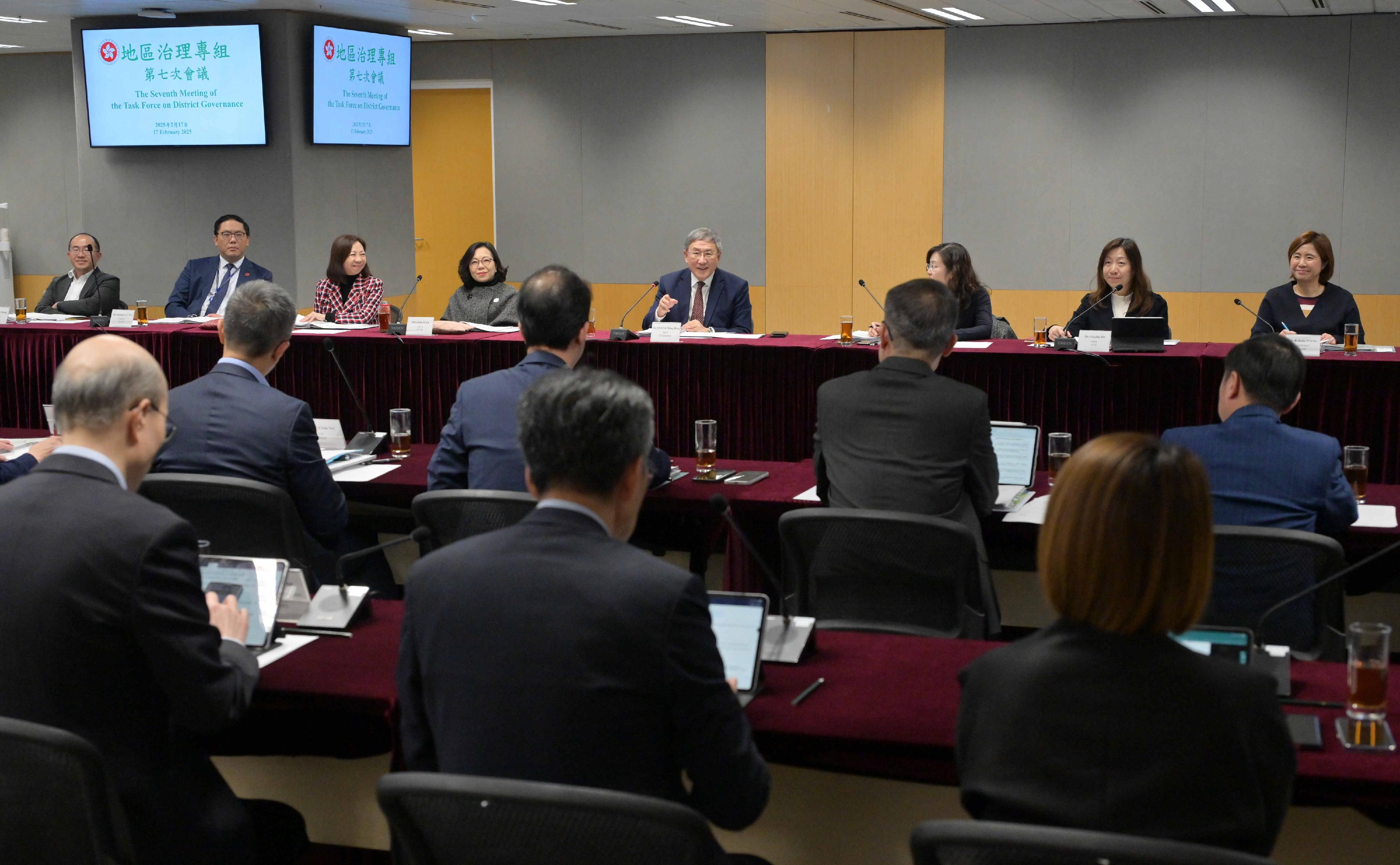
DCS chairs seventh meeting of Task Force on District Governance (with photo)

     The Deputy Chief Secretary for Administration, Mr Cheuk Wing-hing, chaired the seventh meeting of the Task Force on District Governance today (February 17) to follow up on the initiatives endorsed by the Steering Committee on District Governance. The meeting co-ordinated various departments in formulating specific implementation measures on issues of local concern and continuously reviewed the work progress and performance.
 
     Mr Cheuk said, “The Task Force will continue to adhere fully to the overall strategies set by the Steering Committee and actively respond to community concerns about district issues by taking practical actions to improve the living environment, and to enhance people’s quality of life through cumulative results achieved, for building a better community together.”
 
     The Steering Committee chaired by the Chief Secretary for Administration formulated at its fourth meeting strategies on four more district issues to further enhance the community environment and facilities. The Task Force followed up at this meeting the implementation details and the progress of the relevant items, including:
 
1. Improving the waiting environment at public transport interchange to enhance travel experience 

The Transport Department, in collaboration with the Highways Department (HyD), the Architectural Services Department (ArchSD), and the Electrical and Mechanical Services Department, has selected a covered public transport interchange in each of the 18 districts for enhancement works. These include upgrading the lighting, improving the ventilation system, refurbishing the walls and ceilings to provide a more comfortable waiting environment for passengers. These works have commenced this year with 11 for completion in 2025 and the remaining in 2026.

2. Combating air-conditioner water dripping to improve community environment 

The Food and Environmental Hygiene Department (FEHD) will strengthen inspections and enforcement actions against about 30 air-conditioner dripping blackspots from May to September this summer. The FEHD will also launch a publicity and public education campaign to appeal to residents to address the issue of air conditioners dripping water, in order to avoid affecting environmental hygiene in public places and causing a nuisance to citizens.

3. Cleaning pedestrian walkways to improve cityscape 

Starting in February this year, the FEHD has deployed mini street-washing vehicles equipped with pressure washer surface cleaners and high-pressure hot water cleaners at about 80 blackspots across the territory on a regular basis to step up street scrubbing and remove stains or moss, with a view to continuously improving the walking environment and enhancing the cityscape.

4. Strengthening thematic plantings 

The Development Bureau, along with the Leisure and Cultural Services Department, the HyD, the ArchSD, the Civil Engineering and Development Department and the Housing Department, will enhance thematic planting in selected development projects and venues, such as planting species with conspicuous flowers or thematically planting a single type of tree or shrub across a district to create impact, thereby beautifying the cityscape.

     In addition to the four district issues above, the Task Force also followed up on the performance of the 1823 Enhanced Complaint Handling Mechanism and received reports from relevant departments on their work progress regarding the eight key issues identified at the first three meetings of the Steering Committee, including (1) expanding after-school care services and enhancing support for parents; (2) caring for the elderly and enhancing community support; (3) fostering clean markets and mobilising the community to participate in anti-rodent work; (4) enhancing public order and combating crimes on all fronts; (5) improving pedestrian facilities and ensuring road safety; (6) enhancing the community environment and strengthening local characteristics; (7) improving the environment of public housing estates and creating comfortable homes; and (8) caring for the elderly and promoting digital inclusion. Mr Cheuk urged all departments to continue advancing these initiatives and enhancing district governance efficacy, so that the Government can deliver district services more effectively, leading to a more comfortable and better life for citizens.

     Moreover, Mr Cheuk thanked the departments for their efforts over the past two years in implementing the directives of the Steering Committee and the Task Force, which has brought significant achievements in combating hygiene blackspots for the benefit of the public. He added, “We should not permanently classify places that have seen long-term environmental improvements as blackspots. Relevant departments should critically review the situation of all 738 hygiene blackspots and continue to actively follow up on those requiring improvement while identifying others that are suitable for removal from the blacklist. If the conditions of a blackspot have not recurred after improving for two years, it should be removed from the blackspot list. The hygiene blackspot website will be updated in the first quarter this year to reflect the actual situation.”

Photo  
read more

DH announces latest situation of Legionnaires’ Disease cases

     The Centre for Health Protection (CHP) of the Department of Health today (February 17) reported the latest number of cases of Legionnaires’ disease (LD), and reminded the public of the importance of using and maintaining properly designed man-made water systems, adding that susceptible groups should strictly observe relevant precautions.

     From February 9 to 15, the CHP recorded two community-acquired LD cases. The details of the cases are as follows:
 

  1. An 83-year-old female patient with underlying illnesses living in Wong Tai Sin District; and
  2. A 77-year-old female patient with underlying illnesses living in Sai Kung District.

     The CHP is conducting epidemiological investigations to identify potential sources of infection, high-risk exposure and clusters, if any.

     As of February 15, 17 LD cases had been recorded this year. In 2024 and 2023, there were 135 and 121 LD cases respectively.

     Men, people aged over 50, smokers, alcoholics and persons with weakened immunity are more susceptible to LD. Some situations may also increase the risk of infection, including poor maintenance of water systems; living in areas with old water systems, cooling towers or fountains; using electric water heaters, whirlpools and spas or hot water spring spas; and recent stays in hotels or vessels.

     Legionellae are found in various environmental settings and grow well in warm water (20 to 45 degrees Celsius). They can be found in aqueous environments such as water tanks, hot and cold water systems, cooling towers, whirlpools and spas, water fountains and home apparatus that support breathing. People may become infected when they breathe in contaminated droplets (aerosols) and mist generated by artificial water systems, or when handling garden soil, compost and potting mixes.

     Immunocompromised persons should:
 
  • Use sterile or boiled water for drinking, tooth brushing and mouth rinsing;
  • Avoid using humidifiers, or other mist- or aerosol-generating devices; and
  • If using humidifiers, or other mist- or aerosol-generating devices, fill the water tank with only sterile or cooled freshly boiled water, and not water directly from the tap. Also, clean and maintain humidifiers/devices regularly according to manufacturers’ instructions. Never leave stagnant water in a humidifier/device. Empty the water tank, wipe all surfaces dry, and change the water daily. 
     
     The public should observe the health advice below:
 
  • Observe personal hygiene;
  • Do not smoke and avoid alcohol consumption;
  • Strainers in water taps and shower heads should be inspected, cleaned, descaled and disinfected regularly or at a frequency recommended by the manufacturer;
  • If a fresh-water plumbing system is properly maintained, it is not necessary to install domestic water filters. Use of water filters is not encouraged as clogging occurs easily, which can promote growth of micro-organisms. In case water filters are used, the pore size should be 0.2 micrometres (µm) and the filter needs to be changed periodically according to the manufacturer’s recommendations;
  • Drain and clean water tanks of buildings at least quarterly;
  • Drain or purge for at least one minute infrequently used water outlets (e.g. water taps, shower heads and hot water outlets) and stagnant points of the pipework weekly or before use;
  • Seek and follow doctors’ professional advice regarding the use and maintenance of home respiratory devices and use only sterile water (not distilled or tap water) to clean and fill the reservoir. Clean and maintain the device regularly according to the manufacturer’s instructions. After cleaning/disinfection, rinse the device with sterile water, cooled freshly boiled water or water filtered with 0.2 µm filters. Never leave stagnant water in the device. Empty the water tank, keep all surfaces dry, and change the water daily; and
  • When handling garden soil, compost and potting mixes: 
  1. Wear gloves and a face mask;
  2. Water gardens and compost gently using low pressure;
  3. Open composted potting mixes slowly and make sure the opening is directed away from the face;
  4. Wet the soil to reduce dust when potting plants; and
  5. Avoid working in poorly ventilated places such as enclosed greenhouses.

     â€‹â€‹The public may visit the CHP’s LD page, the Code of Practice for Prevention of LD and the Housekeeping Guidelines for Cold and Hot Water Systems for Building Management of the Prevention of LD Committee, and the CHP’s risk-based strategy for prevention and control of LD. read more